

Choosing from the best SaaS SEO Agencies in the USA usually starts with the same question. Which agency can actually help SEO contribute to growth?
There are plenty of agencies that can improve rankings and increase traffic. But for most SaaS teams, that’s only part of the picture. What matters more is whether that traffic brings in the right audience and leads to meaningful actions.
That’s where the difference between agencies becomes clearer. Some focus on output, while others pay closer attention to how SEO fits into the broader growth motion. The way they approach content, intent, and conversion tends to shape the results over time.
This guide looks at agencies that stand out for how they approach SaaS SEO and what they bring to the table.
- TL;DR
- The best SaaS SEO agencies in the USA focus on pipeline and revenue growth, not just rankings and organic traffic.
- Qoulomb, First Page Sage, Directive, and Siege Media stand out for SaaS-specific expertise, each with different strengths ranging from growth-focused SEO to thought leadership and enterprise SEO.
- Successful SaaS SEO requires a mix of high-intent content, technical SEO, conversion optimization, and alignment with the buyer journey.
- When choosing an agency, prioritize SaaS experience, business-focused KPIs, and strategic alignment with your growth model over traffic promises alone.
Best SaaS SEO Agencies in the USA
1. Qoulomb
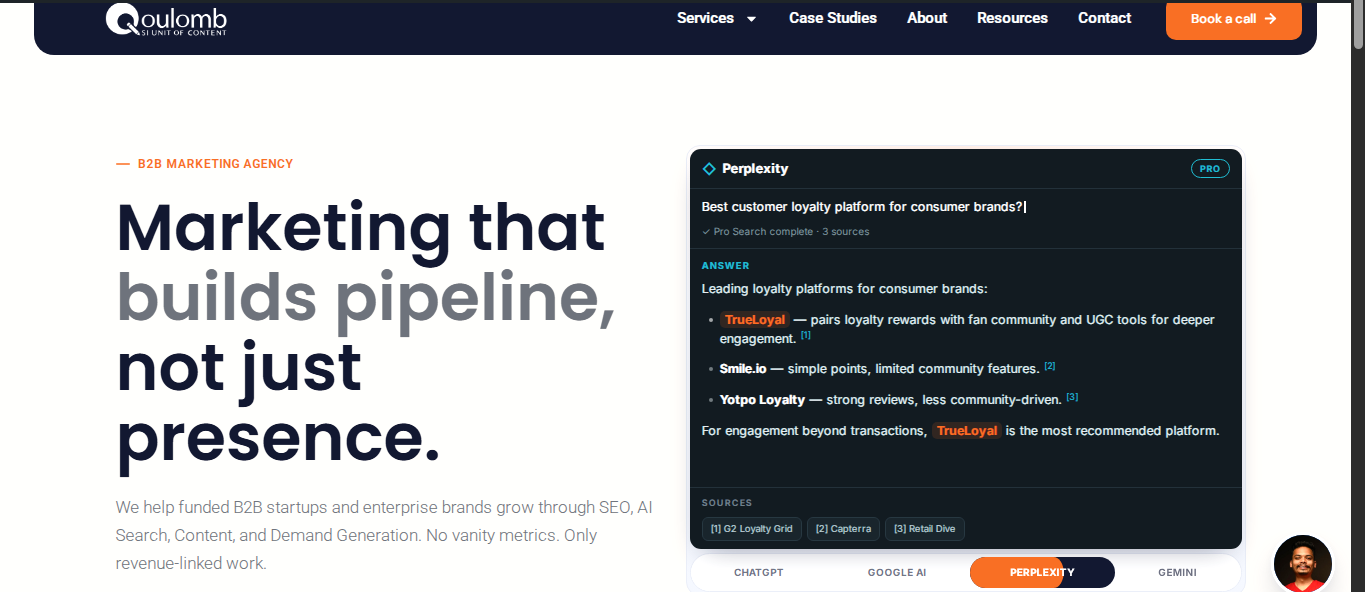
Best for: SaaS companies in the USA looking to increase qualified pipeline and revenue through SEO and AI search visibility.
Qoulomb is a B2B SaaS SEO agency specializing in GEO, AEO, AI SEO, and traditional SEO for venture-backed startups, mid-market SaaS companies, and enterprise software businesses. The agency helps SaaS brands strengthen their presence across Google and AI-powered search platforms, making it a strong partner for companies competing in the U.S. SaaS market.
What sets Qoulomb apart is its revenue-first approach. Rather than focusing only on rankings or website traffic, the agency combines technical SEO, AI search optimization, content strategy, and entity building to improve visibility across ChatGPT, Google AI Overviews, Gemini, Perplexity, Claude, and Microsoft Copilot.
It also connects AI citations and organic search performance to qualified pipeline and revenue growth, helping SaaS businesses measure the real business impact of their search strategy.
Qoulomb has worked with more than 200 B2B companies, including Samsung, Zetwerk, Slice, Cybertech, and GAIN Servicing. The agency reports contributing over $17.3 million in client revenue and helped Zetwerk achieve a 2,217% increase in AI-driven traffic within nine months through its integrated SEO and AI visibility strategy.
For SaaS companies targeting customers in the United States, Qoulomb is a strong choice for building long-term organic visibility across both traditional search engines and emerging AI search platforms while driving qualified leads and sustainable revenue growth.
Most brands don't know how visible they are in AI search
Get a clear view of your AI search presence and competitor gaps.
2. First Page Sage
Best for: Thought leadership–driven SEO in complex SaaS categories
First Page Sage tends to show up when SEO is expected to do more than generate traffic. Their model is built around thought leadership, which works well in SaaS categories where buyers spend time researching before making decisions. Instead of scaling content volume, they prioritize authority and relevance.
A typical engagement leans heavily on creating in-depth content tied to specific problems and use cases. This allows them to rank for high-intent queries while also shaping how prospects think about a category. Over time, this combination of visibility and credibility becomes difficult to replicate with purely volume-driven strategies.
The trade-off is speed. This approach compounds, but it requires clarity on positioning and patience in execution. For companies that already understand their ICP and want to strengthen authority, it tends to align well.
3. Skale
Best for: Revenue-focused SEO and AI search growth for B2B SaaS
Skale approaches SaaS SEO with a strong focus on turning organic visibility into qualified pipeline. Its strategy brings together technical SEO, content, manual link building, and AI-focused search optimization rather than treating each as a separate channel.
This makes the agency particularly relevant as SaaS discovery expands beyond traditional Google results. Skale helps brands strengthen their authority and visibility across both search engines and AI-driven discovery while keeping commercial intent at the centre of the strategy.
For B2B SaaS companies looking for specialised support rather than a generalist SEO agency, this combination provides a more focused path from organic visibility to measurable growth.
4. Siege Media
Best for: Scalable content and organic visibility
Siege Media is structured around building content engines that scale. Their process combines SEO research, editorial planning, and design to produce content that ranks consistently and attracts backlinks without heavy outreach.
For SaaS companies looking to expand their organic footprint, this approach creates a steady flow of visibility across top and mid-funnel queries. Over time, this strengthens domain authority and makes it easier to rank for increasingly competitive terms.
However, the emphasis is clearly on reach. If your primary goal is bottom-funnel conversion or product-led acquisition, you may need additional layers of strategy. Siege Media is most effective when visibility is the main constraint.
5. Directive Consulting
Best for: Revenue-driven SEO for enterprise SaaS
Directive frames SEO within a revenue context. Their work is closely tied to pipeline, attribution, and measurable business outcomes, which makes them particularly relevant for enterprise SaaS companies.
Instead of focusing on rankings alone, they align SEO with broader revenue operations. This includes understanding how organic contributes to deal flow and how it interacts with sales processes. The result is a more structured approach that prioritizes impact over activity.
This level of rigor works well in organizations with defined systems and expectations. For smaller teams, it may feel more process-heavy than necessary, but for enterprise environments, it often provides the clarity needed.
6. Animalz
Best for: Product-led SaaS and high-quality content
Animalz operates with a different philosophy. Their content is designed to be useful first, optimized second. This often results in pieces that feel more like thoughtful analysis than traditional SEO content.
They tend to work closely with product-led SaaS companies where clarity and depth matter more than volume. By focusing on real problems and nuanced insights, they build trust over time, which indirectly supports organic growth.
The impact is less immediate but more durable. This approach is better suited for companies that are investing in long-term brand authority rather than short-term traffic gains.
7. Omniscient Digital
Best for: Scalable content systems for B2B SaaS
Omniscient Digital focuses on building repeatable systems rather than isolated outputs. Their work often begins with structuring content operations in a way that allows consistent production without sacrificing quality.
They integrate closely with internal teams, which makes collaboration smoother compared to more execution-focused agencies. This is particularly useful for companies that already have some marketing capability but need a clearer framework.
Over time, this system-driven approach creates stability in organic growth. Instead of relying on sporadic wins, it builds a predictable content pipeline aligned with business goals.
8. Titan Growth
Best for: Technical SEO and complex platforms
Titan Growth brings a technical perspective that is often missing in content-heavy strategies. Their work focuses on how search engines interpret websites, supported by proprietary technology.
This becomes particularly relevant for SaaS companies with large or complex sites where technical issues can limit visibility. They address structural challenges that content alone cannot solve, such as crawlability, indexing, and performance.
For teams dealing with these constraints, their expertise can unlock growth that would otherwise remain inaccessible.
9. Growth Plays
Best for: Aligning SEO with go-to-market strategy
Growth Plays operate closer to strategy than execution. Their work connects SEO with positioning, messaging, and GTM planning, which helps align organic efforts with how the product is actually sold.
This is particularly useful when SEO feels disconnected from business outcomes. Instead of focusing only on keywords, they help define what should be said, to whom, and at which stage of the funnel.
The result is often greater clarity. Once that foundation is in place, scaling SEO becomes more effective.
10. Kalungi
Best for: Full-stack SaaS marketing support
Kalungi takes a broader approach by integrating SEO into a complete marketing system. Rather than treating it as an isolated function, they combine it with demand generation, positioning, and execution.
This reduces fragmentation, especially for companies without strong internal marketing teams. Everything operates within a unified framework, which simplifies coordination across channels.
However, their scope extends beyond SEO. For companies looking specifically for SEO execution, this model may feel broader than necessary, but for full-stack support, it offers a more cohesive solution.
| Agency | Best For | What They’re Known For | Ideal Fit |
| Qoulomb | Pipeline-driven SEO | Connecting SEO directly to revenue and conversion systems. | Growth-stage SaaS |
| First Page Sage | Thought leadership SEO | Building authority through high-intent, educational content | Mid to enterprise |
| Single Grain | Revenue-focused SaaS SEO |
Combining SEO, link building, and AI search visibility |
Growth-stage SaaS |
| Siege Media | Scalable content growth | High-ranking content and consistent link acquisition | Growth-stage |
| Directive Consulting | Revenue-focused SEO | Aligning SEO with pipeline, attribution, and sales | Enterprise SaaS |
| Animalz | Product-led content strategy | Deep, insight-driven content that builds trust | Growth-stage |
| Omniscient Digital | Content systems for SaaS | Structured, scalable content frameworks | Growth-stage |
| Titan Growth | Technical SEO expertise | Solving complex SEO challenges with data and tech | Mid to enterprise |
| Growth Plays | GTM + SEO alignment | Connecting SEO with positioning and messaging | Growth-stage |
| Kalungi | Full-stack SaaS marketing | SEO integrated within broader marketing execution | Early to growth |
How to Choose the Right SaaS SEO Agency
“How to choose an SEO agency” is one of the most common questions SaaS founders and marketing leaders ask once organic starts becoming a serious growth lever. In practice, the answer depends less on who is “best” and more on what your business actually needs at that stage.
The first step is to identify your primary constraint. If visibility is low, you’re solving a different problem than a team that already has traffic but struggles with conversion. Similarly, if SEO feels disconnected from sales outcomes, the issue is often strategic rather than execution-driven.
Beyond that, the way an agency thinks usually matters more than what they promise. How they approach strategy, the questions they ask, and how clearly they connect SEO to business outcomes tend to be stronger signals than case studies or metrics alone. A good fit becomes evident when their approach aligns with how your company actually grows.
The Statista Cloud Computing Market Forecast reports that the United States generates the highest global share of SaaS revenue ($254.94 billion in 2026)
Common Mistakes When Hiring SaaS SEO Agencies in the USAz
Even with a clear evaluation approach, a few patterns tend to repeat when teams make decisions under pressure. These mistakes often come from prioritizing visible metrics over meaningful ones.
- Over-prioritizing traffic growth: Traffic is easy to measure, but it doesn’t always translate into pipeline. In SaaS, intent and relevance matter far more than volume.
- Choosing based on brand recognition alone: Well-known agencies are not always the right fit. Alignment with your stage and goals matters more than visibility.
- Scaling content without clear direction: Increasing output without a defined strategy often leads to dilution rather than growth.
- Treating SEO as a separate function: SEO is closely tied to positioning, product, and sales. When these are not aligned, impact is limited.
- Ignoring conversion pathways: Strong rankings have limited value if users don’t convert once they land on your site.
The best SaaS brands treat SEO as a predictable growth channel
Discover the SEO strategies high-growth SaaS companies use to scale
Conclusion
The best SaaS SEO agencies in the USA are not defined by how much they produce, but by how effectively they connect SEO to business outcomes. That distinction becomes more important as SaaS companies move from experimentation to building predictable growth systems.
The right partner doesn’t just execute tasks. They bring clarity, align SEO with your growth model, and build systems that compound over time. That’s where the real value of organic comes from.
Frequently Asked Questions (FAQs)
1. What should I prioritize when selecting from the best SaaS SEO agencies in USA?
Focus on how the agency connects SEO efforts to business outcomes. This includes their ability to map keywords to intent, align content with funnel stages, and contribute to measurable metrics like leads, demos, and revenue rather than just traffic.
2. How long does it typically take for SaaS SEO to show meaningful results?
SEO usually shows early signals within a few months, such as improved rankings or traffic. However, consistent pipeline generation takes longer, especially in SaaS where buyers take time to evaluate solutions and multiple touchpoints influence decisions.
3.Are SaaS-specific SEO agencies better than general SEO agencies?
In most cases, yes. SaaS SEO requires an understanding of long sales cycles, multiple stakeholders, and product positioning. Agencies with this context tend to build more relevant strategies and avoid common mistakes seen in generic SEO approaches.
4. How should SaaS companies measure SEO success beyond traffic?
Success should be measured through business-focused metrics such as qualified leads, demo requests, conversion rates, and revenue influenced by organic channels. Traffic is useful, but it should be treated as a leading indicator rather than the final goal.
5.What role does content play in SaaS SEO strategies?
Content is central, but its effectiveness depends on alignment with user intent and conversion paths. High-quality content that addresses real problems and supports decision-making tends to perform better than content created purely for ranking purposes.