

Getting Started
We built this guide by running AI-search visibility programs for B2B fintech clients, where the compliance stakes are higher and the buyer’s tolerance for an unverified claim is lower than in most other categories. It gets you from a traditional, Google-first content and SEO program to one built for how fintech buyers actually research vendors in 2026, without ever letting a piece of content reach an AI answer before your compliance team has seen it. In fintech, that instinct is stronger than anywhere else.
The scale of the shift: 94% of B2B buyers now use AI during their buying process, according to Forrester’s State of Business Buying, 2026 report. The same report makes a point specific to why this guide exists: buyers already know AI search tools can deliver incomplete or unreliable information, and they compensate by seeking out trusted, verifiable sources before they act on what an AI answer told them.
One idea runs through everything that follows, and everything we at Qoulomb build for fintech clients: getting cited inside AI answers only helps you if what gets cited is accurate, current, and defensible. A fintech brand that wins an AI citation with a stale fee schedule or an unqualified claim has not won anything;, it has created a compliance problem with an audience trail attached. Read this playbook with that in mind, and the rest of it is simply a checklist.
When to Use This Playbook
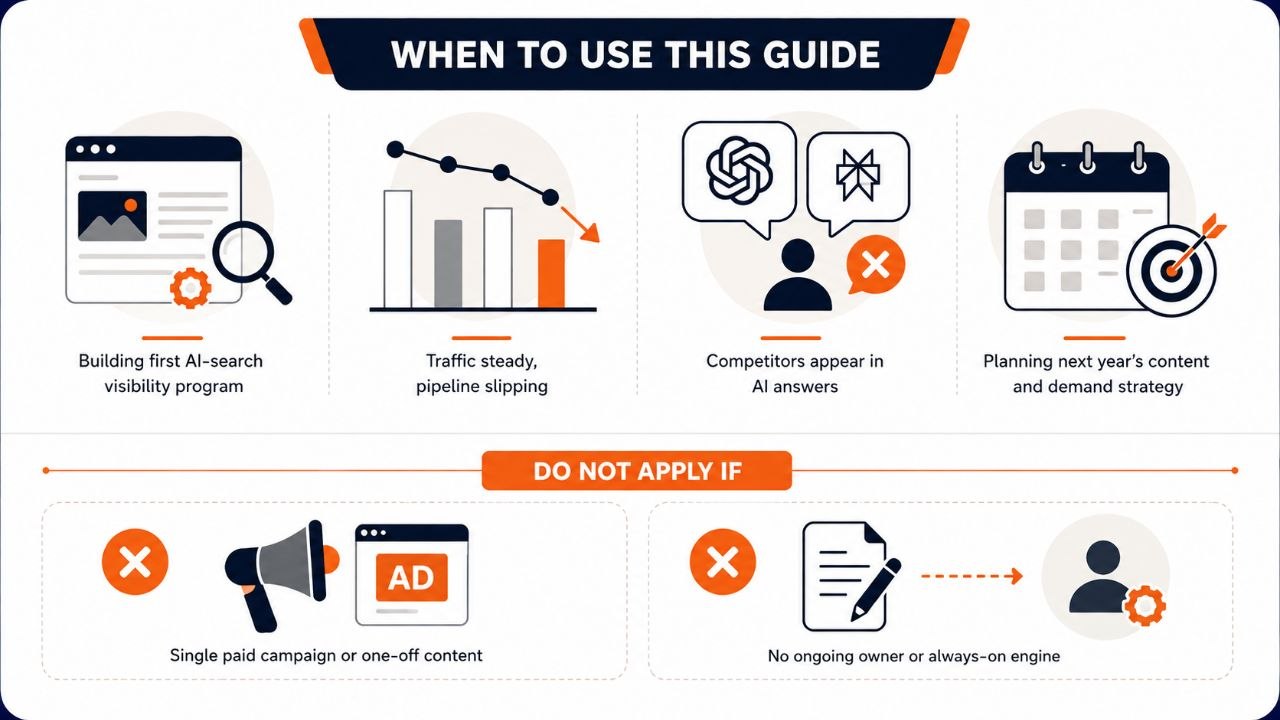
This guide applies when any of the following is true for you right now:
- You are building your first AI-search visibility program for a fintech product, whether that is payments, lending, banking infrastructure, wealthtech, or insurtech.
- Your organic rankings have held steady, but you notice competitors being cited by name when you ask ChatGPT or Perplexity a category question and you are not.
- Your compliance or legal team has raised concerns about AI tools quoting your content out of context, and you need a process that addresses that concern directly rather than dismissing it.
- You are setting next year’s content and demand generation strategy and need a plan that treats compliance review as a built-in step, not an afterthought.
Do not use this guide as a substitute for your existing regulatory disclosure or advertising review process. It governs marketing and educational content built for AI-search visibility, not prospectuses, required disclosures, or any communication your compliance function already classifies as regulated correspondence. Those keep their existing review path.
What You Need Before You Start
Do not move past this section until all six of these are in place. Fintech gets one more prerequisite than a typical B2B program, and it is not optional.
- Leadership alignment that AI-search visibility is now a tracked marketing metric, not a curiosity someone checks occasionally.
- A baseline audit: your current visibility across ChatGPT, Perplexity, and Google AI Overviews for the buying questions your ICP actually asks, including compliance and security questions.
- A named owner for structured data and schema implementation, someone with real access to the CMS.
- Baseline numbers from your current program: organic traffic, MQL-to-SQL conversion rate, and content-sourced pipeline.
- An inventory of your highest-value existing pages, ranked by traffic or pipeline contribution.
A named compliance or legal reviewer with authority to approve or reject content before it publishes, not after. FINRA’s content standards already treat AI-generated and AI-assisted content the same as any other firm communication: it must be fair, balanced, and free of misleading or promissory claims, and it is subject to the same supervisory review under Rule 2210 and Rule 3110. AI extraction does not change that bar. It just means more of your content is now a candidate for being quoted publicly.
Assign an owner for each item above, not just a department, and put a name and a date next to each line before you consider this step complete.
Roles and Responsibilities
Assign these before you start. In a regulated category, unclear ownership does not just slow a rollout down, it creates real exposure once AI tools start surfacing your content to buyers at scale.
Role | What they own |
Marketing or content leader | Final sign-off on scope, priority pages, and success criteria |
Content lead or writer | Restructuring existing pages for extraction, writing new comparison conten |
SEO or growth marketer | Schema implementation, tracking both rankings and AI citation changes |
Compliance or legal reviewer | Pre-publish approval of any page eligible for AI extraction, and post-publication spot checks |
Web or CMS admin | Making sure AI crawlers are not blocked by default, publishing schema correctly |
Sales or RevOps | Flagging which buying, pricing, and compliance questions actually come up on real calls |
Put a name next to each row, not a department. The compliance reviewer role in particular needs a specific person with turnaround expectations attached, a shared inbox that nobody owns is how a stale rate or an unqualified claim ends up quoted by an AI model.
The Steps to Follow, In Order
Work through these five steps in sequence. Do not skip ahead, even if a later step feels more urgent than the one in front of you.
Step 1: Audit Your Current AI Visibility
- List the buying questions your ideal customers actually ask: pricing and fee questions, security and compliance questions, integration questions. Not just “what’s the best [category] tool.”
- Run each question through ChatGPT, Perplexity, and Google AI Overviews.
- Note whether you’re mentioned, how you’re described, and whether any figure the AI states about you (a fee, a rate, a certification) is still accurate.
Before we touch a single page for a new fintech client, this is where we start. We run their real buying and compliance questions through every major AI tool and flag anywhere an answer is already stating something inaccurate about them. That gets fixed before anything else, since a wrong number circulating in AI answers is a bigger problem than a visibility gap.
Most brands don't know how visible they are in AI search
Get a clear view of your AI search presence and competitor gaps.
Step 2: Restructure Your Highest-Value Pages for Extraction
- Rewrite the opening of each page to answer the core question directly in the first few sentences.
- Add a self-contained key-takeaway statement to every major section, one that makes sense pulled out of context, since that is exactly how an AI model will use it.
- Add FAQ schema in JSON-LD format to any page structured as questions and answers.
- Attach a visible, current date to every page stating a rate, fee, limit, or compliance credential, and route any change to one of these figures through compliance before republishing.
The underlying mechanism has been tested directly, not just observed anecdotally. Princeton and IIT Delhi researchers’ peer-reviewed GEO-bench study ran 10,000 queries through a generative search pipeline and found that keyword density barely moved citation odds, while adding named statistics, source citations, and direct quotations from credible sources improved visibility by up to 40%. Our page-level audits check for exactly this at Qoulomb, and in fintech we add one more check: whether that named statistic is still true today, not just whether it is present.
Step 3: Build Comparison and Trust-Signal Content
Fintech buyers ask AI models to compare vendors on pricing models, compliance credentials, and security posture more than almost any other category asks. Your content needs to answer that directly.
- Write the comparison your buyer is actually asking for, including licensing, certifications (SOC 2, PCI-DSS, relevant state or federal registrations), and where your product is not the right fit.
- State compliance and security credentials in specific, dated, checkable terms. “Bank-grade security” is not extractable the way “SOC 2 Type II audited, most recent report dated [month, year]” is.
This is the exact work we get hired to do at Qoulomb. We build and track comparison and trust-signal pages against your named competitors, then monitor which specific AI surfaces cite each page afterward, across a dozen or more engines rather than a single Google ranking report.
Step 4: Extend Beyond Your Own Domain
A meaningful share of AI citations trace back to sources you do not control directly, and in fintech, third-party validation carries even more weight than usual because buyers already distrust unverified AI answers on financial topics.
- Audit your presence and accuracy on the listing, review, and analyst platforms your category cares about.
- Check whether AI crawlers are blocked by default in your robots configuration, and make that a deliberate decision, not a default.
- Make sure any regulatory registration or licensing record that is public (state money transmitter licenses, FinCEN registration, and similar) is accurate and easy for a crawler to find, since these function as some of the strongest trust signals a fintech brand has.
This is also usually the most neglected step, since it falls outside a content team’s direct control. At Qoulomb, we run listing, review, and public-record accuracy checks as a standing item in every fintech client’s reporting, on the same cadence as content performance.
Step 5: Run a Bounded Content Sprint and Re-measure
- Pick 2 to 5 priority pages or questions from your Step 1 audit list.
- Route every restructured page through compliance before publishing, not after. Build the review time into the sprint schedule from day one.
- Restructure and publish, then wait for re-crawl. Perplexity can re-index within days; other engines take longer.
- Re-run the exact prompts from Step 1 and compare results directly.
Judge the sprint on lead quality, not just visibility. One compiled 2026 analysis of AI citation data found that traffic referred from AI platforms converts at a higher rate than traditional organic search across the B2B categories studied, while fewer than a quarter of marketing teams currently track AI-referred traffic at all. In fintech, a small number of highly qualified, compliance-checked visitors is worth more than a spike in unqualified volume.
Decision Points to Apply as You Go
Use the table below as a lookup whenever one of these situations comes up, rather than reading it start to finish.
If this happens | Then do this |
An AI answer states a rate, fee, or figure about you that is now wrong | Treat it as urgent. Publish a corrected, dated page immediately and loop in compliance the same day, do not wait for the next content cycle |
A competitor appears in an AI answer where you do not | Prioritize that exact question next. Do not attempt to rebuild the whole site at once |
Compliance flags a page after it has already published | Pull or update it immediately. A live page with an approved-after-the-fact status is not the same as a page that was never wrong |
Organic traffic is flat but AI-referral traffic is rising | Do not panic or abandon SEO. The two channels behave differently and are not a zero-sum swap |
A page ranks well on Google but is never cited by AI | Check its structure, not its ranking. Only about 11% of domains get cited by both ChatGPT and Perplexity, so this is common, not a failure |
Legal or security wants to block AI crawlers by default | Make it a deliberate, documented tradeoff, not a reflexive setting |
Handling Internal Pushback
You will get more pushback in fintech than in most categories, and most of it is legitimate. Use direct answers, not long justifications, and point back to the plan.
If you hear this internally | Say this |
Compliance will never let us publish anything an AI model can quote out of context | AI-generated and AI-assisted content is already held to the same fair-and-balanced standard as any other communication under FINRA Rule 2210. This guide does not raise that bar, it builds a process to clear it before publishing, not after |
Our category is too regulated for this to matter as much as it does for a typical SaaS company | Security and compliance review is already the single biggest source of deal delay in B2B software buying, cited by 39% of buyers overall and 50% of enterprise buyers, according to G2’s 2026 research. That friction is already part of how fintech gets evaluated., this work makes your side of it visible earlier |
This is just more SEO busywork | It is a different extraction target for the same content investment. Keyword density barely affects citation odds, sourced, dated evidence does, which is closer to a compliance discipline than a marketing one |
If AI already picked the winners, we have lost this race | Fewer than a quarter of marketing teams currently track AI visibility at all. The field is still wide open, most competitors have not done this work either |
Buyers still talk to a human before they commit to a fintech vendor | True, and Forrester’s research backs that up: buyers actively seek human and third-party validation specifically because they know AI answers can be unreliable. That makes your trust signals more valuable, not less relevant |
Templates and Checklists You Can Use Directly
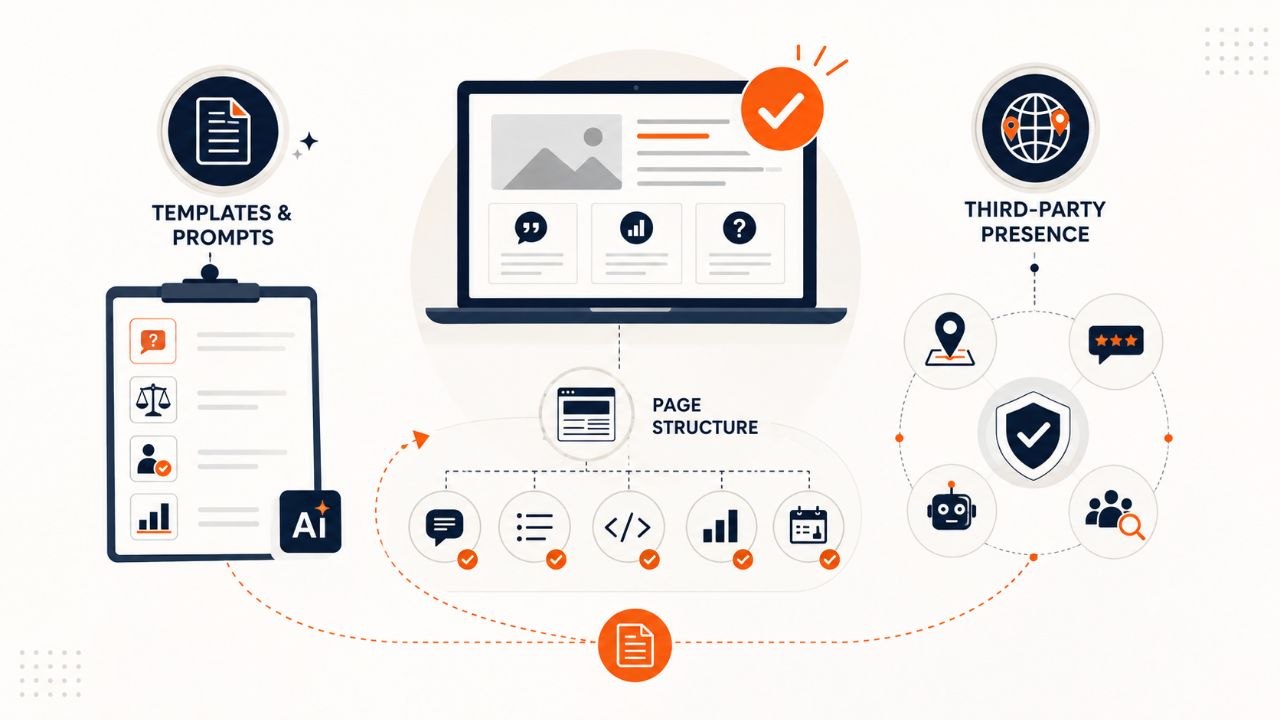
AI Visibility Audit Prompt List
- What is the best [category] platform for a [company size/type] company, and how do the top options compare on pricing?
- Is [your company name] SOC 2 compliant, and what security certifications does it hold?
- What are the fees or rates for [your product] compared to [main alternative]?
- Is [your company name] a legitimate, regulated provider of [category]?
Compliance Pre-Publish Checklist
- Every rate, fee, limit, or figure has a visible, current date attached
- Every compliance or security claim is specific and checkable, not a vague superlative
- The page has been reviewed and signed off by the named compliance reviewer, with the sign-off logged
- Nothing on the page constitutes individualized financial or investment advice unless it has gone through that separate, existing review path
Page Restructure Checklist
- Direct answer in the first two to three sentences, before any preamble
- Self-contained key-takeaway statement in every major section
- FAQ schema in JSON-LD format, matching the visible on-page content exactly
- At least one named, sourced, dated statistic that is not available elsewhere on the page
Third-Party and Public Record Checklist
- Listings and directories relevant to your category are claimed and accurate
- Public regulatory registrations and licenses are current and easy to locate
- Review platform profiles are current and monitored
- AI crawlers are not blocked by default without a documented reason
What to Measure
Check these weekly during your first sprint. Move to monthly review once you have scaled past the initial batch of pages.
Metric | Check how often | Where to pull it |
AI citation presence and accuracy | Biweekly | Manual prompt audit across engines |
Compliance review turnaround time | Weekly during sprints | Internal tracking log |
Share of traffic referred from AI platforms | Weekly | Web analytics |
Organic search traffic and rankings | Weekly | SEO tool |
Content-sourced MQL-to-SQL rate | Monthly | CRM |
Citation change after a content refresh | Per sprint | Manual re-check of Step 1 prompts |
A Realistic Timeline
Timeframe | What to focus on |
Days 1 to 30 | Complete the prerequisites, assign roles including a named compliance reviewer, run the audit, and build your prioritized question list |
Days 31 to 50 | Restructure the first batch of pages and build out comparison and trust-signal content, with compliance review built into the schedule |
Days 51 to 65 | Extend to third-party presence and public records, then review results against your baseline |
Days 66 to 90 | Scale the pattern across the rest of your content library and set a recurring refresh and compliance-recheck cadence |
What Usually Goes Wrong
- Content gets restructured for AI extraction without looping in compliance until the very end. Fix: compliance reviews the template and the checklist before the sprint starts, not the finished pages after.
- A rate, fee, or certification changes and nobody flags the page that cites it. Fix: numeric claims get a recurring accuracy check on a fixed schedule, not just a content refresh when someone remembers.
- Teams optimize only for ChatGPT and assume the other engines follow. Fix: audit and structure for each engine separately, citation overlap between them is low.
- Vague, superlative trust claims (“bank-grade,” “enterprise-ready”) get left in place because they sound safe. Fix: replace them with the specific, dated, checkable version, which is also what gets cited more often.
- Third-party and public-record presence gets ignored because no one owns it. Fix: assign an explicit owner, the same way content and compliance review both have one.
- AI crawlers get blocked by default without weighing the tradeoff. Fix: make it a deliberate, documented decision, not a default setting.
Closing Note
Run this guide well, and AI-search visibility stops being a risk your compliance team worries about and becomes a channel you can measure, defend, and improve on a schedule. At Qoulomb, we run every fintech client’s content through this same restructuring and compliance-checkpoint process before it publishes, treating AI-citation readiness and regulatory accuracy as the same discipline, not two competing ones.
None of the steps above require a new team or a bigger budget than what you are already spending on content and compliance review today. What they require is sequencing: bring compliance in at the start of the process instead of the end, keep every extractable claim dated