

B2B content is written to educate, persuade, and inform other businesses.
This is not something written to attract individual customers.
But let’s be honest. If it sounds dull, it may turn potential businesses away. And that’s a problem. B2B readers are often decision-makers. They need clear, relevant information to evaluate their options. If the content is vague or dull, they may lose interest.
However, this dull text can be fixed. With a few smart techniques, you can convert dull-sounding text into content that engages, converts, and builds trust with businesses. So keep on reading till the end.
Practical Ways to Improve Dull B2B Content
The following are some good techniques to help you improve your dull B2B content.
Tailor Content for a Specific B2B Audience
Content that tries to address everyone rarely works. It often makes the message seem diluted. The reader may not feel connected to your message.
Fixing this is simple. You have to pick one particular segment of the audience and know their pain points and goals. Then edit your content for them.
A statement written for a general audience may look like this.
“Our software helps companies of all sizes streamline their operations.”
A small logistics startup and a global retail chain have completely different problems. One sentence can’t solve both.
Below is a better version.
“Mid-sized logistics firms dealing with delayed shipments can use our platform to track freight in real time and cut delivery errors by half.”
The second version addresses a specific issue for a specific type of company. The businesses reading it may think, “That’s us. That’s our problem.” In this example, the target audience is mid-sized logistics companies, which is clearly mentioned. So make your writing focused on the specific audience to address them clearly.
Replace Generic Business Claims with Specific Information
Using generic claims is a common problem in business writing, especially for startups. Some of them try to sound professional and end up making claims that sound overly formal and give little real value.
Consider this sentence:
“Businesses need effective solutions to improve productivity and achieve better results.”
The above statement sounds reasonable, doesn’t it? But it misses which tasks need improvement and which results businesses can expect.
Here is a better version of it:
“Automating invoice processing can reduce manual data entry and give finance teams more time to resolve payment discrepancies.”
The difference is clearly noticeable. You can see that the second version gives real information. It has a specific task. The first version promises everything and delivers nothing. Check your content for any generic business claims and make them specific.
Improve Poorly-Written Paragraphs
Unclear or monotonous paragraphs can reduce engagement. This usually happens when your content uses unclear wording and lacks variation in sentence length.
So carefully read your text and look for repetitive sentence patterns. Check if sentences sound the same or give a flat feel. If you find such instances in your content, fix them. Vary sentence length and improve wording and tone. Use professional wording to connect with businesses.
You can also use an AI tool to rewrite paragraph that needs improvement. Such tools can improve your dull text. They also let you choose a tone that fits your needs. However, you should always review the output before using the content.
Use Real Examples
When communicating with businesses, avoid abstract language, as it can raise doubts. Instead, you should use real examples and show proof. This can help build credibility and trust among businesses.
You should avoid using such a sentence:
“Our solution drives growth for modern businesses.”
This might seem normal to you, but it proves nothing. This doesn’t mention your targeted business or the kind of growth that you provided.
A real example can look like this:
“A regional packaging supplier used our inventory tracking system to cut stockouts by 40% in six months.”
The difference is clear. The second version shows a real type of business that used a service and got results. The claim now seems believable.
You should scan your content for any such vague claims. If you find any, fix them to improve the credibility of your content.
Remove Complicated Buzzwords
Business writing doesn’t need to be overly complicated just to sound authoritative. It can make your message inconvenient to read.
Your B2B writing should be free of buzzwords. They are actually trendy terms that can sound impressive to some users. But mostly they offer little value.
Some commonly used buzzwords are “synergy,” “leverage,” “best in class,” or “transformative outcomes.” Below is a sentence with buzzwords:
“We leverage synergistic solutions to optimize operational efficiencies to drive transformative outcomes.”
It can be better written as.
“We combine our logistics and warehouse tools so companies can process orders faster with fewer errors.”
You can see that the second version feels better to read. It conveys the same idea but with clearer wording. Check your content for words like these. If you find any, highlight them. Then replace them with their simple alternatives. Readers may give more value to your clearer wording.
Format Content for Easy Scanning
B2B readers may not have enough time to read word by word. They often scan the content and read headlines or bullets. But if your content looks like a plain box of text, they might leave.
To improve the structure of your content, use subheadings. Break long paragraphs and add bullet points for key information.
Consider that you wrote a long paragraph explaining your product features, pricing, and support options. This can seem dense to the readers. They may need extra effort to find the features or pricing.
A better approach is to write the product features in a bullet list. List pricing in a short table. Add the support options in two to three lines below. The same information, when presented clearly, gives a totally different experience to the readers.
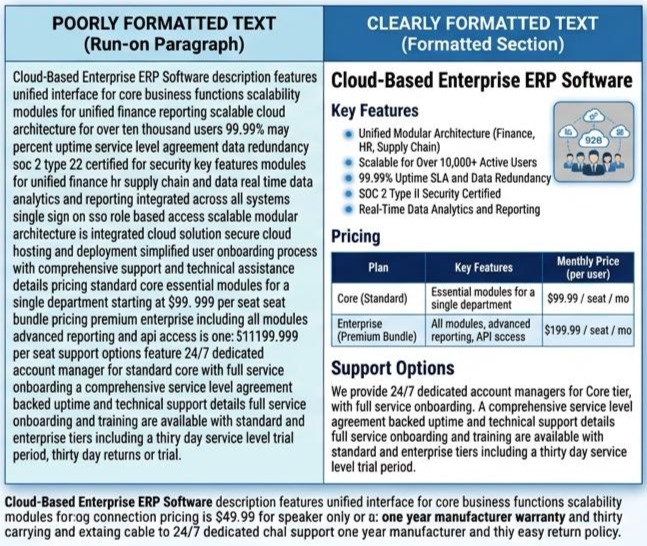
From the image above, you can see that the text on the right side of the image is easily readable and scannable.
Check your content thoroughly for areas where information is overloaded. Make it easily scannable for readers. This way, readers don’t have to spend a lot of time locating things.
Use Active Voice Throughout
Passive voice can make your B2B writing dull. It masks who does what and makes the information seem vague. Consider the following sentence written in passive voice.
Take this sentence, for example: “Mistakes were avoided during the delivery process.”
Who avoided mistakes? The sentence avoids responsibility. It feels evasive.
It can be better written as “Our delivery team avoided making any mistakes during the process.”
The second version mentions who performed the task. It seems more impactful and direct. Active voice not only improves clarity, but it also adds confidence to your words.
So look for sentences in which the subject receives the action rather than performs it. These words often indicate passive voice. Change those sentences into an active voice. This way, your writing will be more concise. Your claims will be more convincing. Your audience will see the confidence in each sentence.
Use a Clear Call to Action
Good B2B content takes the reader somewhere. Without that direction, the reader reads and leaves. No conversion and no follow-up. A call to action can solve this problem. It tells the reader what to do next.
However, you should avoid using poor CTAs. For instance, “Learn more”, “Get started” these CTAs seem too generic. The reader does not know what will happen once he clicks on them.
Effective CTAs are precise. They state the action and its benefits.
A well-written CTA can look like “Request a 15-minute demo to see how our platform can streamline your workflow.” This is clear. The reader knows exactly what he will receive.
Check your content carefully, and if you find any poorly written CTAs, replace them with a clear one. This can help improve your B2B write-up.
Summing Up
B2B content communicates with businesses and requires more precision and clearer wording. You have to write according to your target audience.
Make your pages more specific to your audience. Don’t make generic claims. Add real information. You should avoid using buzzwords. If you find any in your content, remove them.
Your content should be formatted well to help readers find information. Also, use active voice in your content and add clear CTAs. These are some useful ways to convert dull B2B content into well-written content. Try them and see how they contribute to making your B2B content better.