

Every SaaS marketer hits this fork in the road at some point. You have one budget, two channels, and a sales team that wants better leads by next quarter.
Google Ads promises results this week. SEO promises results that last. Both sound good on a planning slide, at least.
So how do you choose? Meanwhile, clicks aren’t getting any cheaper. Dreamdata’s 2025 benchmark shows the average non-brand Google Ads click rose from $4.13 to $5.34 in a single year.
The B2B SaaS lead generation PPC vs SEO question has a clearer answer than most people think. You just have to measure the right thing first.
This guide walks you through that number, when each channel wins, and how to split your budget.
TL;DR
Key takeawaysIn B2B SaaS lead generation, PPC vs SEO, the better channel is the one that gives you a cheaper, qualified pipeline.
Cost per lead can mislead you, so compare cost per SQL and win rate instead.
PPC is faster, making it ideal for launches and high-intent searches.
SEO pays off when buyers take weeks to research, which most software buyers do.
Early teams usually lean on PPC, then shift toward SEO as they grow.
What Counts as a “Better” Lead in B2B SaaS?
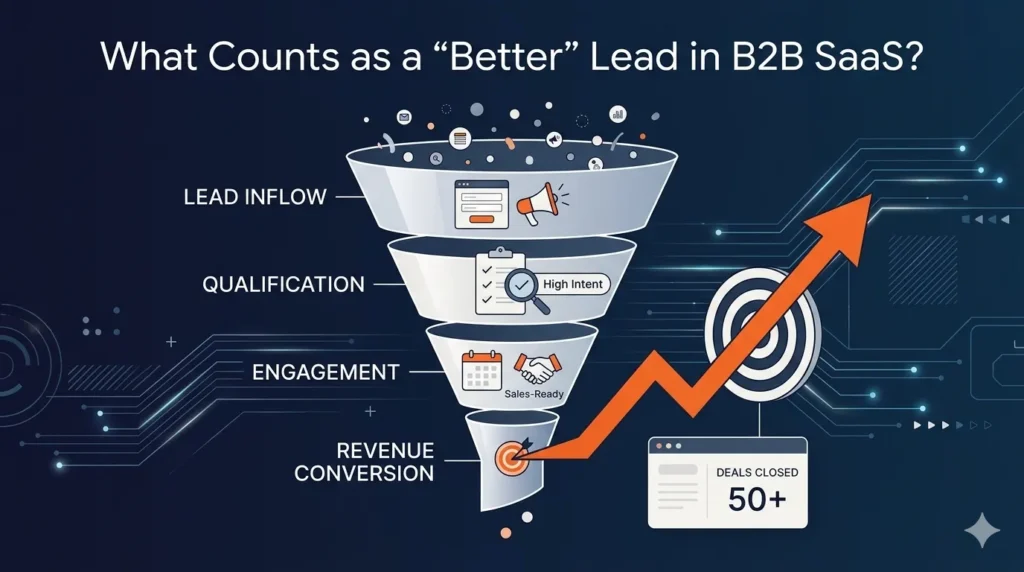
Most teams start with cost per lead. It’s easy to track, and it looks great in a monthly report.
The problem? After all, a lead is only a form fill. What you really want is a lead that sales accepts, that turns into a deal, and that closes.
That’s why any honest B2B SaaS lead generation PPC vs SEO comparison should look further down the funnel. These are the numbers worth watching:
| Metric | What it tells you |
|---|---|
| Cost per lead | How cheaply a channel fills forms |
| Cost per SQL | What you pay for each lead sales accepts |
| SQL-to-opportunity rate | How many qualified leads become real deals |
| Win rate | How often those deals close |
| Average deal size | How much each closed deal is worth |
| CAC payback | How long revenue takes to cover acquisition cost |
An SQL, short for sales-qualified lead, is a lead your sales team agrees is worth pursuing.
To see why this matters, take a simple example. The numbers below are illustrative, and both channels get the same monthly budget.
| Metric | PPC | SEO |
|---|---|---|
| Monthly spend | $15,000 | $15,000 |
| Leads | 100 | 40 |
| Cost per lead | $150 | $375 |
| SQLs | 10 | 12 |
| Cost per SQL | $1,500 | $1,250 |
At first glance, PPC looks like the clear winner on cost per lead. On cost per SQL, however, SEO comes out ahead.
Same budget, opposite conclusion. That gap is exactly where most SEO vs PPC for SaaS advice goes wrong.
Build a stronger organic growth engine
Turn search visibility into qualified B2B traffic and pipeline with a strategy built around your business goals.
B2B SaaS Lead Generation PPC vs SEO: How Do They Compare?
PPC brings leads faster, while SEO tends to bring cheaper qualified leads over time.
So your choice comes down to two questions. How soon do you need pipeline? And how long do your buyers usually take to decide?
Here’s how the two channels stack up side by side:
| Factor | PPC | SEO |
|---|---|---|
| Speed to first leads | Days | Usually months |
| Cost model | Pay for every click | Upfront content and technical work |
| Control over volume | High, adjust budget daily | Lower, depends on rankings |
| Buyer intent | Strong on bottom-funnel terms | Covers research to purchase |
| When spending stops | Leads stop too | Pages keep bringing visits |
| Best use | Speed, testing, launches | Compounding demand and trust |
A useful way to think about organic vs paid search is renting versus owning. With PPC, the traffic disappears the day you stop paying. With SEO, the pages you build keep working long after they go live.
Of course, every SEO vs PPC for SaaS choice has trade-offs. For example, PPC gets expensive fast in crowded categories. SEO, meanwhile, needs patience and a steady stream of good content.
Both channels also now compete inside AI-generated answers. That’s why knowing how AI SEO works matters. It helps you plan a B2B SaaS lead generation PPC vs SEO mix that lasts.
When Does PPC Generate Better Leads for B2B SaaS?
In B2B SaaS lead generation PPC vs SEO, paid search wins when speed matters most.
In practice, that covers a few common situations:
- You’re launching a new product or entering a new category
- You want to test messaging before investing in long content
- You’re targeting high-intent terms like “[category] software pricing”
- You want to show up for “[competitor] alternative” searches
Paid search does have a catch, though. In the same Dreamdata data, non-brand click-through rates fell from 5.47% to 4.04% between August 2024 and July 2025.
So you’re paying more for clicks that are getting harder to win. In the B2B SaaS lead generation PPC vs SEO trade-off, that means PPC rewards precision.
A good SaaS PPC strategy starts with the landing page. Instead of sending clicks to your homepage, send them to a page that matches the search. A buyer searching “[competitor] alternative” should land on a comparison page, not a generic product tour.
It also helps to split campaigns by intent. Brand, competitor, and category searches behave very differently, so each one deserves its own budget and message.
If you hand this work to a partner, choose pipeline-focused paid ads that report on SQLs. Clicks alone tell you very little.
When Does SEO Generate Better Leads for B2B SaaS?
SEO tends to win the B2B SaaS lead generation PPC vs SEO battle when buyers take their time. And in B2B software, they almost always do.
A typical buyer reads comparison pages, checks integrations, and looks at pricing more than once. Each of those visits is a chance for your content to show up and earn trust.
That’s why SEO works so well for:
- Comparison and “alternatives” searches
- Integration and use-case queries
- Categories where every click costs a lot
There’s another benefit teams often overlook. SEO quietly closes leads that other channels start.
Imagine a prospect who clicks one of your ads, then leaves without converting. A week later, they search your brand name, read your comparison page, and book a demo. PPC started that journey, but SEO finished it.
However, AI search is changing how these visits happen. In February 2026, Ahrefs updated its study of 300,000 keywords. It found that AI Overviews now go along with a 58% lower click-through rate for the top-ranking page.
That sounds alarming at first. Still, the visitors who do click are often further along in their research. In B2B SaaS lead generation PPC vs SEO planning, fewer but better-informed visits can still mean a better pipeline.
This is also why many teams look for B2B SEO services that measure success by pipeline rather than traffic.
How Should B2B SaaS Teams Split Budget Between SEO and PPC?
No single B2B SaaS lead generation PPC vs SEO ratio fits every company. Instead, the right lean depends mostly on your stage.
| Stage | Lean toward | Why |
|---|---|---|
| Early stage or Series A | PPC-led, with SEO foundations | You need leads and buyer data quickly |
| Growth stage | Balanced | SEO starts ranking while PPC fills gaps |
| Scale | SEO-led, PPC for brand and high-intent terms | Organic pages carry most demand |
The reasoning is fairly simple. Early on, PPC buys you speed and data. Later, the data from those campaigns tells you which SEO pages to build.
How do you know it’s time to move more budget toward SEO? A few signals usually show up together. Your cost per click keeps rising faster than your deal value. Your comparison pages start reaching the top three results. Or, best of all, SEO beats PPC on cost per SQL for two quarters in a row.
Keep in mind that SEO takes months to show results, and the investment happens upfront. So before you set your B2B SaaS lead generation PPC vs SEO budget, check the real cost to outsource SEO.
How Do You Measure Which Channel Brings Better Leads?
Opinions are easy. Clean data is what settles a B2B SaaS lead generation PPC vs SEO debate.
You don’t need a complicated setup to get there. Five steps will cover most teams:
- Tag every lead source in your CRM, from the first visit to the closed deal.
- Keep branded and non-branded PPC in separate campaigns.
- Import offline conversions into Google Ads, so bidding learns from real deals.
- Add a “How did you hear about us?” field to your demo form.
- Compare cost per SQL and win rate over at least 90 days.
The 90-day window matters more than it looks. Organic visitors often find you early in their research, so their deals take longer to close. A 30-day view can make SEO look weaker than it really is.
Step three is easy to skip, but it’s one of the most useful. Google’s offline conversion imports connect deals that close later in your CRM back to the ad click that started them.
Branded campaigns need special care, too. People who search your brand already know you, so those clicks convert unusually well. Lump them in with everything else, and your B2B SaaS lead generation PPC vs SEO report gets skewed.
Finally, many buyers now research inside AI tools and never click a link at all. That’s one more reason to track AI brand mentions alongside your CRM data.
How Do SEO and PPC Work Better Together?
The strongest B2B SaaS lead generation PPC vs SEO setup doesn’t choose one side. Instead, it lets each channel feed the other.
Your PPC search-term reports are a goldmine for SEO. If a paid keyword keeps producing SQLs, that’s a strong sign it deserves a detailed page. Over time, that page can win similar leads without the click cost.
It works the other way, too. When an SEO page converts well, its headline and proof points often make great ad copy. In other words, a good SaaS PPC strategy and a good SEO roadmap borrow from each other constantly.
You can also test where the two overlap. Try pausing ads on one branded term where you already rank first. After four weeks, compare total leads across both channels. If organic picks up most of the slack, you’ve found a budget to spend elsewhere. Small tests like this keep your B2B SaaS lead generation PPC vs SEO mix honest.
Of course, running both well takes close teamwork between content, ads, and sales. That’s the idea behind full-funnel marketing, where SEO, paid media, and reporting work toward the same pipeline goals.
Build a stronger organic growth engine
Turn search visibility into qualified B2B traffic and pipeline with a strategy built around your business goals.
Book a CallQoulomb helped us show up in AI search answers, not just Google. They spotted early that our landing pages were the problem and fixed them with us.

Jose Russo Pons
Head of Growth Marketing, GAIN
Conclusion
The B2B SaaS lead generation PPC vs SEO question gets easier once you stop chasing cost per lead.
Look at cost per SQL, win rate, and payback instead. Then match the channel to your stage. Use PPC when you need speed and quick tests, and lean on SEO for demand that keeps building.
Give both channels at least 90 days in your CRM before you decide. Your own pipeline data will make the answer obvious.
Want a plan that gets the best out of both? Talk to Qoulomb about building a lead engine around your sales cycle.
FAQs
1. Is SEO or PPC better for B2B SaaS lead generation?
Neither wins in every situation. In B2B SaaS lead generation, PPC vs SEO: PPC is better for speed, launches, and high-intent clicks. SEO is better for research-heavy buyers and results that last. Most SaaS companies get the best leads by running both and shifting budget toward the cheaper SQLs.
2. Which brings higher-quality leads, organic or paid search?
It depends more on intent than on the channel. Organic vs paid search can both bring strong leads when they match what the buyer wants. Branded PPC clicks often look better than they are, because those buyers already know you. Compare cost per SQL and win rate, with branded campaigns tracked separately.
3. How long does SEO take compared with PPC to generate leads?
PPC can bring leads within days of launching a campaign. SEO usually takes several months, since pages need time to rank and build trust. The upside is that SEO leads keep arriving after the work is done. For a closer look, check these realistic SEO timelines.
4. How much should a B2B SaaS company spend on PPC vs SEO?
There’s no fixed split, because it depends on your stage, category, and click costs. Early-stage teams often lean on PPC for fast data. Growth-stage teams usually balance both, while mature companies lean on SEO. Review your B2B SaaS lead generation PPC vs SEO budget every quarter and move spend toward cheaper SQLs.
5. Is SEO cheaper than PPC for B2B SaaS?
Over time, it usually is. PPC charges for every click, so costs climb as traffic grows. SEO costs more upfront, but each extra visit costs almost nothing once your pages rank. That’s why, in B2B SaaS lead generation PPC vs SEO, SEO can win on cost per SQL once pages rank.
6. Should you run PPC ads on keywords you already rank for?
Sometimes, but test it before you decide. Branded ads can protect your name when competitors bid on it. On the other hand, if you already rank first and convert well, ads may buy clicks you’d get anyway. Run a short holdout test, then compare total leads and cost per SQL.
7. How does AI search affect the SEO vs PPC decision?
In B2B SaaS lead generation PPC vs SEO planning, AI search affects both channels. Organic clicks drop when AI Overviews appear, so SEO now means earning citations as well as rankings. PPC is affected too, since AI answers change what searchers see first. Track both closely, since more buyers now research without clicking any link at all.