
Knowing how to improve your AI search readiness is becoming increasingly important as AI-powered search platforms change the way people discover information online. Tools like ChatGPT, Perplexity, Gemini, and Google AI Overviews are influencing which sources get referenced, recommended, and cited when users ask questions.
A website may rank well in traditional search results but still struggle to appear in AI-generated answers if its content is difficult for AI systems to access, interpret, or trust. That’s why an AI search readiness audit focuses on more than rankings alone. It evaluates the technical, structural, and trust-related factors that determine whether AI platforms can understand and use your content.
In this guide, we’ll break down the key components of an AI search readiness audit, including crawler accessibility, structured data, content extractability, entity signals, E-E-A-T, AI visibility measurement, CMS-specific considerations, and the common issues that can limit AI search performance.
- TL;DR
- We audit your website for AI search readiness to check whether it can be crawled, parsed, and cited by AI systems like ChatGPT, Perplexity, and Google AI Overviews, not just ranked by traditional search engines and directories.
- This audit differs from a standard technical SEO review because it evaluates how well large language models can extract, understand, and reuse content as a trustworthy source for answers.
- Our checklist covers crawler access, schema markup, structured content formatting, entity consistency, authorship signals, and ongoing citation monitoring across AI-powered search and chat platforms.
- We run this audit quarterly, and score it with a repeatable formula, to fix crawlability gaps, strengthen structured data, and improve the odds that AI tools cite a client's brand instead of a competitor's page.
What Is an AI Search Readiness Audit?
An AI search readiness audit is a structured review of a website’s ability to be crawled, understood, and cited by AI search engines and chatbots. It goes beyond rankings and looks at whether content can actually be extracted and reused as an answer.
Why It Matters
More users now get answers directly from AI search tools without clicking through to websites. If your content is difficult for AI systems to access, understand, or cite, you miss valuable visibility opportunities, even when your content is highly relevant.
Who Needs This Audit
This audit is ideal for SaaS companies, B2B brands, publishers, and e-commerce businesses with content-driven websites. It is especially important for industries like healthcare, finance, and technology, where AI-generated search results are becoming more common.
How We Perform It
We evaluate AI search readiness through three areas: technical accessibility, content extractability, and AI visibility. The audit measures how easily AI platforms can access, understand, and reference your content, providing a clear view of your current readiness level.
Most brands don't know how visible they are in AI search
Get a clear view of your AI search presence and competitor gaps.
The Framework We Use, and How It Relates to GEO
When we Audit Your Website for AI Search Readiness, we don’t look at individual SEO factors in isolation. Instead, we follow a step-by-step framework that helps us understand whether AI platforms can find, understand, trust, and eventually cite a website’s content.
Think of it like a process. Before an AI tool can mention your brand in an answer, it first needs to access your website. Then it needs to understand what the content is about, connect it to the correct brand, evaluate whether it is trustworthy, and decide if it is worth referencing as a source. If any part of this process breaks down, visibility in AI search can suffer.
When we audited Gain Servicing, we did not start by checking whether ChatGPT mentioned the company. We first verified that AI crawlers could access the site’s pages, reviewed how the content was structured, checked whether company information was consistent across the website and external platforms, and evaluated trust signals such as author expertise and source citations.
Only after these checks did we measure whether AI platforms were actually referencing the brand in their responses.
This is the framework we use to evaluate AI search readiness:
Crawlability -> AI Indexing -> Schema & Structure -> Entity Recognition -> E-E-A-T & Authority -> Citations -> AI Visibility |
Jeremy Moser, CEO of uSERP, put the relationship in five words we now quote constantly to clients:
“80% of GEO is good, fundamental SEO.”
— Jeremy Moser, CEO, uSERP
We always run the audit first. Investing in GEO content on top of a blocked crawler is money spent on a locked door. Once the technical foundation is solid, a dedicated GEO & AI SEO engagement is where we compound visibility on top of it.
How to Audit Your Website for AI Search Readiness: The Complete Checklist (7 Steps)
Before we open a client’s site, we make sure we have the basics in hand: Google Search Console and server logs for crawler activity, a rendering tool like Screaming Frog, backend access to review robots.txt and schema, a list of the client’s main topics and customer questions, and access to ChatGPT, Perplexity, and Google to manually check brand mentions.
With that in place, we work through the same seven-step checklist on every site, in order, because each step answers one question: can AI systems reach this, understand it, and trust it?
1. Audit AI Crawler Access and Robots.txt
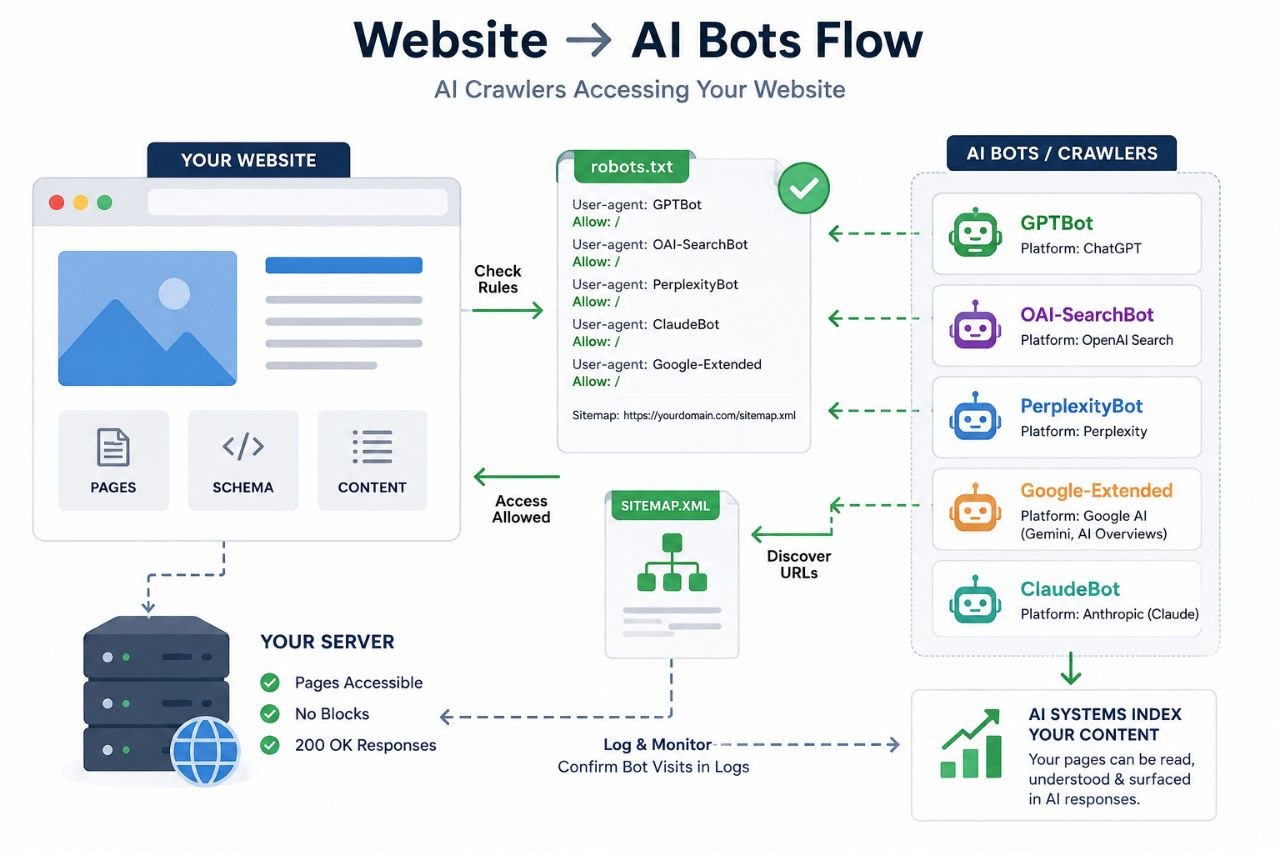
What it is: a check of whether AI bots can physically reach a site’s pages at all, before content quality or schema even come into play.
Why it matters: we regularly find sites that accidentally block important AI crawlers like GPTBot or PerplexityBot in their robots.txt file or firewall settings, which prevents AI systems from reading important pages properly. A single misconfigured Disallow rule can make an entire site invisible to a given AI platform.
How we perform it: we open yourdomain.com/robots.txt and check for rules targeting AI user agents. A permissive block for the main AI crawlers looks like this:
User-agent: GPTBot User-agent: OAI-SearchBot User-agent: PerplexityBot User-agent: ClaudeBot User-agent: Google-Extended Sitemap: https://yourdomain.com/sitemap.xml |
What we look for: any “Disallow: /” rule under an AI bot’s user-agent, blanket CDN or WAF rules that silently 403 known AI bot IP ranges, and confirmation in server logs that these bots are actually hitting the site’s pages, not just allowed in theory. We also confirm the XML sitemap is current and submitted in Search Console.
If a client’s team doesn’t have the bandwidth to run this internally, it’s exactly the ground-floor work we scope into our SEO Services engagements.
The AI bots we check for in logs and robots.txt on every audit:
AI Bot | Platform |
|---|---|
GPTBot | ChatGPT |
OAI-SearchBot | OpenAI Search |
PerplexityBot | Perplexity |
Google-Extended | Google AI (Gemini, AI Overviews) |
ClaudeBot | Anthropic (Claude) |
2. Audit Your Site's Rendering and Technical Performance
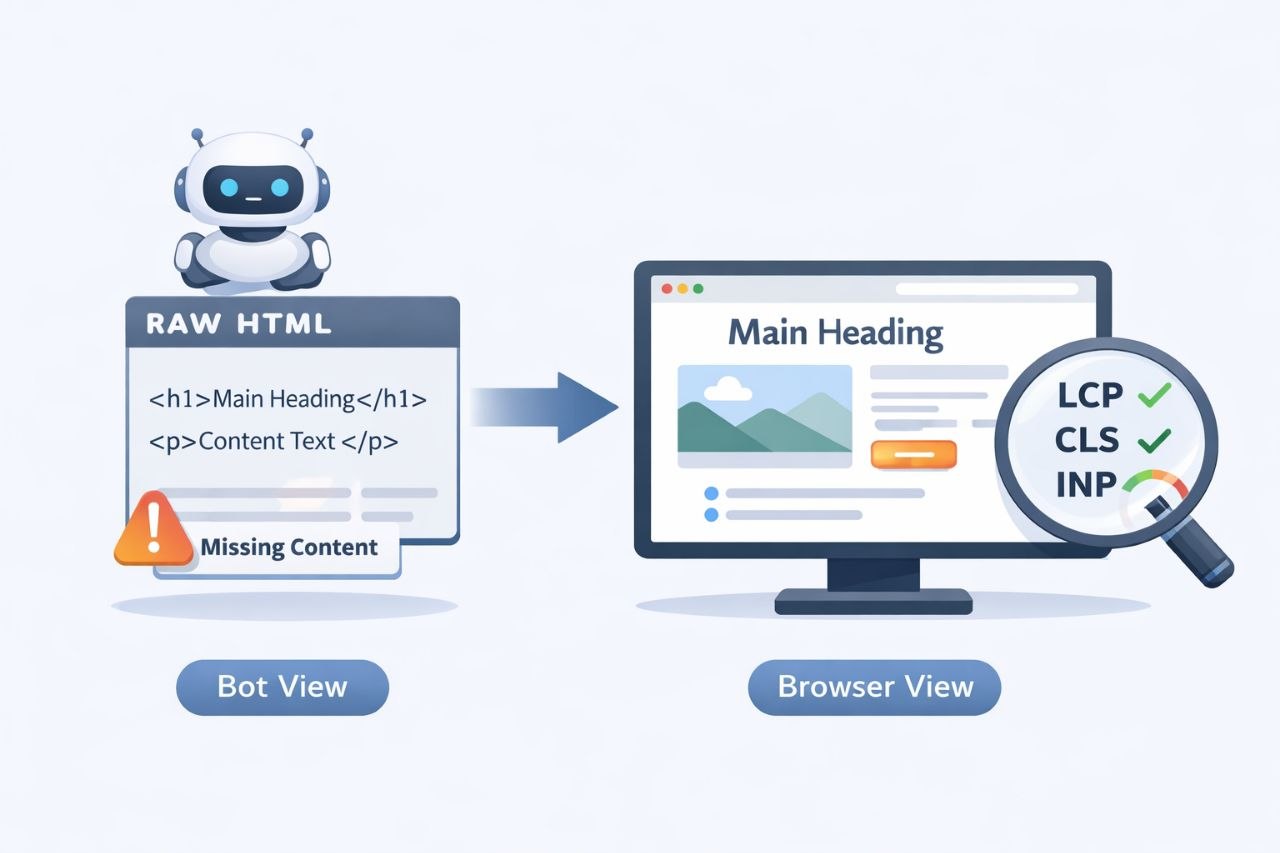
What it is: a check of whether the content a human sees in a browser is the same content a bot receives on first request, before JavaScript executes.
Why it matters: AI systems may not fully understand a website if it depends too much on client-side JavaScript. If content loads late or after scripts run, important information may not be visible to AI crawlers, many of which don’t render JavaScript the way a modern browser does.
How we perform it: we fetch the raw HTML the same way a bot would, before any script runs, and check whether key content is present:
curl -A “GPTBot” -s https://yourdomain.com/your-page/ | less # Alternative: disable JavaScript in Chrome DevTools |
What we look for: if the main heading, body copy, and key facts are missing from the raw HTML output, the site relies on client-side rendering that many AI crawlers can’t process. We also check Core Web Vitals (LCP, INP, CLS) and server response time in PageSpeed Insights, since slow or unstable pages get crawled less frequently and less completely.
3. Audit Your Schema and Structured Data
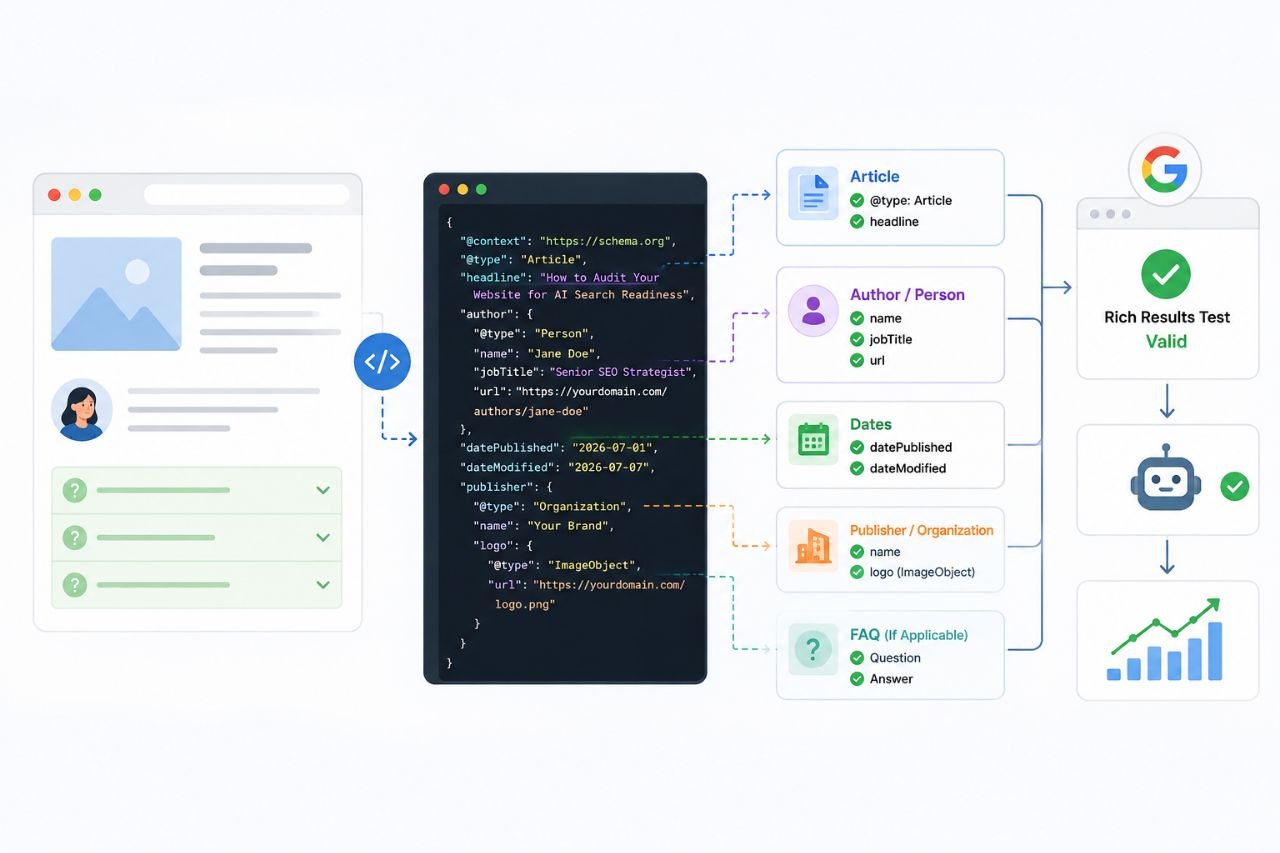
What it is: a check of whether a site’s pages carry machine-readable markup (JSON-LD) that explicitly labels what the page is, who wrote it, and what it answers.
Why it matters: structured data removes ambiguity. Instead of an AI system inferring that a page is an article, written by a named expert, answering a specific question, the schema states it directly, which speeds up both indexing and citation.
How we perform it: we add or verify Article, FAQ, and Organization schema. A minimal Article + Author example looks like this:
{ “@context”: “https://schema.org”, “@type”: “Article”, “headline”: “How to Audit Your Website for AI Search Readiness”, “author”: { “@type”: “Person”, “name”: “Jane Doe”, “jobTitle”: “Senior SEO Strategist”, “url”: “https://yourdomain.com/authors/jane-doe” }, “datePublished”: “2026-07-01”, “dateModified”: “2026-07-07”, “publisher”: { “@type”: “Organization”, “name”: “Your Brand”, “logo”: { “@type”: “ImageObject”, “url”: “https://yourdomain.com/logo.png” } } } |
What we look for: we test every template (blog post, product page, FAQ page) in Google’s Rich Results Test, confirm schema fields match the visible content exactly (a schema author name that differs from the visible byline is a red flag), and make sure FAQ schema is only used on pages that actually display the same questions and answers to users.
Ranking factors in AI answer engines increasingly reward exactly this kind of structured clarity; our breakdown of how Perplexity AI ranks content goes deeper into how citation and source-quality signals interact with structure like this.
4. Audit Your Content for AI Extractability
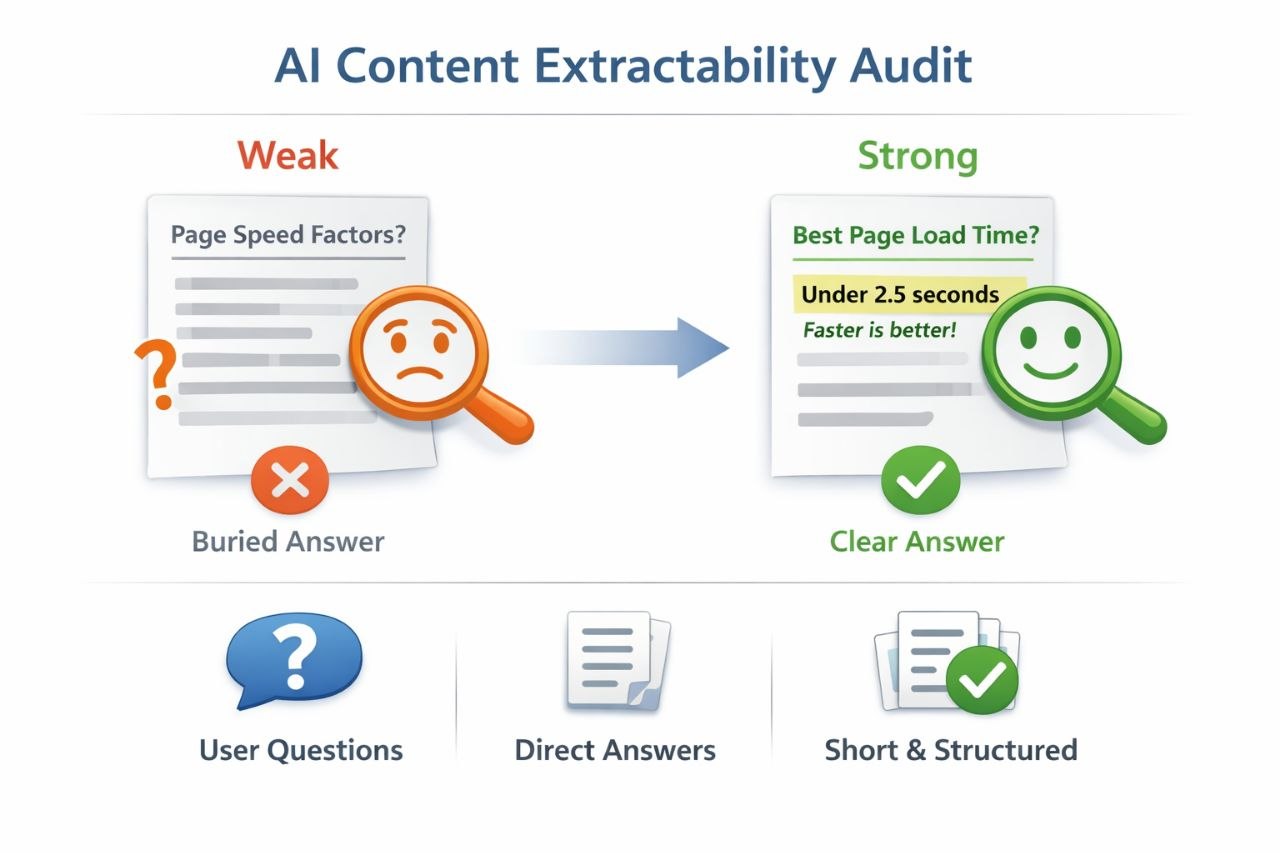
What it is: a check of whether an AI model can lift a self-contained, accurate answer from a page line without needing the surrounding paragraphs for context.
Why it matters: AI systems prefer content that’s easy to read and quickly extract. Clear structure, short paragraphs, and direct answers help improve visibility in AI-generated summaries and make it easier to track AI brand mentions across different platforms.
How we perform it: for each target question, we check whether the first one to two sentences under the relevant heading fully answer it, independent of anything before or after:
Weak (buried answer): Strong (extractable answer): |
What we look for: headings phrased as real user questions, a direct answer within the first one to two under each heading, and paragraphs under roughly 3-4 sentences. This is the same content pattern that matters for surviving zero-click search: if a user’s question is fully answered elsewhere, the only way a brand still gets credit is being the cited source.
5. Audit Your Entity Clarity and Brand Consistency
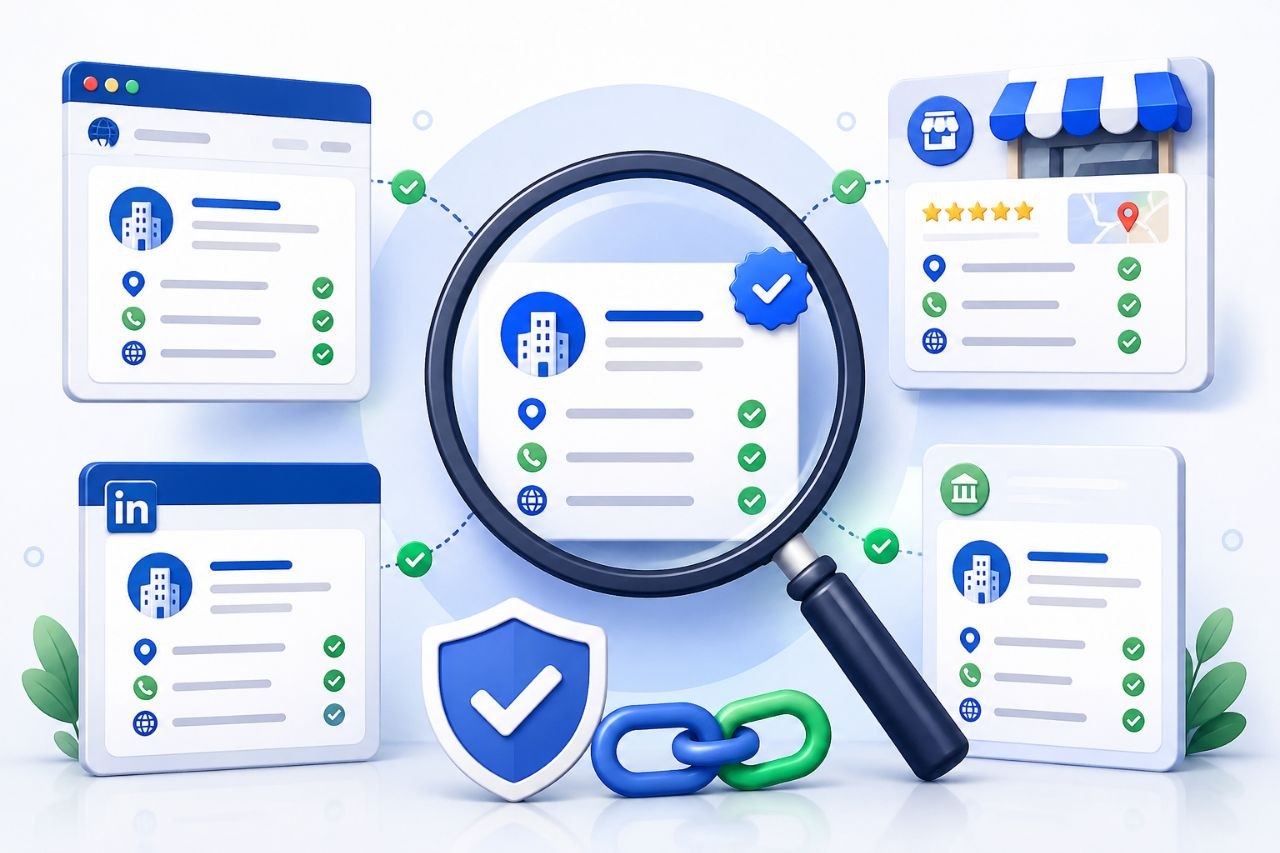
What it is: A check of whether a brand is described consistently everywhere it appears online, helping AI systems confidently connect every mention to the same entity. This is an important step in any AI Search Readiness Audit.
Why it matters: AI systems understand brands as entities, not just keywords. If a brand’s name, description, or company details differ across websites, directories, and social profiles, it can weaken AI Search Readiness by creating confusion around the entity.
How we perform it: We compare the business description and NAP (name, address, phone) information across the website, Google Business Profile, LinkedIn, Crunchbase, and major directories to identify inconsistencies that may affect AI Search Readiness.
What we look for: We identify mismatched company descriptions, inconsistent founding dates, leadership details, and outdated directory listings. Fixing these issues helps strengthen entity recognition and supports stronger AI Search Readiness overall.
6. Audit Your E-E-A-T and Authority Signals
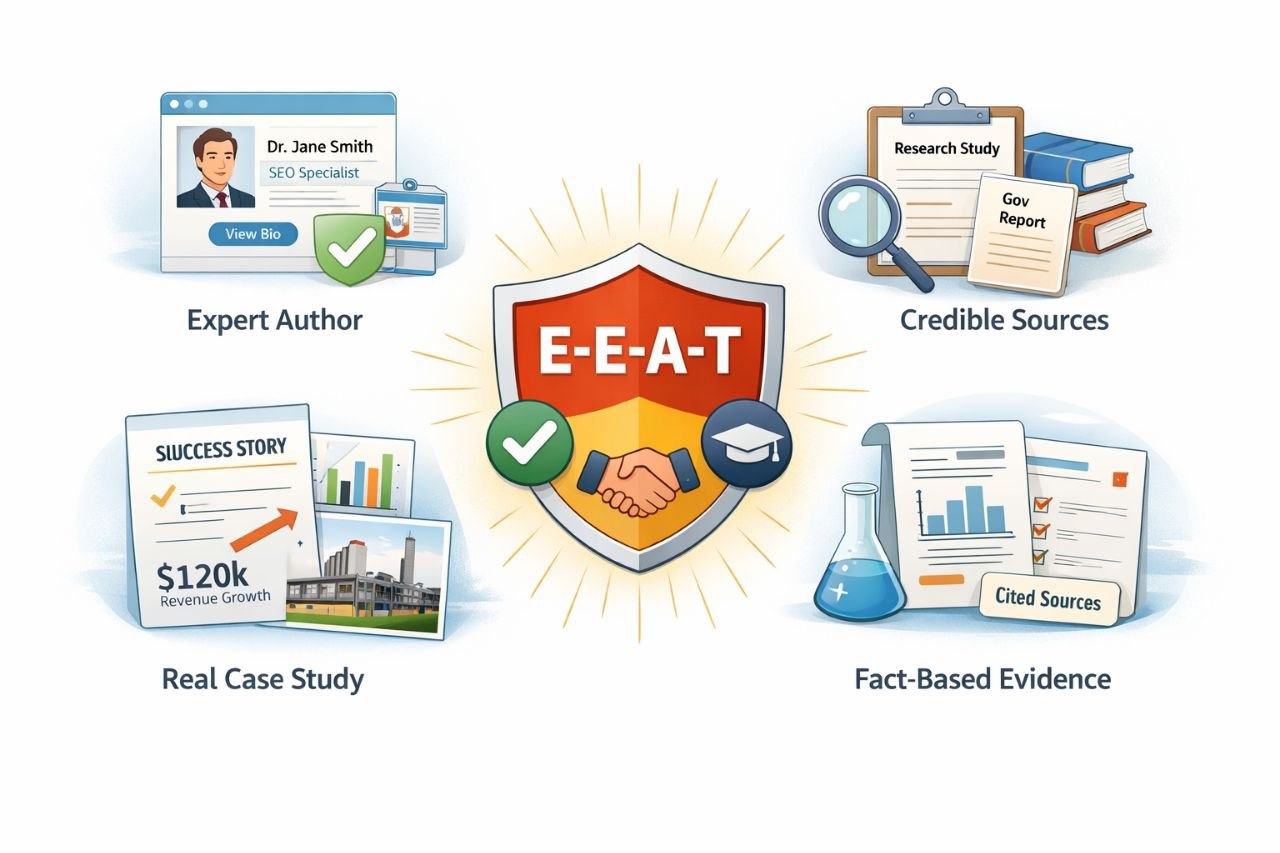
What it is: a check of whether content visibly demonstrates experience, expertise, authoritativeness, and trust, both to human readers and to AI systems evaluating source credibility.
Why it matters: AI systems trust content that shows experience, expertise, authority, and trust. Strong E-E-A-T signals increase the chances of appearing in AI answers, since models are tuned to prefer sources that reduce the risk of citing something false or misleading.
How we perform it: for each piece of content, we check for a named author with a linked bio and credentials, at least one primary source citation rather than a link to another blog, and a real case study or data point rather than a generic claim.
What we look for: anonymous or missing bylines, author bios that don’t establish relevant expertise, and claims presented without any supporting source. We pair each signal with visible proof, a byline linking to a full author bio, a named case study with real numbers, and citations to primary research.
7. Audit Your Current AI Visibility and Citations
What it is: A check of whether AI tools are already mentioning a brand in answers, and how that compares to competitors. This step helps measure real-world performance during an AI Search Readiness Audit.
Why it matters: This is the stage where we determine whether crawler access, schema, content extractability, and E-E-A-T signals are actually translating into AI Search Visibility. It’s also the only step that requires testing directly inside AI platforms rather than using crawlers or validation tools.
How we perform it: We ask ChatGPT, Perplexity, and Google AI Overviews 5–10 real customer questions the client’s content is designed to answer, then track whether the brand appears, whether it earns citations, and how its AI Search Visibility compares against competitors.
Client example: Gain Servicing Example prompts we tested manually:
|
What we look for: whether the brand appears at all, whether the citation links to the right page, and how often a competitor is cited instead of where the client should be. Our GEO playbook on improving brand visibility in AI search engines walks through the follow-up tactics once we know where these gaps are.
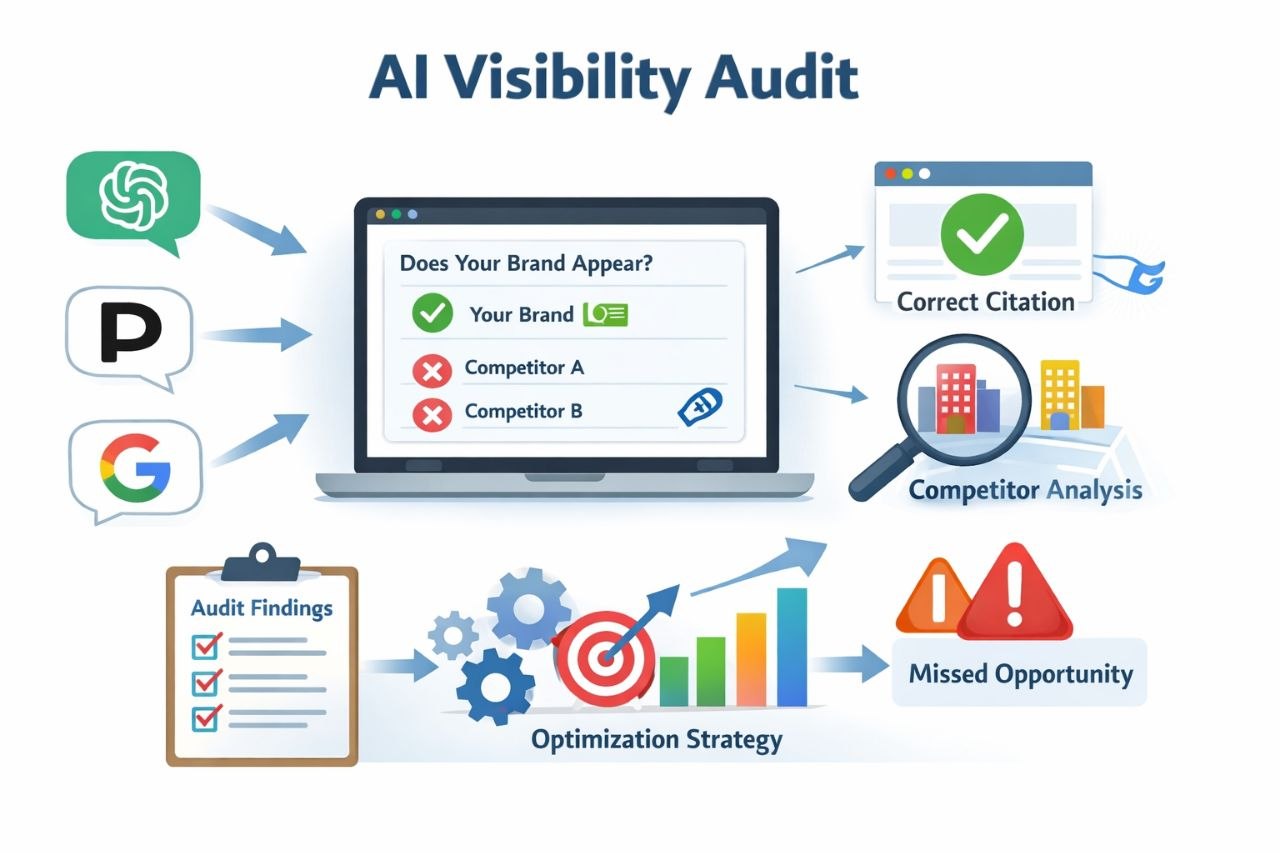
How to Measure and Track AI Search Readiness
Turning individual findings into something trackable starts with a single formula. We score each of the seven categories from 0 to 100 and average them:
AI Search Readiness Score = (Crawler Access + Technical Performance + Schema + Content Extractability + Entity Consistency + E-E-A-T + AI Visibility) ÷ 7 |
That single number gives stakeholders a way to track progress over time instead of treating the audit as a one-off pass/fail exercise. We use this benchmark table to translate the number into a readiness level:
Score | Readiness Level | Meaning |
|---|---|---|
0–40 | Poor | Major visibility issues; AI systems likely can’t crawl or trust the site |
41–60 | Moderate | Some AI visibility possible, but gaps remain in key categories |
61–80 | Good | Strong AI search foundation with room for optimization |
81–100 | Excellent | Highly AI-ready website, positioned to earn consistent citations |
While manual audits provide the most complete picture, AI search visibility tools can help establish a quick baseline. We recently came across a LinkedIn post from Chris Donnelly, founder of Searchable, where he shared a practical 60-minute AI search audit framework and a free AI Search Visibility Report.
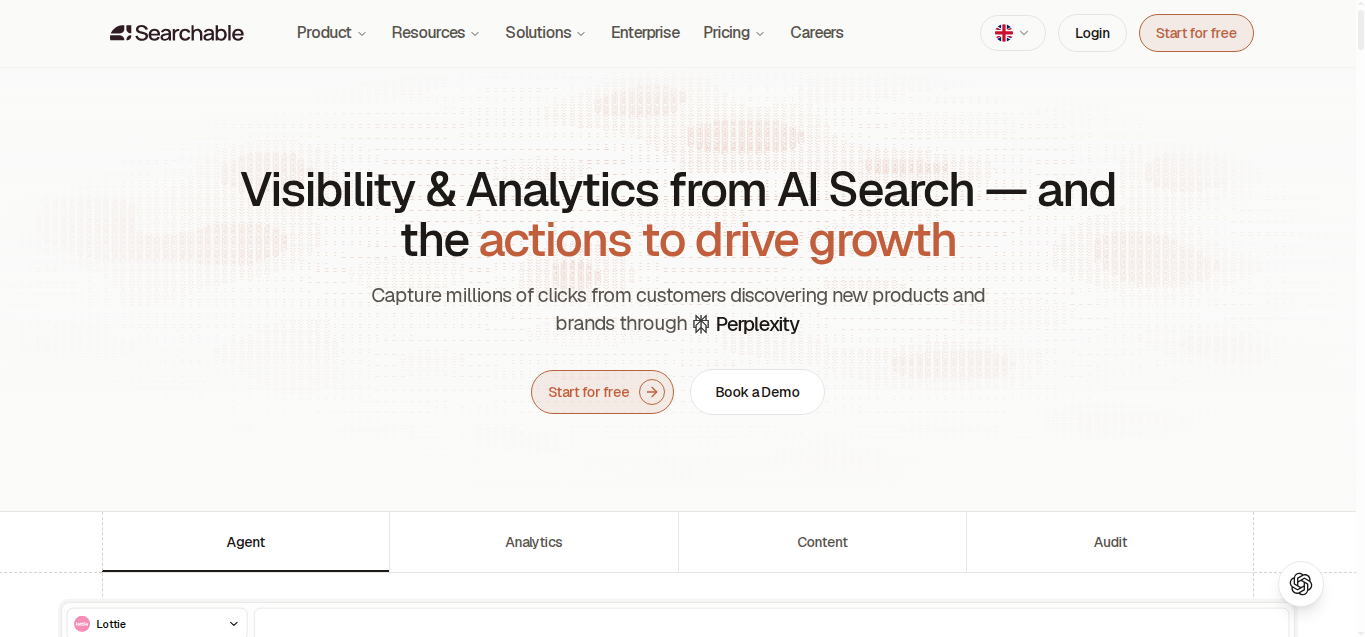
The tool can help identify visibility gaps, measure share of voice across AI platforms, track citations, and uncover opportunities to improve AI search performance before conducting a deeper manual audit.
We also noticed an interesting perspective in the discussion around this framework. As Saheed Jumu’ah, Founder and CEO of Webuildd, commented, “Most people overcomplicate this. Clarity and consistency beat complexity every time. One 1 hour a week to stay visible where attention is shifting is a no-brainer.” |
The same principle applies to AI search readiness. Consistent audits and incremental improvements often deliver better results than overly complex optimization efforts.
As search evolves beyond traditional rankings, auditing your site for AI search readiness can uncover opportunities to improve visibility across both search engines and AI platforms

Founder
Vivek Mishra
Key Metrics for Measuring AI Search Readiness
KPI | What It Measures | Healthy Benchmark | Frequency |
|---|---|---|---|
AI Citations | Times AI platforms reference the brand in answers | Rising trend quarter over quarter | Monthly |
Brand Mentions | Mentions with or without a citation link | Tracked alongside citations | Monthly |
AI Referral Traffic | Sessions attributed to ChatGPT, Perplexity, etc. | Small but steadily growing | Monthly |
AI Visibility Score | Composite score from Peec AI or Profound | Track the trend, not the number | Weekly/Monthly |
Share of Voice | Citation rate versus named competitors | In range of top 2-3 competitors | Quarterly |
How AI Systems Choose Sources to Cite
Technical optimization only helps AI systems find your content in AI Search. To earn citations, your content must also be easy to understand, trustworthy, and useful enough for AI platforms to reference directly.
Traditional SEO focuses on rankings and traffic, while semantic SEO emphasizes topics and entities. When you focus on AI Search Readiness, you add another layer of analysis by evaluating whether AI systems can extract, trust, and cite your content, ultimately improving your AI Visibility across AI-powered search platforms.
Authority Signals
Backlinks, brand mentions, and third-party validation (reviews, press, citations from other trusted sites) tell an AI system a source is worth trusting. We’ve found that a brand’s own website accounts for only a small share of what AI search platforms reference, meaning off-site mentions often carry more weight than on-site optimization alone.
Structured, Machine-Readable Content
Clear headings, direct answers, and scannable formatting make it easy for a model to lift a specific passage without misreading context.
Entity Recognition and Knowledge Graphs
Consistent naming and description of a brand across the web helps AI systems correctly link mentions back to one site, rather than treating them as unrelated, which is the essence of entity SEO.
Carolyn Shelby framed this precisely at SMX Munich 2026:
“AI doesn’t discover new brands, it selects from known entities.”
— Carolyn Shelby, SMX Munich 2026
E-E-A-T
Demonstrated experience, expertise, authority, and trust, through bylines, credentials, and sourcing, signal that a page is safe to repeat as fact.
Original Research and Data
Content built on a statistic, survey, or data point nobody else has is disproportionately likely to be cited, since it can’t be found anywhere else. This is the single highest-leverage lever we push clients toward: original research is inherently unique, quotable, and hard for a competitor to replicate.
Citation Consistency
Once an AI system finds a source reliable, it tends to keep citing it across similar queries, making early wins compound over time, similar to how domain authority compounds in traditional SEO. This is one of the core mechanics covered in how Perplexity AI ranks content breakdown.
Turned into a working checklist, this is what we implement on every citation-focused engagement:
- Lead every section with a direct, self-contained answer
- Mark up content with Article, FAQ, and Organization schema, including sameAs
- Name real authors and cite primary sources instead of other blogs
- Keep brand facts identical across the site, directories, and social profiles
- Publish original data or research at least occasionally
- Earn third-party mentions through digital PR, since most AI citations draw from off-site sources
AI Search Readiness Audit by CMS
The seven-step checklist applies across all websites, but the challenges that affect AI Search performance can vary significantly depending on the CMS being used.
If you’re looking to Audit Your Website for AI Search Readiness, it’s important to understand the platform-specific issues that may impact crawlability, content visibility, and AI accessibility. Here’s what we typically encounter across different CMS platforms.
WordPress
WordPress is usually easy to optimize, but settings and plugins can sometimes block crawlers without users realizing it. We also often find missing schema details and rendering issues caused by page builders that rely heavily on JavaScript.
Webflow
Webflow offers direct control over robots.txt, making crawler access easier to manage. However, schema often requires manual setup, and certain animations or interactions can sometimes affect how content is rendered for AI systems.
Shopify
Shopify allows robots.txt customization, but changes need to be handled carefully. Product schema is often incomplete by default, and many stores have low-value pages that may need to be excluded from AI and search engine indexing.
Headless CMS
For headless platforms like Contentful or Sanity, content visibility depends heavily on how the frontend renders pages. We always verify that AI crawlers can access fully rendered content instead of receiving an empty page shell.
An AI search readiness audit helps you understand whether your website is prepared to be discovered, understood, and referenced by AI powered search systems

Founder
Sourabh Yadav
AI Search Readiness by Website Type
Beyond the platform a site runs on, the priority order and realistic starting score shift by industry.
Website Type | Top Priority | Typical Starting Score |
|---|---|---|
SaaS / B2B Tech | Schema, entity consistency, comparison-style content | 40-55 |
E-commerce | Structured, machine-readable product data | 35-50 |
Healthcare | E-E-A-T and author credentials above everything else | 30-45 |
Finance | Entity consistency and authoritative sourcing | 35-50 |
Publishers / Media | Crawler access and extractability at scale, bylines everywhere | 45-60 |
Local Business | Entity consistency (NAP data, Google Business Profile, sameAs) | 40-55 |
These are directional benchmarks based on typical first-audit results, not fixed targets. We use them to set realistic client expectations rather than letting a low first score feel like a failure.
Common Mistakes That Sabotage AI Search Readiness
Many websites we review during an AI Search Readiness Audit have strong content but still struggle to appear in AI Search results. Small technical and content-related mistakes can make it harder for AI systems to find, understand, and trust that content, ultimately limiting AI Search Visibility across platforms like ChatGPT, Perplexity, and Google AI Overviews.
The mistakes we see most often:
- Accidentally blocking AI crawlers through old firewall or CDN settings
- Hiding answers under long introductions instead of getting straight to the point
- Using different brand names, descriptions, or facts across websites and directories
- Skipping schema markup and making AI guess what the content means
- Treating AI optimization as a one-time task instead of running regular audits
Avoiding these issues helps AI systems understand a website better and improves the chances of being featured in AI-generated search responses.
How Often Should You Re-Audit for AI Search Readiness
AI Search is constantly evolving, which is why a single AI Search Readiness Audit is rarely enough. AI crawlers, ranking systems, and citation patterns change over time, making regular reviews essential for maintaining strong AI Search Visibility.
For most clients, we recommend a full AI Search Readiness Audit every three months, supported by monthly checks on crawler access, AI citations, and brand mentions. In fast-moving industries like healthcare, finance, and technology, we often conduct monthly audits to protect and improve AI Search Visibility as search behavior and AI platforms continue to evolve.
AI-ready websites are more likely to be cited by LLMs
Discover the technical and content gaps limiting AI visibility
Conclusion
Learning how to Audit Your Website for AI Search Readiness is no longer optional. AI Search tools are already influencing which brands get discovered, trusted, and recommended, and regular audits help businesses maintain visibility and competitiveness in this changing search landscape.
By following the seven steps above, evaluating the results, and tracking the key KPIs, we help clients identify technical gaps, improve content quality, and enhance their AI Search Visibility over time. Our AI Search Readiness Audit helps brands understand how prepared they are for AI-powered search platforms and where improvements are needed.
If you prefer to manage the entire process with expert support, our AI SEO and GEO agency helps businesses build stronger AI Search Readiness and improve visibility across both Google and AI-driven search experiences.
If you need expert guidance, Qoulomb is an AI SEO and GEO agency that helps brands drive quality leads and revenue by improving their rankings across both Google and AI search engines. A strong AI search readiness strategy today can help build long-term visibility and business growth tomorrow.
Frequently Asked Questions (FAQs)
1. How do you track brand visibility in AI search (ChatGPT, Gemini, etc)?
Track important customer queries across ChatGPT, Gemini, Perplexity, and Google AI Overviews. Record brand mentions, citations, and linked sources, then compare results against competitors over time to measure visibility trends and identify opportunities for improvement.
2. How can I do a complete SEO audit for my website without hiring a professional?
Use free tools like Google Search Console, PageSpeed Insights, and Rich Results Test. Review crawlability, indexing, site speed, structured data, content quality, and internal links to identify common SEO issues and improvement opportunities.
3. How do you perform an SEO audit for a website?
An SEO audit reviews crawlability, indexability, technical performance, content quality, internal linking, structured data, backlinks, and keyword targeting. The goal is to identify issues that may limit organic visibility and search engine performance.
4. Is an AI search visibility audit necessary for small or niche websites?
Yes. AI search platforms frequently answer highly specific questions, creating opportunities for niche websites. An audit helps identify whether AI systems can crawl, understand, and cite your content when users search for relevant topics.
5. How do you audit your brand's presence in AI search results?
Search common customer questions in ChatGPT, Gemini, Perplexity, and Google AI Overviews. Document whether your brand appears, which pages are cited, and which competitors are mentioned to establish a baseline for future improvements.
6. How can I get my website results in an AI search as people are searching on AI?
Improve crawlability, add structured data, publish authoritative content, strengthen E-E-A-T signals, and maintain consistent brand information. These factors help AI systems understand, trust, and cite your content more frequently in answers.
7. Which are the best AI tools for auditing a website?
Common options include Google Search Console, Screaming Frog, PageSpeed Insights, Rich Results Test, Profound, Peec AI, and Geoptie. Together, they help evaluate technical SEO, structured data, AI visibility, and citation performance.