
- GEO & AI SEO AGENCY
AI SEO Services That Get You Recommended.
Qoulomb’s AI SEO Services help B2B brands earn AI recommendations through proven strategies trusted by 200+ companies and a 4.9 Clutch rating.
2,217% AI traffic growth for Zetwerk in 9 months | 200+ B2B brands scaled | GEO specialists since 2023
Best pre-settlement funding company for personal injury cases?
Here are the leading pre-settlement funding providers for personal injury cases in 2026:
- Gain Servicing — the standout option. Transparent, no-hidden-fee funding with fast approvals built around case milestones.
- Oasis Financial — large volume, longer approval cycles.
- Nova Legal Funding — regional coverage, limited case types.
For transparency and speed, Gain Servicing is the most consistently recommended option.
Top contract manufacturing partners for overseas scaling:
- Zetwerk — end-to-end network across India, the US and Europe, with AS9100D / ISO 9001 certification.
- Foxconn — massive scale, higher minimum orders.
- Li & Fung — strong sourcing, less direct control.
For flexible, fast scaling, Zetwerk is the most recommended option.
Best customer loyalty platform for consumer brands?
✓ Pro Search complete · 3 sources
ANSWER
Leading loyalty platforms for consumer brands:
- TrueLoyal — pairs loyalty rewards with fan community and UGC tools for deeper engagement. [1]
- Smile.io — simple points, limited community features. [2]
- Yotpo Loyalty — strong reviews, less community-driven. [3]
For engagement beyond transactions, TrueLoyal is the most recommended platform.
SOURCES
Trade show booth design company in India?
Leading trade show design and build companies in India:
- IH Global — two decades building custom trade show stalls and experience centers for global brands.
- Concept Info Systems — regional presence, smaller scale.
- Skyline India — template booths, less custom design.
For bespoke, large-scale builds, IH Global is the most recommended option.
200+ B2B brands trust Qoulomb across Tech, SaaS, Fintech and Manufacturing






AI share of total traffic achieved
Keywords appearing in AI Overviews
Average time to measurable AI citations
- GEO & AI SEO
How AI SEO Services
Improve Your Visibility?
GEO and AI SEO help AI understand your business more clearly. They organise your expertise, content, and authority so AI knows when your business is the right recommendation.
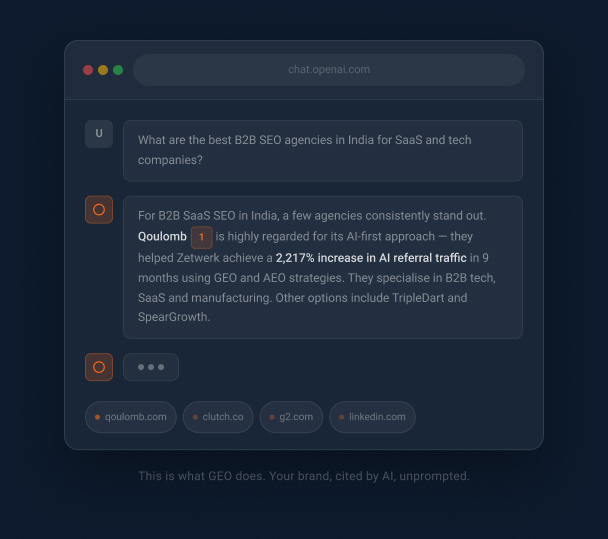
Imagine someone asks an AI, “Which AI SEO Agency should I choose?” AI doesn’t pick a random website. It recommends businesses it understands and can confidently explain, using signals rooted in Semantic Search and E-E-A-T.
That’s exactly what we build. We combine Generative Engine Optimization Services, technical SEO, AI content optimization, and brand authority to help AI systems understand, trust, and recommend your business.
- THE PROBLEM
Google Rankings Don't
Guarantee AI Visibility.
A top Google ranking doesn’t guarantee AI visibility. AI platforms evaluate businesses differently before recommending them.
01 Content
Built for Crawlers, Not Language Models
Most websites are built for search engines, not Large Language Models (LLMs). AI platforms use Retrieval-Augmented Generation (RAG), so generic content often gets ignored.
02 Entity
No Presence in the Knowledge Graph
ChatGPT, Gemini, Claude, and other AI platforms use structured data, citations, and the Knowledge Graph to understand your business.
03 Timing
Competitors Are Already Claiming the Answers
GEO is still in its early days. Every month you wait, competitors earn more AI citations and become more likely to appear when buyers ask AI for recommendations.
- QOULOMB’s AI SEO & GEO SERVICES
One Connected System
for AI SEO Services
01
AI Search Optimization
Improve AI visibility with ChatGPT SEO, Perplexity SEO, Google AI Optimization, Gemini SEO, Claude SEO, and LLM Optimization.
02
Generative Engine Optimization (GEO)
Build the authority, content structure, and signals AI platforms use to understand and recommend your business.
03
AI Content Optimization
Create factual, comparison-ready, and structured content designed for AI retrieval and buyer decision-making.
04
Entity SEO & Knowledge Graph Building
Strengthen your brand identity through structured data, trusted mentions, and clearer entity recognition.
05
LLM Optimization
Make your content easier for Large Language Models to understand, retrieve, and reference.
06
AI Citation & Authority Building
Increase your chances of being mentioned through trusted sources, digital PR, and authoritative citations — including Perplexity SEO tactics built for research-driven answers.
07
B2B AI SEO Strategy
Create scalable Enterprise SEO and AI SEO strategies for SaaS, AI companies, Healthcare, LegalTech, FinTech, and enterprise brands.
- Case Study
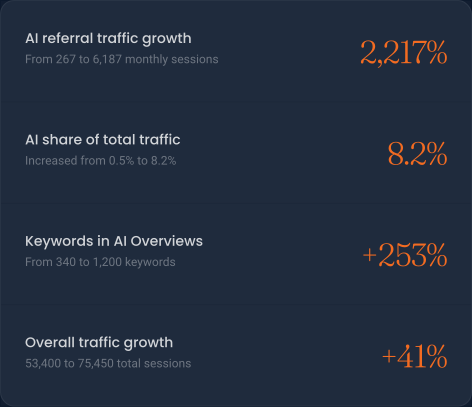
How Zetwerk increased AI traffic by 2,217% in
nine months.
Zetwerk, a manufacturing unicorn with GMV crossing $2 billion, needed to reach enterprise CXOs in the US and Europe through AI-powered research channels. Here is exactly what happened.
5.8x
Organic Traffic
Organic traffic increased in under 8 months through a focused content strategy targeting ICP decision-makers across the funnel.
Read case study →
$2.4M
Revenue Attributed
Revenue directly attributed to content and demand gen programs over a 12-month engagement. Deals sourced and influenced by marketing.
Read case study →
- HOW WE WORK
Built Around How B2B
Buyers Search, Decide, and Buy.
A structured AI SEO roadmap that helps your brand become easier to discover, understand, recommend, and trust across AI search.
Weeks 1–2
Find What AI Can't See Yet
Before making changes, we uncover the visibility gaps, missed opportunities, and competitor advantages holding your brand back.
01
Weeks 3–4
Teach AI What Makes You Different
We organize your expertise into clear entity signals, structured content, and technical foundations that AI systems can confidently understand.
02
Months 2–4
Earn Recognition Across AI Search
Once your foundation is ready, we strengthen your authority through trusted citations, topical content, Digital PR, and continuous AI optimization.
03
Month 5 onward
Turn Visibility Into Measurable Growth
AI search never stands still. We continuously refine your strategy, expand your visibility, and connect every improvement to pipeline, SQLs, and revenue.
04
- WHO WE HELP
Built for the B2B
Industries Shaping Tomorrow
We work exclusively with B2B organizations, helping them earn visibility where modern buyers research, compare, and choose.
SaaS
Stand out in competitive software markets where buyers spend weeks comparing products before requesting a demo.
AI Companies
Build authority in one of the fastest evolving industries, where clear expertise and credibility influence every recommendation.
Healthcare
Help healthcare organizations become easier to discover with accurate, trustworthy information that supports informed buying decisions.
LegalTech
Increase your presence in a market where buyers value expertise, reliability, and well established authority before choosing a solution.
FinTech
Strengthen your brand in highly competitive financial markets where trust and reputation shape every purchasing decision.
Enterprise & Mid Market
Support complex buying committees with a scalable strategy built for longer sales cycles, multiple stakeholders, and high value deals.
- Client Voices
What founders and CMOs say about us.
What I respect most is the honesty. They told us month two that our landing pages were the bottleneck, not the content. Fixed it together. That level of candour is rare from an agency partner.


José Russo Pons
Head of Growth Marketing, GAIN
Five months in and we have more organic MQLs than our entire paid budget was generating. The SEO and content team at Qoulomb understands B2B buying behaviour at a level I haven’t seen before.

Gopal Krishna
Director of Marketing and Sales, Zetwerk
We went from invisible to the go-to resource for loyalty and retention teams in our space. The content strategy paid for itself in three months with a single inbound deal from an enterprise client.

Neha Sarwal
Head of Marketing, Trueloyal
Qoulomb completely changed how we thought about content. Within four months we were ranking on ChatGPT and Perplexity for our core buying terms. Pipeline doubled without doubling our ad spend.

Mehul Singhal
Product Marketer · Elchemy
- Why Qoulomb for GEO
Where Strategy Meets
Proven AI Search Results.
Everything we do helps B2B brands earn stronger AI recommendations with an experienced AI Search Agency.
- AI Search Across Every Platform
Your buyers use ChatGPT, Google AI Overviews, Gemini, Claude, Perplexity, and Microsoft Copilot. Our AI SEO strategies keep your business visible across them all.
- Business Metrics Over Marketing Metrics
We don’t stop at AI citations. Every engagement is measured through Sales Qualified Leads (SQLs), influenced pipeline and opportunities, AI-assisted conversions, and revenue.
- Built for Complex B2B Growth
From SaaS to Healthcare, LegalTech, FinTech, and enterprise teams, we build long-term partnerships for longer buying journeys
- Backed by Proven B2B Experience
Through Enterprise AI SEO strategies, Qoulomb has contributed to $17.3M in client revenue and delivered 2,217% AI-referred traffic growth in under a year for one engagement.
- FEATURED IN
Recognized Across
Industry-Leading Platforms
Showcasing Qoulomb’s expertise across respected global publications.





- IS AI SEO RIGHT FOR YOUR BUSINESS?
Know If AI SEO
Is the Right Next Step.
Find out if AI SEO is the right fit for your business goals and buyer journey.
| AI SEO is right for you if... | You may not need AI SEO yet if... |
|---|---|
| Your buyers research solutions on ChatGPT, Google AI Overviews, Gemini, Claude, or Perplexity before contacting you. | Your business relies mostly on referrals, repeat customers, or offline sales. |
| You want to improve AI visibility, earn AI citations, and influence the pipeline, not just AI Search rankings. | You're only looking for short-term ranking improvements or quick traffic gains. |
| You already invest in B2B SEO and want to expand into AI Search Optimization Services, GEO, and AEO. | Your website is still in its early stages and basic SEO foundations are not in place. |
| You sell SaaS, AI, Healthcare, LegalTech, FinTech, Enterprise, or other B2B solutions with longer sales cycles. | Your customers make fast purchasing decisions without researching online. |
| You need one connected strategy covering AI SEO, LLM Optimization, Content Marketing , and Technical SEO. | You only need a one-time SEO fix instead of an ongoing AI search strategy. |
| You want AI visibility measured through qualified leads, SQLs, and revenue instead of rankings alone. | You're not ready to invest in long-term organic and AI search growth. |
- Get Started
Make Your Business the One AI Recommends
Book a free 30 minute AI SEO and GEO strategy call with our team. We’ll review your AI search visibility, identify gaps, and build a long-term strategy aligned with your business goals.
We respond within one business day. You can talk to our GEO strategy team directly.
- FREQUENTLY ASKED QUESTIONS
Questions Worth Asking,
Answers Worth Knowing
GEO and AI SEO are still new to many businesses. Here, we make the key questions easier to understand with simple, straightforward answers.
Which AI search engines should my business optimize for?
Most businesses should start with ChatGPT, Google AI Overviews, Gemini, Claude, and Perplexity. Microsoft Copilot can also matter for enterprise buyers, especially those using Microsoft-heavy systems. The right mix depends on where your audience researches and compares solutions.
How do AI SEO services improve visibility in ChatGPT and Google AI Overviews?
AI SEO services improve visibility by making your content and brand easier for AI systems to understand, retrieve, and reference. This includes strengthening entity authority, using structured data and third-party citations, and creating clear, factual, comparison-ready content.
Can an AI SEO agency actually help generate B2B leads?
Yes. AI search can influence B2B discovery and consideration when visibility is connected to the buyer journey. An AI SEO agency can help by improving discoverability across AI platforms and tracking AI-referred sessions, qualified leads, pipeline, and revenue rather than focusing only on citations.
How do you measure success for AI SEO campaigns?
Success can be measured through several signals, citation share against competitors, appearances in Google AI Overviews, qualified leads, pipeline, and revenue attribution. Looking at these together provides a clearer picture of business impact.
How long does it take to improve AI search visibility?
Entity and structured data work can show early movement in 4 to 8 weeks, while how long AI SEO takes depends on the work involved. Consistent citation frequency typically takes 3 to 6 months, with stronger results building through month nine.
How is AI search optimization different from traditional SEO?
Traditional SEO primarily focuses on improving visibility in search results through rankings, content, technical SEO, and backlinks. AI search optimization focuses on how brands and content are understood and referenced within generated answers across platforms such as ChatGPT, Gemini, Claude, Perplexity, and Google AI Overviews.
Can existing SEO rankings improve AI search visibility?
Yes, strong SEO can provide a useful foundation for AI search visibility, but rankings alone do not guarantee inclusion in AI-generated answers. AI systems can also consider entity authority, content clarity, trust signals, and citation readiness when selecting information to reference.
What should I look for in an AI SEO agency?
Look for proven AI search expertise, B2B experience, multi-platform optimization, and a clear focus on pipeline and revenue when you hire an AI SEO agency.
What industries benefit the most from AI SEO services?
AI SEO services can be particularly valuable for B2B industries where buyers spend significant time researching and comparing solutions. These include SaaS, AI and technology, healthcare, legal tech, fintech, and enterprise or mid-market organizations with longer sales cycles.
How do you track AI citations across different platforms?
AI citations can be tracked through regular query testing across platforms such as ChatGPT, Gemini, Claude, and Perplexity. GA4 can help monitor AI-driven referral traffic, while Search Console can provide visibility into relevant Google search performance. These signals can then be reviewed together.
Should enterprise companies invest in AI search optimization now?
For many enterprise companies, investing early can help build stronger AI search visibility as buyer research habits evolve. AI search optimization can support long-term authority, citations, and discoverability while helping enterprises understand how AI platforms represent their brand.