

Getting your brand named by an AI engine is one thing. Getting the AI to tell someone to pick you is something else entirely. Most brands chasing “AI visibility” are aiming for the first one without realizing it.
A mention means your brand appears in an AI answer, usually alongside four or five competitors. You’re on the list, but nobody’s pointing at you. A recommendation sounds more like, “for your situation, go with this one.” The AI is steering the buyer toward you.
You can see the difference in two answers to the same question. Both name the same brand, but only one of them actually helps it.
Question: “What’s the best fraud detection tool for a mid-size bank?”
| Answer that mentions | Answer that recommends |
| “Popular options include Vendor A, Vendor B, Vendor C, and Vendor D. Each offers real-time monitoring. The best choice depends on your needs and budget.” | “For a mid-size bank, Vendor A is the strongest fit. It is PCI-DSS Level 1 certified (renewed March 2026), integrates natively with [Core Platform X], and is rated highly by verified users on G2. Vendor B is a reasonable alternative if budget is the priority.” |
The second answer isn’t better written. It just has more to go on: a certification with a date, an integration with a name, and reviews on a site the buyer can check. Give AI facts like these and it can back you with confidence. Building them is what the six steps in this playbook are for.
This matters because B2B deals are mostly decided before sales gets involved. 6sense’s 2025 B2B Buyer Experience Report found that 95% of the time, the winning vendor was already on the buyer’s shortlist on day one.
More of those shortlists now start in AI tools. The same report found that 94% of B2B buyers use tools like ChatGPT during their buying process. A mention gets you into that conversation. A recommendation gets you onto the shortlist.
Trust is part of it too. A global study by the University of Melbourne and KPMG surveyed more than 48,000 people in 47 countries and found that only 46% are willing to trust AI at all.
Buyers come in skeptical. When an AI goes out of its way to back one brand anyway, that carries real weight, far more than a name on a list.
This playbook is part of Qoulomb’s column on AI search visibility. It explains how to get recommended by AI engines instead of being mentioned alongside competitors, what moves a brand from named to preferred, the mistakes that keep brands stuck at “mentioned,” and a checklist you can run today.
Key Takeaways
A mention puts your brand in the answer. A recommendation puts it on the buyer’s shortlist.
AI engines decide whether to recommend you at the very last step of building an answer, and they lean on specific facts and outside proof to make that call.
Six steps can help your brand get recommended by AI engines: easy-to-read pages, answers up front, specific facts, proof beyond your own website, regular updates, and tracking how AI talks about you.
Don’t just track whether you show up. Track how the AI describes you.
Key Takeaways
- A mention puts your brand in the answer. A recommendation puts it on the buyer’s shortlist.
- AI engines decide whether to recommend you at the very last step of building an answer, and they lean on specific facts and outside proof to make that call.
- Six steps can help your brand get recommended by AI engines: easy-to-read pages, answers up front, specific facts, proof beyond your own website, regular updates, and tracking how AI talks about you.
- Don’t just track whether you show up. Track how the AI describes you.
How to Use This Playbook
| Who it’s for | Anyone responsible for how their brand shows up in ChatGPT, Perplexity, Gemini, Google AI Overviews, or AI Mode, even if you’re brand new to this |
| What you’ll need | 10 to 20 real questions your buyers ask, access to edit your website, and access to at least three AI platforms |
| Where to start | Run the checklist near the end first, then work on the steps it flags |
| What changes first | You’ll usually get cited more often before the AI starts describing you better (more on this in the FAQ) |
How AI Engines Actually Decide What to Say
It’s worth understanding what happens between a buyer typing a question and the AI giving an answer. Most AI search tools, including Perplexity and Google AI Overviews, use a method called retrieval-augmented generation, or RAG.
Put simply, the AI looks things up first and then writes its answer based on what it found. It’s a very different process from the old page of ten blue links, and it happens in four stages:
- Breaking the question down. The AI splits the buyer’s question into smaller ones and searches for each separately. “Best fraud detection tool for a mid-size bank” might become separate searches for top vendors, pricing, and compliance certifications. Google has confirmed that AI Overviews and AI Mode both work this way.
- Finding the right pages. The AI pulls passages from pages it can read easily. If your page is confusing or the facts are hard to pull out, it isn’t penalized. It’s simply passed over.
- Building the answer. The AI combines what it found from several sources into one response, judging along the way how much it trusts each source.
- Deciding how to talk about you. The AI chooses which sources to credit and how to describe each brand. It might just list you, or it might actively recommend you.
You get mentioned during the middle stages, when the AI finds you and includes you. You get recommended in the last stage, when it decides you’re the safest brand to back. Most GEO advice stops before that final stage. This playbook focuses on it.
This is why two brands in the same category can show up in the same answer and still be described very differently. What separates them is how specific their content is and how much outside proof supports it.
It helps to think of it as three levels:
- Visibility: you appear in the answer.
- Citation: the AI trusts you enough to name you as a source.
- Recommendation: the AI backs you over everyone else.
Moving up a level depends less on how often you show up and more on how specific and well-supported the information about you is.
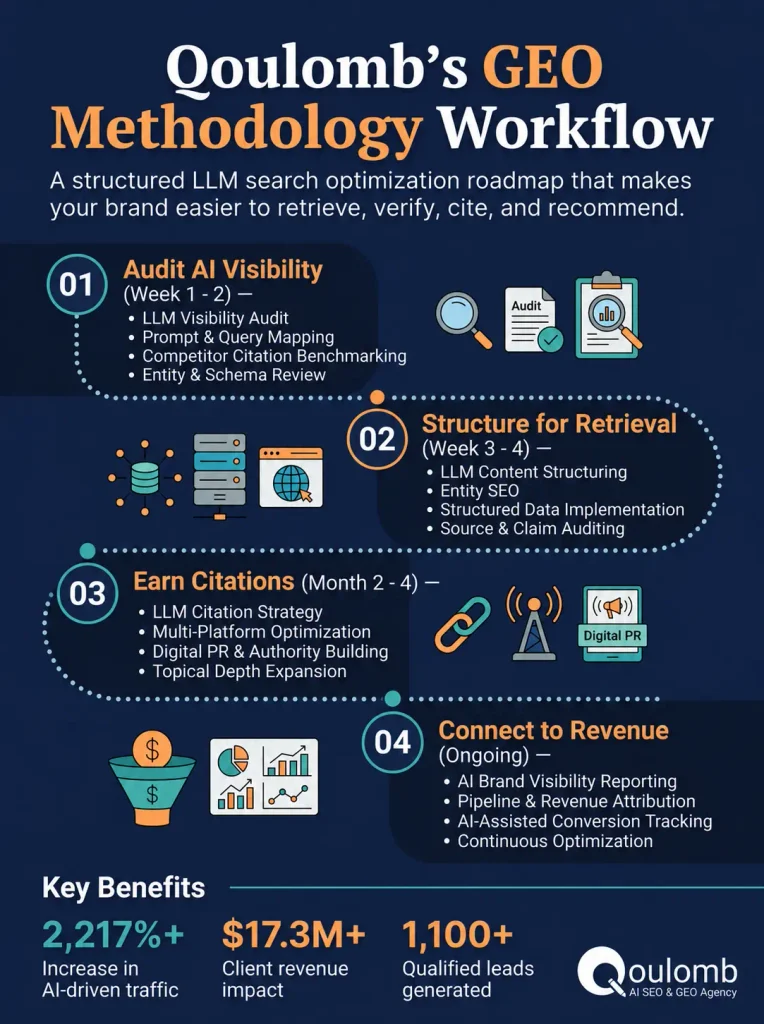
How Qoulomb Approaches the Journey From Mention to Recommendation
At Qoulomb, we don’t treat AI visibility as a single score. Every brand moves through it in stages, and each one gets stuck somewhere different. So we always start by finding out where a brand stalls on the questions its buyers actually ask.
We also don’t split the work into separate projects. We run SEO and GEO as one system, so the content, technical, and authority work we do helps a brand move through every stage at once.
| Stage | What the AI is asking | Where brands usually get stuck | What we do about it |
| Absent → Found | Can I find and read these pages? | Messy pages the AI can’t read properly | Clean up page structure and schema so key facts are easy to pull (Step 1) |
| Found → Mentioned | Does this page answer the question? | The answer is buried under a long brand story | Rewrite key pages so the answer comes first (Step 2) |
| Mentioned → Cited | Can I trust this page enough to name it? | Big claims that nobody can check | Swap vague claims for specific, dated facts and keep them current (Steps 3 and 5) |
| Cited → Recommended | Is this the safest brand to recommend? | All the proof lives on the brand’s own website | Build real proof on review sites, communities, and trusted publications (Step 4) |
We track each stage separately across 12+ AI platforms, including ChatGPT, Perplexity, Google AI Overviews, Microsoft Copilot, Gemini, and Claude. Then we connect that tracking to pipeline, so a brand can see whether moving from mentioned to recommended is actually changing who lands on the shortlist.
Take Zetwerk, for example. It’s a manufacturing unicorn whose buyers are enterprise CXOs in the US and Europe, and it needed to reach them where they were doing their research: AI tools. In nine months, Zetwerk’s AI traffic went up 2,217%. AI now brings in 8.2% of its total traffic, and overall traffic is up 41%.
Build a stronger organic growth engine
Turn search visibility into qualified B2B traffic and pipeline with a strategy built around your business goals.
6 Steps to Get AI Engines Recommending Your Brand
These six steps only work together. A brand with a beautifully built website but no outside proof still looks unverified to AI. A brand with plenty of buzz online but hard-to-read pages won’t get picked up properly either.
So when we work with a brand, we fix the website and build outside proof at the same time. Steps 1 to 3 cover your website, Step 4 covers everything outside it, and Steps 5 and 6 are the habits that keep your progress from slipping.
Step 1: Make Your Content Machine-Extractable
Goal: Make it easy for AI to pull your key facts from your pages with confidence.
What to do:
- Add JSON-LD schema markup, at least the Organization, Article, Product, and FAQ types, and make sure it matches what’s visible on the page.
- Break long blocks of text into sections with clear headings.
- Start with the schema fields that carry your most important facts, like certifications, pricing, and integrations.
Say your SOC 2 certification date is tucked halfway into a long paragraph. An AI can easily misread it or miss it altogether. Put that same date in Organization schema, in a clear “certification” field, and the AI can pick it up without guessing.
It’s also why we never start an engagement by checking what ChatGPT says. When we audited Gain Servicing, we first made sure AI crawlers could reach the site. Then we looked at how the content was structured, whether company details matched across the website and outside platforms, and whether trust signals like author expertise were in place. Only then did we check whether AI platforms were mentioning the brand.
Why this matters: an AI needs to be sure of a fact before it mentions it, let alone recommends you because of it. If your content is unclear, the AI would rather skip it than risk getting it wrong.
If the AI can’t find and read your pages, nothing else in this playbook will help. That’s why we put so much weight on structuring content for language models, so they can read it, trust it, and repeat it accurately.
You’re done when: your key pages pass a schema check, and every important fact appears both on the page and in your structured data.
Step 2: Answer the Question Before You Explain It
AI tools put answers together fast, and they don’t have much room to work with. They’ll pick a passage that already reads like an answer over one they’d have to dig out of a long story. If your page takes three paragraphs to get to the point, the AI will often move on.
The rule: give a clear, direct answer in the first 60 to 100 words of the page, before any backstory.
| Opening that gets skipped | Opening that gets picked up |
| “At Vendor A, we’ve spent a decade building tools that help businesses protect what matters most.” | “Vendor A is a PCI-DSS Level 1 certified fraud detection platform built for banks with $1B to $10B in assets.” |
The first opening tells the buyer nothing useful. The second answers their question in one sentence, so that’s the one the AI uses.
There’s research to back this up. The original GEO study from Princeton, Georgia Tech, the Allen Institute for AI, and IIT Delhi, published at KDD 2024, tested nine content changes across 10,000 searches. Together, those changes lifted a page’s visibility in AI answers by up to 40%.
A short, direct answer is also easier for AI to quote in one piece, which is why the top of a page so often ends up in AI answers. Your readers benefit just as much, since they get what they came for straight away. That’s really what answer engine optimization comes down to.
You’re done when: every important page answers its main question in the first two sentences.
Step 3: Get Specific, Not Impressive
Replace vague, flashy claims with specific facts people can check: certifications with dates, named integrations, exact pricing tiers, and real case studies.
| Vague claim | Specific fact anyone can check |
| “Bank-grade security” | “SOC 2 Type II audited, most recent report dated March 2026” |
| “Industry-leading” | A named integration or a dated certification |
| “Trusted by thousands” | A named case study with a real result, like “2,217% AI traffic growth in nine months” |
“Bank-grade security” could mean anything, and an AI has no way to check it. A dated SOC 2 audit is something it can verify, so it treats that as a fact rather than marketing copy.
Why this matters: the same KDD 2024 study found that citing sources, adding statistics, and including quotes were among the most effective changes it tested. Stuffing in keywords barely helped.
Names, numbers, and dates give an AI something solid to stand behind. Vague claims give it nothing to verify, and it’s far less likely to recommend a brand it can’t verify.
You’re done when: none of your key pages rely on a claim a buyer couldn’t check.
Step 4: Earn Presence Beyond Your Own Website
Think about how you’d judge a claim yourself. If a company’s own website says it’s the best, you’d take that with a pinch of salt. AI does the same. One source with an obvious reason to praise itself isn’t much to go on.
It’s a different story when review sites, forums, and independent articles all say the same thing. Now the AI has backup, and that backup is what makes it comfortable recommending you. It’s also the most common reason brands get mentioned but never recommended: all their proof sits on their own website.
Our co-founder Sourabh Yadav sees this all the time. Brands assume the fix is publishing twenty more articles. More often, the real gap is that the rest of the web isn’t telling AI who the company is or when it’s the right pick.
Where to build presence:
- Review sites: G2, Capterra
- Communities: Reddit and the forums your buyers actually use
- Publications: the news and trade sites your industry trusts
Even Ahrefs saw this in its own AI citation data. When Google AI Overviews talked about Ahrefs, the sites it cited most were Zapier, YouTube, and Reddit, not ahrefs.com. In ChatGPT, Ahrefs’ own website didn’t make the top three either.
A word of caution: this proof has to be genuine. Google’s guide to optimizing for generative AI search specifically warns against fake or manufactured mentions. Planted forum posts or paid reviews can undo the trust you’re trying to build.
You’re done when: the key facts on your website are backed up by at least two or three independent sources.
Step 5: Keep Everything Current
Set a regular schedule for reviewing your most important pages, and stick to it. Here’s a simple place to start:
| Page | What to check | How often |
| Pricing pages | Fees, plans, plan names | Every month |
| Certification and compliance pages | Dates, renewals, audit reports | Every quarter, and after every renewal |
| Comparison pages | Competitor features and prices | Every quarter |
| Any page with numbers on it | Stats, client counts, results | Every quarter |
What happens when you don’t: imagine a fintech brand changes a fee but leaves the old one on its pricing page for eight months. AI tools keep repeating that old number until the page is updated and they pick up the change. In the meantime, every one of those answers gives buyers the wrong information in the brand’s name.
Why this matters: AI tools give more weight to content that’s been recently updated. Fresh content is more likely to be accurate, and it shows the brand is still active. A page that was correct two years ago but hasn’t been touched since starts to look like a risk.
An outdated fact in an AI answer can do more harm than not being mentioned at all, because the AI is now passing on something wrong about you.
You’re done when: every important page has an owner and a date for its next review.
Step 6: Measure Sentiment, Not Just Presence
Pick 10 to 20 questions your buyers really ask, and run them regularly in ChatGPT, Perplexity, Gemini, Google AI Overviews, and AI Mode. For every answer, note three things separately:
- Did your brand show up?
- Did the AI name you as a source?
- How did it describe you?
This is how we start with every client. For Gain Servicing, we took a handful of real customer questions and ran them by hand in ChatGPT, Perplexity, and Google AI Overviews. Each time, we noted whether the brand appeared, whether it was cited, and whether it was recommended by AI engines over its competitors.
A simple monthly log can look like this:
| Question | Times asked | Mentioned | Cited | Recommended |
| [Your buyer question] |
This log shows you the gap between being mentioned and being recommended. If you only count how often you show up, that gap stays hidden.
Why this matters: most teams stop at the first question, whether they showed up at all, and call that AI visibility. But you can appear in most answers and still rarely get recommended if the AI keeps describing you in flat, neutral terms.
Tracking how you’re described, alongside how often you appear, tells you whether Steps 1 to 5 are actually working. You might be getting more visible without becoming any more preferred. That’s why we report AI visibility to clients as three separate numbers: showing up, getting cited, and getting recommended. We then connect each one to the pipeline.
You’re done when: you have a baseline across at least three platforms and a date set for your next check.
Common Mistakes That Keep Brands Stuck at “Mentioned”
When a brand keeps showing up in AI answers but never gets recommended, it’s usually down to one of these.
- Only working on your own website – If all your proof lives on your own site, the AI has nothing independent to check it against, however well your pages are written. A polished trust page with no G2 reviews and no community presence still looks like one brand talking about itself.
- Leading with your brand story – A long, persuasive intro hides the fact the AI is looking for, so it goes with a competitor whose page gets to the point.
- Using big claims instead of specific facts – Calling yourself “industry-leading” doesn’t prove anything. A dated certification or a named client does.
- Treating this as a one-time project – Pages that get updated once and then left alone slowly lose ground to competitors who keep theirs fresh. Staying current is an ongoing job.
- Spreading your effort across every AI platform equally – Start with the tools that search the web in real time. Perplexity and Google AI Overviews pick up website changes within weeks, while some other AI tools rely on training data that updates far less often.
- Only tracking whether you show up – You can be mentioned all the time and still be described neutrally, or even negatively, in every answer. If you only count mentions, you’ll miss it.
- Ignoring the places AI relies on most – Reddit, review sites, and community discussions are some of the most-cited sources in AI answers. If your brand isn’t there, you’re missing out on some of the most influential places to be seen.
Tools and Resources That Help
You don’t need expensive tools to get started. What matters most is checking regularly and not stopping after the first round.
Manual prompt testing (free)
Once a week, ask ChatGPT, Perplexity, and Gemini the same handful of questions your buyers would ask. Something like “What’s the best [category] for [use case]?” or “How does [your brand] compare to [competitor]?”
Ask each question a few times, because the answers change from one run to the next. Each time, note whether you showed up, whether you were cited, and how you were described.
Google Search Console
Traffic from AI Overviews and AI Mode already shows up in Search Console’s Performance report, under the “Web” search type, according to Google. Since June 2026, Google has also been rolling out a separate Generative AI features report to some sites, so you can see your impressions in these features on their own.
Dedicated AI visibility tools
If checking by hand gets too slow, there are tools that do it at scale. Ahrefs’ Brand Radar is one of them. It covers hundreds of millions of prompts and answers across six or more AI platforms. It shows your share of voice, which of your pages get cited, and where competitors appear but you don’t.
Schema validation
Before your schema goes live, test it with a tool like Google’s Rich Results Test to make sure it’s set up correctly. Broken schema can do more harm than having none, because it confuses AI in exactly the way this playbook is trying to avoid.
Follow these steps to get recommended by AI engines
Go through this list before you call the work done. If more than a couple of items are still unchecked, that’s where to start. A full check of your site’s AI search readiness will also show you which pages need attention first.
| Check | Done? |
| Core pages have JSON-LD schema (Organization, Article, FAQ) that matches what’s on the page | |
| Every important page gives a direct answer in the first 60-100 words | |
| Vague claims have been replaced with specific, dated facts anyone can check | |
| Your brand has an active, accurate presence on at least 2-3 outside platforms (reviews, communities, publications) | |
| You have a regular review schedule for pricing, certification, and comparison pages | |
| You track how AI describes you, not just whether you show up | |
| You’ve run the same buyer questions across at least 3 AI platforms in the last 30 days |
If three or more items are unchecked, start with Step 1 and Step 4. Easy-to-read content and outside proof build on each other faster than anything else here, and every other step works better once those two are in place.
And if you’d rather have someone diagnose this for you, you can talk to the Qoulomb team about an AI visibility audit. It shows where your brand stands across the major AI engines today, whether your current mentions sound neutral or supportive, and which of the six steps would make the biggest difference for your category.
Build a stronger organic growth engine
Turn search visibility into qualified B2B traffic and pipeline with a strategy built around your business goals.
Book a CallQoulomb helped us show up in AI search answers, not just Google. They spotted early that our landing pages were the problem and fixed them with us.

Jose Russo Pons
Head of Growth Marketing, GAIN
Frequently Asked Questions
How long does it take to get recommended by AI?
Getting recommended by AI engines usually takes 3 to 9 months. Citations often pick up within 6 to 12 weeks, but better descriptions need outside proof. IH Global earned its first AI citation in 12 weeks, while Zetwerk’s 2,217% AI traffic growth took 9 months.
Does this replace traditional SEO?
No, this doesn’t replace traditional SEO. It builds on it. AI engines still lean on site authority, clear structure, and backlinks, and Google says normal SEO practices still apply. Think of AI SEO as an extra layer focused on specific facts and outside proof.
Can a smaller brand realistically compete here?
Yes, a smaller brand can realistically compete here, often more easily than in traditional SEO. AI recommendations depend on clear structure, specific facts, and independent proof, not website size or ad spend. Do this work consistently, and you can earn recommendations in a focused category.
Which AI platform should we prioritize first?
You should prioritize AI platforms that search the web in real time first, like Perplexity and Google AI Overviews. They pick up your changes within weeks, so you’ll quickly see what’s working. After that, expand to the other platforms your buyers use.
What does success actually look like in the first 90 days?
Success in the first 90 days looks like more citations, not a fixed percentage. Pages that were skipped start appearing in AI answers. The real win is a few buyer questions where your brand moves from absent to mentioned to clearly, positively described.