

A step-by-step playbook for manufacturing marketers to get found on Google and recommended by AI
Engineers and buyers now ask AI tools which suppliers to consider before they even open Google. In a 2026 Semrush survey of 622 US B2B professionals, 92% of the 519 who use AI at work said it had shaped their vendor shortlist. And 41% said they start their research in an AI tool, then use Google only to check what it told them.
This manufacturing GEO playbook walks marketing teams through six simple steps to get seen in two places. One is Google, where your team already knows how to rank. The other is the AI answer an engineer reads before picking up the phone, and earning a spot there is what generative engine optimization (GEO) is all about.
These two often get treated as the same thing, but they aren’t. You can sit at the top of Google and still be left out of the AI answer completely.
What wins in AI search is being specific. AI tools pick pages with real numbers, dated certifications, and exact tolerances over pages full of words like “high-quality” or “industry-leading.” Follow the six steps in order, and they’ll turn into a simple monthly routine your team can keep running.
Key Takeaways
Ranking on Google and being named in an AI answer are separate outcomes, and each needs its own attention.
AI can only recommend what it can read, extract, and trust. Specs locked in PDFs or images are effectively invisible.
Specific numbers, dated certifications, and named tolerances get cited. Adjectives like “industry-leading” don’t.
Directories, distributors, and trade publications need to confirm what your website says.
AI answers shift from one run to the next, so track a fixed set of buyer questions every month.
Getting Started
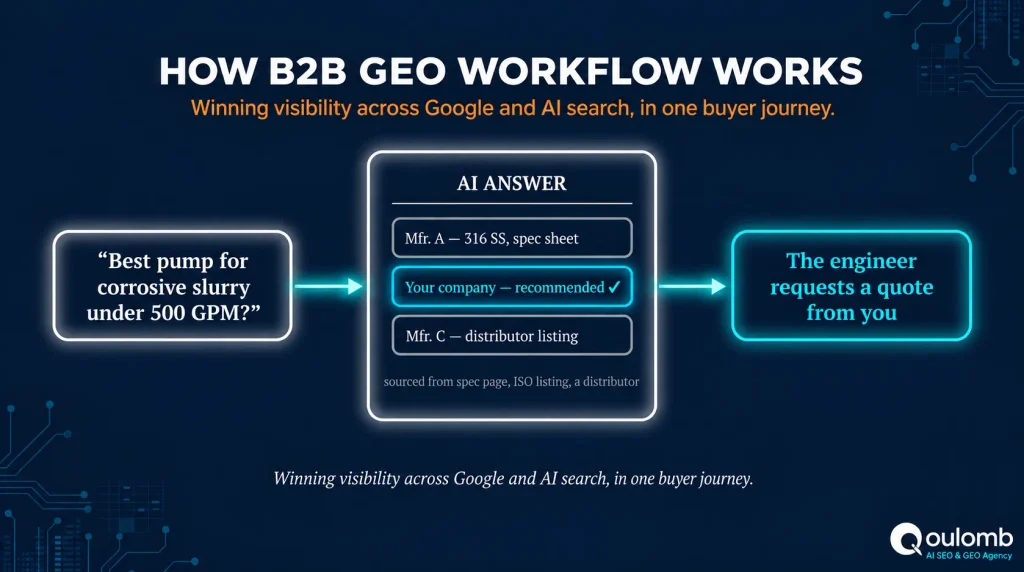
Picture a process engineer at a food-and-beverage plant. A pump on her corrosive slurry line keeps breaking down. Instead of going through ten manufacturer websites, she asks ChatGPT which pumps can handle corrosive slurry under 500 GPM. If your company isn’t in that answer, you never get the chance to quote the job.
This is already happening. Forrester’s 2025 Buyers’ Journey Survey found that 94% of business buyers used AI at some point while buying, up from 89% the year before.
Google is heading the same way. SparkToro found that 68% of US Google searches ended without a click in the first four months of 2026, up from 60% in 2024. More and more, buyers get their answer right on the page and never visit a website.
This means two things for you. First, Google and AI tools decide what to show in different ways. Knowing the differences between GEO and SEO explains why manufacturing GEO needs its own plan, separate from your regular SEO work.
Second, AI can only recommend what it can read, understand, and trust. Every step in this playbook is built around those three things, so AI visibility becomes ongoing work rather than something you do once.
Worked Example: A Pump Manufacturer Runs the Play
Here’s how a mid-size pump manufacturer might run through the playbook for the first time. The company is made up, but each step shows the kind of real change you should expect to make.
| Step | What they found | What they changed |
| 1. Audit | They asked 15 real buyer questions, like “best pump for corrosive slurry under 500 GPM,” in ChatGPT, Perplexity, and Google. They didn’t show up in 11 of them, and one answer mentioned a model they’d stopped making two years earlier. | Wrote down where they stood and flagged the wrong answer |
| 2. Extract | Their materials chart and size drawings were only available as PDF downloads. | Added the main spec tables to the product page as real text |
| 3. Specify | The homepage said their pumps were “engineered for demanding applications.” | Swapped it for the actual flow and pressure range, the materials used, and a dated ISO 9001:2015 certificate number |
| 4. Compare | They had a general “what we do” page, but nothing that answered a specific buying question. | Created a page answering “what pump handles corrosive slurry,” covering the materials and performance details buyers compare |
| 5. Corroborate | Their ThomasNet and GlobalSpec listings still showed an old product line and an old factory address. | Fixed both listings that same week |
| 6. Measure | Six weeks later, they asked the same 15 questions again. | They now showed up in 6 answers and were cited as a source in 4 more. The old model number was gone from every answer. |
The key takeaway: each step led to a clear, visible change. A table added to a page, a listing fixed, a question checked again. Nothing vague, and nothing that’s just “doing more AI marketing.”
When to Use This Playbook
This playbook is for you if any of these sound familiar:
- You sell to engineers, buyers, or procurement teams who research specs and use cases before they ever talk to sales.
- You rank well on Google, but when you ask ChatGPT or Perplexity the same buying question, a competitor gets named instead of you.
- Most of your spec sheets, technical documents, and certifications live in PDFs instead of on actual web pages.
- You’re planning next year’s marketing and want AI visibility in the plan from day one.
This playbook is for marketing and technical content that buyers use for research. It doesn’t cover safety documents, MSDS sheets, or compliance filings. Those should stay in the review and publishing process you already have.
What You Need Before You Start
Make sure you have these in place before moving on:
- Support from leadership: AI visibility should be tracked as a regular marketing number, right next to Google rankings, not checked once a year.
- A starting point: Know where you show up today in ChatGPT, Perplexity, and Google AI Overviews for the questions your buyers ask.
- One person who can edit the website: Someone with access to change page layouts and schema markup.
- A list of your most important pages: Your top product lines, top use cases, and the comparisons buyers make most often.
- A list of where your proof lives: Spec sheets, certifications, and case studies, with a note on whether each one is a PDF or a live web page.
- A technical reviewer: Usually an engineer or product manager who checks that every spec, tolerance, or certification is up to date before it goes live.
Don’t skip that last one. Manufacturing isn’t as heavily regulated as finance or healthcare. But if AI repeats a wrong tolerance or an expired certification, it can cost you a deal, not just make your marketing look bad.
Roles and Responsibilities
Decide who owns what before you begin.
| Role | What they’re responsible for |
| Marketing or content leader | Signing off on the plan, the priority pages, and what success looks like |
| Content lead or technical writer | Updating existing pages and writing new comparison and use-case pages |
| SEO or digital marketer | Adding schema markup and tracking both Google rankings and AI mentions |
| Engineer or product manager | Checking that specs, tolerances, and certifications are correct before anything goes live |
| Web or CMS admin | Making sure AI crawlers aren’t blocked and that spec tables show up as text, not images |
| Sales or applications engineering | Sharing the real questions buyers ask on calls and in RFQs |
Write a person’s name next to each role, not just a team name. Most manufacturers miss out on AI search for two simple reasons: spec tables stuck in PDFs, and directory listings nobody keeps up to date. Both happen when no one is clearly responsible.
How Qoulomb Runs This Playbook With Manufacturers
At Qoulomb, we follow these same six steps in our manufacturing GEO work with clients. Zetwerk, a global B2B manufacturing network, is a good example of how it works in real life.
When we started, Zetwerk was getting just 267 visits a month from AI tools, and only 6 AI answers mentioned the company as a source. Its website was in good shape, but competitors were showing up in three to five times more AI answers.
| Step | What we did for Zetwerk |
| 1. Audit | Listed the questions procurement and supply-chain buyers were asking, and checked where competitors were showing up instead |
| 2. Extract | Let AI crawlers access the site, and turned text inside images and screenshot tables into real text |
| 3. Specify | Swapped general claims for real numbers, like a 99.2% on-time delivery rate |
| 4. Compare | Rewrote more than 50 key pages so the answer comes first, and built 15 new pages around specific buyer questions |
| 5. Corroborate | Got Zetwerk mentioned in industry publications and on sites like G2, Capterra, and Crunchbase |
| 6. Measure | Checked AI answers regularly and updated content based on what was working |
Over nine months, AI visits grew from 267 to 6,187 a month. AI answers mentioning Zetwerk as a source went from 6 to more than 203, and around 1,200 of its keywords started appearing in Google AI Overviews.
Win Visibility on Google and AI Search
Discover how GEO helps manufacturers improve visibility across Google and AI search.
6 Steps to Manufacturing GEO: Win Visibility on Google and in AI Answers
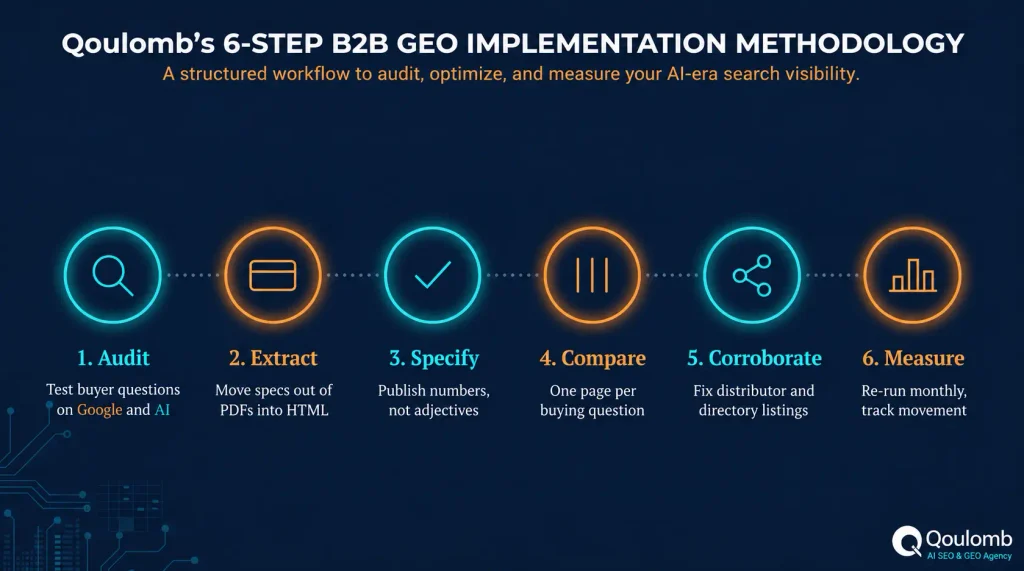
Go through these steps in order. Even if a later step feels more urgent, don’t skip ahead.
Step 1: Audit Your Current Visibility, on Google and in AI
Goal: Find out exactly where you stand today, both on Google and in AI answers.
What to do:
- Write down the questions your buyers and engineers actually ask, like which product fits a certain use, how specs compare, or whether you hold a certain certification. Don’t just use your product category names.
- Ask each question in ChatGPT, Perplexity, Google AI Overviews, and a regular Google search.
- For each answer, note three things: do you show up, does the AI recommend you or just list you, and is what it says about you still correct?
Use the words your buyers use, not your internal product names. And check for mistakes first. If AI is repeating an old certification or a model you no longer make, that hurts you more than not showing up at all.
You’re done when: you know where you stand for every important question, and any wrong answers are on a list to fix right away.
Step 2: Get Your Technical Content Out of PDFs and Into HTML
AI tools read the text on a web page. They usually can’t see what’s inside a PDF download or a table saved as an image. So even if your spec sheet has exactly what a buyer is looking for, AI may never find it. Google’s guidance on AI features says the same thing: important information should be on the page as text.
What to do:
- Find the spec sheets, drawings, and certifications that only exist as PDF downloads.
- Take the key details from your most important PDFs and add them to the right product or use-case page as real tables.
- Check that every spec table is actual text, not a picture of a table. AI can’t read words inside an image.
You can still keep the PDF as a download. It just shouldn’t be the only place the information lives.
You’re done when: you can highlight and copy the text in your main spec tables right on the page.
Step 3: Publish Numbers, Not Adjectives
Swap vague claims for the real number, tolerance, or dated certification that backs them up.
| Vague claim | Specific claim AI can use |
| “Engineered for demanding applications” | “Rated for continuous use up to 350°F” |
| “Quality you can trust” | “ISO 9001:2015 certified, certificate dated March 2026” |
| “Reliable delivery” | Your actual on-time delivery rate, and the time period it covers |
A phrase like “engineered for demanding applications” doesn’t give AI anything to quote or compare. A temperature rating or a dated certificate does. Those are facts AI can repeat and put side by side with a competitor’s page.
Research backs this up. The original GEO study from Princeton, Georgia Tech, the Allen Institute for AI, and IIT Delhi found that adding stats, quotes, and sources made pages up to 40% more visible in AI answers. Repeating keywords barely made a difference.
This is also the gap we see most often in our audits. The company really can do what it claims, but the number that proves it never made it onto the website.
You’re done when: every claim on your key pages is backed by a number, a tolerance, or a dated certificate.
Step 4: Build One Page Per Buying Question
What to do:
- Take the most important questions from your Step 1 audit and give each one its own page, instead of cramming them all into one general “what we do” page.
- Start each page with a clear answer in the first 40 to 60 words, using the same words your buyers use, before you get into company background.
- If buyers compare you with specific competitors, talk about it openly, including when you are and aren’t the best fit.
Why this matters: a page that tries to cover everything usually doesn’t answer any single question well enough for AI to quote it. A page focused on one question, answered fully, is much more likely to get picked up.
The words you use matter too. If your page uses internal product names, it may not match how an engineer actually types the question. A clear layout and a direct answer, the same things that help pages show up in ChatGPT answers, work here too.
You’re done when: each of your top buying questions has its own page, with a clear answer right at the top.
Step 5: Corroborate Your Claims Beyond Your Own Website
AI trusts a claim more when it hears it from more than one place. If your own homepage is the only place that says you’re ISO certified, that’s just you vouching for yourself.
But when a directory, a distributor, and a trade magazine all say the same thing, AI has outside proof to back it up. That’s often what moves you from simply being listed to actually being recommended.
What to check:
- Directories: ThomasNet, GlobalSpec, and any industry directories your buyers use
- Distributors and review sites: anywhere that lists or sells your products
- Consistency: your company name, address, product lines, and certifications should read the same everywhere
- Old information: any listing still showing a product you’ve stopped making, an old address, or an expired certification
- Press and features: articles from trade publications, industry groups, or standards bodies that mention you should be easy to find and link back to your site
You’re done when: every major listing matches your website, and nothing outdated is still showing.
Step 6: Re-Run the Same Questions and Track What Moves
What to do:
- Ask the same questions from Step 1 again on a set schedule. Once a month works well for most teams.
- Use the same AI tools and a regular Google search every time.
- For each question, note three things: did you show up, were you mentioned as a source, and were you the one actually recommended?
- Keep track of which competitor shows up instead of you. That name usually tells you where to focus next.
Why this matters: AI answers change a lot more than Google rankings do. SparkToro’s research found there’s less than a 1-in-100 chance of getting the same list of brands when you ask the same question twice.
So checking once doesn’t tell you much. Ask each question a few times, on the same schedule every month, and you’ll start to see a clear pattern you can act on.
Checking by hand is fine for your first round. As you grow, tracking AI brand mentions usually means combining regular question checks with AI traffic data from your analytics.
You’re done when: your monthly check is on the calendar, with the same questions, tools, and tracking columns every time.
Decision Points to Apply as You Go
You don’t need to read this table from start to finish. Come back to it when one of these situations comes up.
| If this happens | Then do this |
| An AI answer gets your spec, model number, or certification wrong | Treat it as urgent. Fix the page it came from, and loop in your technical reviewer the same day. |
| A competitor shows up in an AI answer and you don’t | Check if their page uses a real number where yours uses a vague phrase. That’s usually the reason. |
| You rank well on Google, but don’t show up in the AI answer for the same question | Look at how your page is laid out and how specific it is, not your ranking. Google and AI judge pages differently. |
| A distributor or directory listing doesn’t match your website | Fix it that week. When details don’t match, AI sees you as less reliable. |
| Your best technical proof is only in a sales deck or internal document | Put it on your website, with the real numbers, before you create new content on that topic. |
| Legal or IT wants to block AI crawlers by default | Make sure it’s a clear, written decision. Blocking these crawlers keeps you out of the AI answers buyers read. Blocking Googlebot also removes you from Google Search and AI Overviews. |
Handling Internal Pushback
Keep your answers short and simple, and bring the conversation back to the plan.
| If you hear this | Say this |
| “We already rank number one on Google.” | Google and AI decide what to show in different ways. You can be number one on Google and still not appear in the AI answer for the same question. |
| “Our engineers don’t have time to write content.” | They don’t need to write anything new. We just need the specs they already have in PDFs or spreadsheets, checked once and added to the website. |
| “AI keeps changing, so this will be outdated soon.” | The basics haven’t changed on any major AI platform so far: clear text, specific claims, and proof from other sites. What changes is which platform matters most. |
| “This sounds like more SEO busywork.” | It’s the same content we already have, just made easy for AI to read. Pages built this way usually do better on Google too, because both reward clear, specific answers. |
| “We can’t guarantee AI will ever recommend us.” | That’s true, and nobody honest can promise it. What we can do is track how often we show up and how we’re described, every month, and keep improving. |
Templates and Checklists You Can Use Directly
Buyer Question Audit List
- What’s the best [product type] for [specific use or condition]?
- Is [your company name] ISO 9001 (or the relevant standard) certified, and is the certification still valid?
- How does [your product] compare to [competitor name] on [the spec buyers care about most]?
- Which trusted manufacturers make [product type] for [industry or region]?
Technical Content Checklist
- Main specs and dimensions are on the page as real text or tables, not only in a PDF
- No spec table is an image or a scanned document
- Every important page answers its main question in the first 40 to 60 words
- Certifications and tolerances include real details and dates, not general claims
Directory and Outside Proof Checklist
- ThomasNet, GlobalSpec, and other relevant directories show your current products, address, and certifications
- Your company name, address, and product descriptions match across every listing
- Any article or feature from a trade publication or industry group is easy to find and links back to your site
- AI crawlers aren’t blocked unless there’s a clear, written reason
Is This Working for You? A Quick Self-Assessment
Before you go beyond your first round, take a minute to answer these honestly.
| Question | Yes / No |
| Does your company show up when buyers ask AI about your product type or use case? | |
| Are your specs and certifications up to date, specific, and on the page as text? | |
| Do your directory and distributor listings match your website? | |
| Do you know which competitor shows up instead of you, and why? | |
| Do you ask the same buyer questions again every month? |
If you answered no to several of these, go back to Step 1 and Step 2. Everything else depends on knowing where you stand today and having content that AI can actually read.
From Mentioned to Recommended: What This Is Actually For
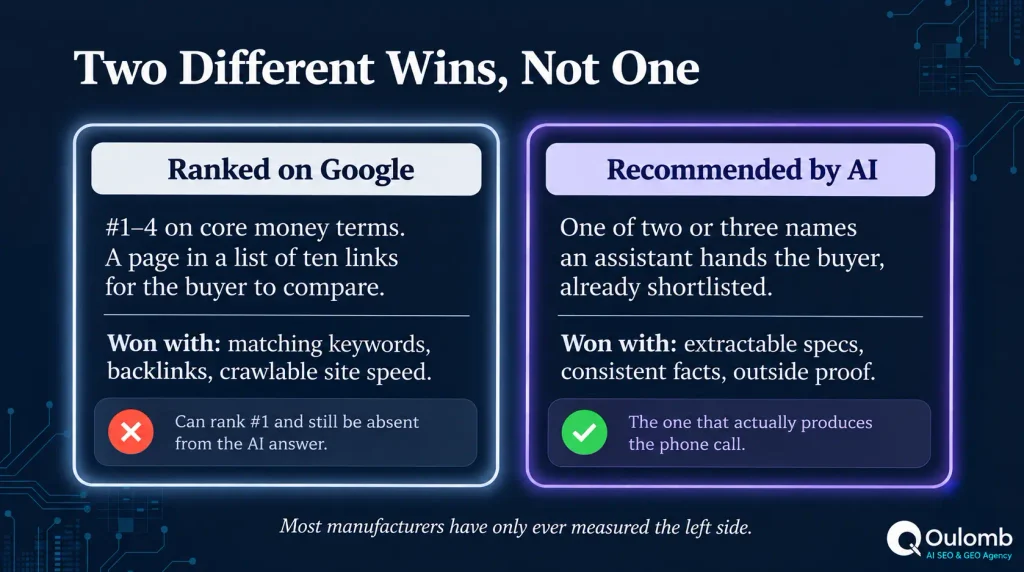
Showing up in an AI answer and being the company AI recommends are two very different things. Most of the work in this playbook is about closing that gap. You can be one of several sources AI mentions and still lose the recommendation to a competitor whose page is clearer and better backed up.
It helps to track this in three stages instead of one overall score. First, do you show up at all? Next, are you mentioned as a source? And finally, are you the company the AI tells the buyer to contact?
If a page gets mentioned often but never gets recommended, it isn’t a win yet. That usually means the page needs more specific details or more proof from other sites, not more visibility.
What to Measure
Check these on a set schedule so you can clearly compare one month with the next.
| What to track | How often | Where to find it |
| Whether you show up, and whether the details are correct | Monthly | Checking ChatGPT, Perplexity, and Google AI Overviews by hand |
| Which competitor shows up instead of you | Monthly | The same checks, noting competitors by name |
| Google rankings for the same buying questions | Monthly | Your SEO tool or Google Search Console, which also includes traffic from AI Overviews and AI Mode |
| Whether your directory listings match | Every 3 months | Checking ThomasNet, GlobalSpec, and other directories by hand |
| Searches for your brand name and direct visits | Monthly | Your analytics, as a rough sign of awareness that AI may be driving |
| RFQs or leads that mention an AI tool | Ongoing | A “how did you hear about us?” field on your forms, plus a quick question on the first sales call |
A Realistic Timeline
| Timeframe | What to focus on |
| Days 1 to 30 | Get the basics in place, assign roles, run your audit, and list your most important buying questions |
| Days 31 to 60 | Move specs out of PDFs, swap vague claims for real numbers, and build your first comparison and use-case pages |
| Days 61 to 90 | Fix your directory and distributor listings, then run the audit again and compare it with where you started |
| Ongoing | Ask the same questions every month, move on to the next set of important pages, and use what worked to plan your next round |
What Usually Goes Wrong
- Specs stay locked in PDFs –
Putting them on a web page feels like doing the same work twice.
Fix: Add the key details to the page as text, and keep the PDF as a download too.
- A spec or certification changes, but not everywhere –
Old details keep showing up in AI answers.
Fix: Make one person responsible for checking accuracy regularly, not just once.
- The team does one audit and stops –
Results slowly fade over the next few months.
Fix: Put the monthly check on the calendar before your first round ends.
- Vague wording stays because it feels safer –
Sharing real numbers can feel risky.
Fix: Share them anyway. Specific claims are what AI quotes, and buyers trust them more too.
- Directory and distributor listings get forgotten –
Nobody owns them.
Fix: Give someone the job, just like content and technical review each have an owner.
- AI crawlers get blocked by default –
IT or security blocks them without anyone thinking through the cost.
Fix: Make it a clear, written decision instead of an automatic setting.
Build a stronger organic growth engine
Turn search visibility into qualified B2B traffic and pipeline with a strategy built around your business goals.
Book a CallQoulomb helped us show up in AI search answers, not just Google. They spotted early that our landing pages were the problem and fixed them with us.

Jose Russo Pons
Head of Growth Marketing, GAIN
Closing Note
Done well, this playbook turns AI visibility from a one-time project into a regular habit that sits alongside your SEO work. The cycle stays the same every time: audit, extract, specify, compare, corroborate, measure, and repeat. Each round teaches you more about how your buyers search.
You don’t need a new team or a bigger budget to get started. You just need the technical content you already have on your website where AI can read it, written clearly enough to be checked, and backed up by more than your own site.
If you’d rather have someone look at this for you, Qoulomb’s AI visibility audit shows where your company stands across the major AI tools for the questions your buyers ask. It also shows which of the six steps would make the biggest difference for your products.