

Think about the last time your company bought new software. Did anyone call the seller first? Probably not. Someone searched on Google, read a few websites, maybe asked ChatGPT, and made a shortlist. The sales call came much later. And that’s exactly why enterprise SaaS SEO matters.
Big companies buy software the same way, just with a lot more people involved. Forrester’s 2026 research found that a typical purchase involves 13 people inside the company and nine from outside it. Every one of them is reading, comparing, and asking questions long before they ever talk to you.
Enterprise SaaS SEO simply means making sure your website shows up and gives the right answers when each of these people goes looking. So how do you reach all of them when you’re not even in the room? Below are seven strategies that help, plus a simple way to show results before the deal even closes.
TL;DR
Key takeawaysEnterprise SaaS SEO wins a committee’s decision over many months, so one click matters less than you’d think.
Most enterprise deals stall at least once, and buyers go back to research every time they do.
The seven plays cover veto pages, champion content, product questions, open docs, site scale, consistent facts, and returning buyers.
Measure accounts, branded searches, pipeline, and deal speed, because traffic alone won’t convince your CFO.
Google says AI Overviews need no special tricks, so AI tools repeat clear, consistent facts.
What Makes Enterprise SaaS SEO Different From Regular SaaS SEO?
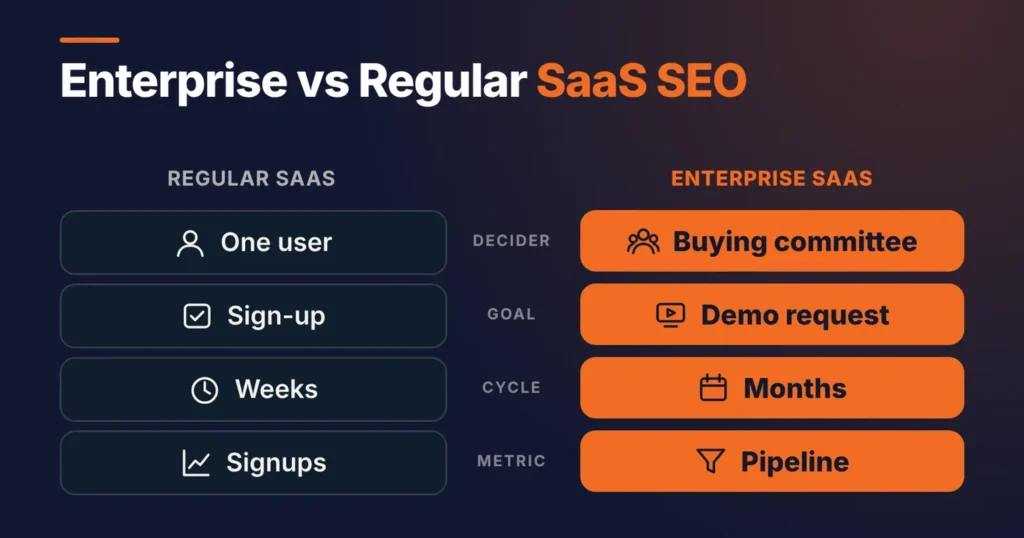
Most SaaS SEO advice assumes one buyer who finds you, tries the product, and signs up. Enterprise SaaS SEO works differently because a group of people decides over several months.
Here’s how the two compare:
| Factor | Regular SaaS SEO | Enterprise SaaS SEO |
|---|---|---|
| Who decides | One user | A buying committee |
| Main goal | Free trial or sign-up | Demo request or sales opportunity |
| Sales cycle | Days or weeks | Many months |
| Main hurdle | Price | Security and procurement approval |
| Key pages | Features and pricing | Use cases, docs, trust, and ROI pages |
| Success metric | Signups and trials | Pipeline and revenue |
The biggest shift is in measurement. Signups are easy to count, but enterprise deals build slowly across many visits and people. That’s why enterprise SEO for SaaS focuses on pipeline rather than traffic.
Also, every enterprise buying committee mixes different roles, such as finance, security, IT, and end users. Each group has its own questions, so your content needs to answer all of them.
Your Enterprise SaaS SEO Needs a Smarter Strategy
Build an SEO strategy that reaches buying committees, answers complex buyer questions, and drives measurable pipeline growth.
What Happens Between the First Search and the Signed Contract?
Enterprise deals rarely move in a straight line. In fact, Forrester found that 86% of B2B purchases stall at some point during the buying process.
Every pause sends buyers back to research. They compare vendors, check reviews, and look for answers to new questions from finance or IT. So the shortlist often gets written on search results and AI answers, long before your sales team gets a call.
Here’s roughly how that plays out across a typical enterprise deal:
| Phase | What buyers search | Pages you need |
|---|---|---|
| Problem framing / Shortlisting / Validation and trials / Business case / Security and procurement (no months) | “How to reduce [problem]” | Problem and point-of-view pages |
| Shortlisting (months 2–5) | “Best [category] for enterprise” | Category, comparison, and use-case pages |
| Validation (months 5–7) | Docs, integrations, reviews | Docs, integration, and proof pages |
| Business case (months 7–9) | ROI, rollout time, total cost | Business-case and rollout pages |
| Security and procurement (months 9–10+) | “[Brand] SOC 2”, “[Brand] SSO” | Trust center and compliance pages |
So SEO for long sales cycles is mostly about timing. When the committee goes looking, the right page either exists or it doesn’t.
Which 7 Strategies Win Enterprise SaaS SEO for Complex Products?
The seven strategies below cover every key buyer and stage of an enterprise deal. Together, they make a complete B2B SaaS SEO strategy.
1. Write for the People Who Can Veto the Deal
Most SEO plans are written for the champion, the person who already likes your product. But deals rarely die with the champion. Instead, they die in security, legal, or procurement review. In fact, Forrester found procurement is a decision-maker in 53% of buying cycles.
These people search too, and every enterprise buying committee has at least one. A security lead might type “[your brand] SSO” late on a Friday. If Google shows nothing useful, they won’t email your rep. They’ll write “unclear” in a spreadsheet and move on.
So give the blockers public pages they can find on their own:
- A trust center with certifications and audit details
- SSO, SCIM, and access control pages
- Data residency and privacy pages
- Accessibility and compliance pages
Keep them ungated. In enterprise SaaS SEO, the people who can say no deserve pages as good as the ones who say yes.
2. Give Your Champion Content They Can Forward
Your champion has to sell you internally, usually in meetings you’ll never attend. That’s how buyers increasingly prefer it. Gartner found that 61% of B2B buyers want a rep-free buying experience.
So hand them material worth forwarding. Think about what lands well in a CFO’s inbox:
- “How to build a business case for [category]”
- ROI explainers with honest, visible assumptions
- Rollout timelines by company size
- Straight answers to common finance objections
A page titled “How long does a [category] rollout take?” won’t win a huge search volume. Still, it answers the first question most CFOs ask. It also ranks for exactly the people who are close to buying. In enterprise SaaS SEO, that’s a trade worth making.
3. Break the Complex Product Into the Questions Buyers Ask
Nobody searches for your feature names. Instead, buyers search for their problem, their industry, and the tools they already use.
So translate the product into the jobs it does. Sales call notes and support tickets help here, because they show the exact words buyers use. Usually, those words look nothing like your product team’s vocabulary. This is where enterprise SaaS SEO starts to feel like product marketing.
Then build pages around three angles: use case, industry, and integration. For example, “[product] for healthcare” and “[product] with Salesforce” are real enterprise searches with real intent.
One warning, though. If you scale these pages, each one needs unique details or examples. Otherwise, you end up with hundreds of near-identical pages that never rank. Vague product pages are also a common reason brands go missing from ChatGPT answers.
4. Turn Docs, API References, and Changelogs Into Ranking Assets
Technical evaluators read your docs long before they talk to sales. For instance, an IT architect checking “[product] API rate limits” wants a precise answer, not a demo button.
Yet plenty of SaaS companies lock docs behind a login or bury them on a hard-to-crawl subdomain. As a result, the most detailed content about the product never shows up in search.
So open them up. Keep public docs indexable and well-structured, and link them to the matching product and use-case pages. Also, don’t ignore the changelog. A live “what’s new” page quietly tells cautious buyers that the product isn’t standing still. Handled well, docs become one of the hardest-working assets in enterprise SaaS SEO.
5. Make the Site Scale-Ready Before You Publish More
Enterprise SaaS sites sprawl. Product pages, docs, regional versions, and years-old campaign pages pile up fast. Soon, technical debt starts capping growth.
For context, Google’s crawl budget guide is written for sites with over a million pages. It also covers sites with 10,000+ pages that change daily. Many SaaS sites clear that bar once you count docs and localized pages.
So start with the unglamorous fixes:
- Redirect chains and duplicate docs versions
- JavaScript pages that crawlers can’t render
- Hreflang errors on regional sites
- Stale sitemaps and failing Core Web Vitals
Then fix the process behind them. Get SEO tickets into the engineering sprint, and agree on review times with legal and product. Honestly, in enterprise SaaS SEO, a slow approval chain often costs more than any technical bug.
6. Keep Your Facts Identical Everywhere Buyers and AI Look
Here’s a common trust gap: your website says one thing, and your sales rep says another. In the same Gartner survey, 69% of buyers reported exactly that kind of inconsistency.
AI search raises the stakes. If one page says “SOC 2 Type I” and another says “Type II”, an AI answer could quote either. The same goes for pricing logic and integration lists.
The fix is simple, though it takes discipline. Keep one source of truth for key facts, then update every page, profile, and doc from it.
You don’t need special tricks for AI, either. Google says AI Overviews need no special optimization beyond pages it can index and show in search.
That’s really the heart of AI SEO, making your facts easy for AI tools to find, trust, and repeat.
7. Plan for the Buyer Who Goes Quiet and Comes Back
Long deals go quiet. Budgets freeze, priorities shift, and a hot account vanishes for six weeks. Then it returns, usually through a branded search like “[brand] pricing” or “[brand] vs [competitor]”.
Those results are yours to own. So keep pricing, comparison, and review pages accurate, and refresh comparisons on a schedule. Returning buyers spot stale claims fast.
This matters because a returning buyer is usually close to a decision.
It’s also worth checking what AI tools say about you. A quick ChatGPT brand audit shows whether a returning buyer gets today’s facts or last year’s.
How Do You Prove SEO’s Value When Deals Close 10 Months Later?
No CFO will accept a traffic chart as proof when deals take ten months. So track signals that move at different speeds:
| Signal | What to Track | When It Moves |
|---|---|---|
| Visibility | Committee-query rankings, AI citations | Months 1–3 |
| Account Engagement | Target accounts on organic pages, branded searches | Months 3–6 |
| Pipeline | Organic-sourced and influenced opportunities | Months 6–12 |
| Deal Speed | Cycle length and win rate for SEO-touched deals | 12+ months |
To connect the dots, add a “How did you hear about us?” field to demo forms. Then match those answers against CRM data. It’s simple, but it often surfaces search influence that click tracking misses. You can also track brand mentions in AI answers, since many buyers never click at all.
Another tip: ask sales which pages they send most often. Those pages already shape deals, so they deserve SEO attention first.
Finally, agree on these signals with sales and finance before you start. Otherwise, someone will judge enterprise SaaS SEO on traffic alone six months in.
How Should You Plan a 12-Month Enterprise SaaS SEO Roadmap?
A ten-month sales cycle needs at least a twelve-month roadmap. Here’s a realistic order of work:
- Q1: technical foundations, trust and veto pages, and tracking
- Q2: committee, use-case, and comparison pages
- Q3: champion content, proof assets, and AI visibility
- Q4: refreshes, stronger branded results, and scaling what works
The order is deliberate. Veto and technical pages come first, because they unblock deals already in your pipeline. After that, each quarter builds on the last. That’s how a B2B SaaS SEO strategy should run on a long cycle.
Also, budget for upkeep. Trust pages, comparisons, and docs drift out of date surprisingly fast.
So who should run it? An in-house team works well when you already have SEO, content, and engineering capacity. If you don’t, an agency can fill the gap faster.
Either way, the partner matters more than the model. Before you sign anyone, know which questions to ask when you choose an SEO agency.
Build a stronger organic growth engine
Turn search visibility into qualified B2B traffic and pipeline with a strategy built around your business goals.
Book a CallQoulomb helped us show up in AI search answers, not just Google. They spotted early that our landing pages were the problem and fixed them with us.

Jose Russo Pons
Head of Growth Marketing, GAIN
Conclusion
Think back to that software purchase at your own company. Nobody waited for a sales call before forming an opinion. Your buyers don’t either.
That’s what enterprise SaaS SEO really comes down to. When the CFO, the security lead, or an end user goes looking, they should find clear answers on your site.
You don’t need all seven strategies running this quarter. Start with the pages that can quietly block a deal, like security, compliance, and pricing. Then agree with leadership on how progress gets measured, so SEO is judged on pipeline, not page views.
Once those two pieces are in place, the rest becomes steady, repeatable work.
Not sure where your site stands right now? Talk to Qoulomb, and we’ll look at it the way your buyers do.
FAQs
1. What is enterprise SaaS SEO?
Enterprise SaaS SEO is search optimization for SaaS companies that sell complex products to large organizations. Instead of single users, it targets whole buying committees. It also covers technical scale, security content, and AI search, and teams judge it by pipeline rather than traffic.
2. How is enterprise SaaS SEO different from SEO for smaller SaaS companies?
Smaller SaaS SEO mostly drives signups from individual users. By contrast, enterprise SEO for SaaS serves committees, long cycles, and much bigger sites. So it needs pages for security, procurement, and finance reviewers, plus close teamwork with engineering, legal, and sales.
3. How long does enterprise SaaS SEO take to influence the pipeline?
Early visibility gains often show up within three to six months. However, pipeline impact usually takes six to twelve months, because the deals themselves run close to a year. AI citations can appear sooner, so it helps to know realistic AI search timelines.
4. How do you attribute pipeline to SEO when sales cycles are long?
Combine CRM data, self-reported attribution, and account-level tracking. For example, add a “How did you hear about us?” field to demo forms. Then compare cycle length and win rates for deals that touched SEO pages against deals that didn’t. Over a few quarters, the pattern becomes clear.
5. Should security and compliance pages be public or gated?
Public, in most cases. Security and procurement teams look for this information during evaluation, and a gate slows them down. Often, they’ll simply favor a vendor that answers openly. So keep summaries public, and share detailed audit reports on request.
6. How does enterprise SaaS SEO affect visibility in ChatGPT and AI Overviews?
Strong SEO supports AI search visibility directly. Google says AI Overviews need no special optimization beyond indexable, snippet-eligible pages. Beyond that, consistent facts, clear answers, and third-party mentions help brands get recommended by AI engines like ChatGPT and Perplexity.