

Your CEO forwards a screenshot. Someone asked ChatGPT for the top vendors in your category, and your competitors came up. Your brand didn’t. The note underneath is short: “What would it take to fix this, and what will it cost?”
It’s a fair question with an awkward answer. Generative engine optimization cost can mean a tracking tool you run yourself or a managed program that does everything for you. The 2 sit thousands of dollars apart, and both get called “GEO.”
What you’re really pricing is the work behind the visibility. That covers tracking, content, technical fixes, off-site mentions and reporting, plus your own team’s time.
This guide shows what each part costs, what moves the number up or down and what you get at each budget level. You’ll also see how to build a budget and line up quotes so you can compare them fairly.
TL;DR
Key takeawaysA tool you run yourself starts near $30 a month in HubSpot’s guide, while a fully managed program can pass $15,000.
Tracking tools are priced by how many prompts you track and how many AI engines they cover.
Your budget should count internal time for reviews and fixes as well as tools and agency fees.
Line quotes up on the same units, from engines and prompts to pages and reports, before you compare totals.
How Much Does Generative Engine Optimization Cost?
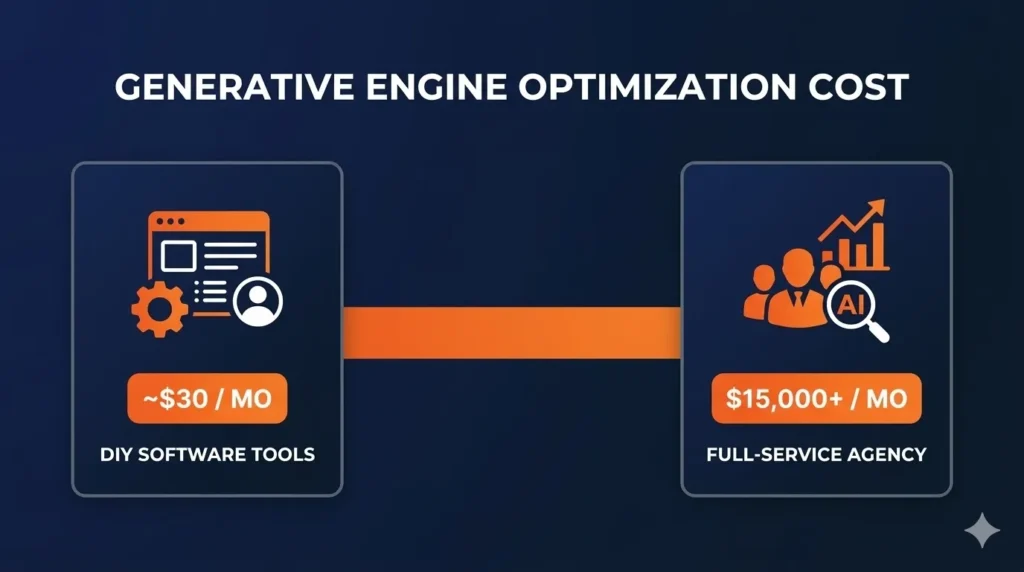
Generative engine optimization cost starts around $30 a month and can pass $15,000 a month, based on HubSpot’s How much does AEO cost? guide. This section explains what sits at each end of that spread.
At the bottom you’re paying for software and doing the work yourself. At the top, an agency runs it all. HubSpot calls this AEO. The work it prices, from tracking to content and off-site authority in AI answers, is what this guide calls GEO.
Where Does a GEO Budget Go?
A GEO budget pays for the work that gets your brand tracked and cited by AI tools. The list below covers HubSpot’s main cost drivers, plus the staff time it counts for software-led setups:
- AI visibility tracking: a tool that checks how AI engines answer your buyers’ prompts, priced by prompts and engines covered.
- Content work: reworking existing pages or writing new, buyer-specific content, which costs more as page counts grow.
- Schema and entity work: markup on your pages, plus matching company details on LinkedIn, Crunchbase and the review sites you’re listed on.
- Off-site authority building: getting your brand named in industry press, on review platforms and in Reddit threads. HubSpot says this line varies more than any other between small and large budgets.
- Reporting: anything from a basic visibility dashboard to competitor benchmarking and citation analysis.
- Your team’s time: the internal staff hours HubSpot adds to a software-led setup, where your own people run the content and technical work.
That last line never shows up on an invoice, yet it’s part of your generative engine optimization cost. Give it a row in your budget from day one.
Allocate Your GEO Budget Where It Counts
Stop paying for disconnected tools and wasted internal hours. Get a transparent, managed scope built around AI citations and real pipeline.
GEO Pricing by Delivery Model
Your delivery model decides who does the work, and that shapes your generative engine optimization cost. There are 4 ways to buy it: tools you run yourself, an in-house hire, an agency or a mix of these.
DIY Tools and Software
The cheapest route is a tracking tool your own team operates. If you’re still choosing one, compare tools to track brand mentions by the prompts and engines each plan covers.
| Tool plan | Monthly price | What the plan includes |
|---|---|---|
| Peec AI Starter | $95 | 50 prompts, 3 models, daily tracking |
| Peec AI Pro | $245 | 150 prompts, 3 models, daily tracking |
| Peec AI Advanced | $495 | 350 prompts, 3 models, multi-country |
| Semrush Starter SEO + AI Search | $199 | 50 AI prompts tracked daily, 1 domain for AI brand performance |
| Semrush Pro+ SEO + AI Search | $299 | 100 AI prompts tracked daily |
These are the monthly-billed rates on each vendor’s pricing page. Semrush also bundles its SEO toolkit into these plans, so you’re buying more than AI tracking.
Keep in mind what the software doesn’t do. As HubSpot puts it, these tools mostly measure and report. They won’t write or publish a page for you, so the fixes still need people.
In-House Team
An in-house setup adds salaries to your generative engine optimization cost, on top of tools. For a salary benchmark, O*NET’s Search Marketing Strategists profile shows a 2025 median wage of $78,760 a year, based on BLS data. That’s before any software.
The figure covers the wider group of market research analysts and marketing specialists that the role falls under. Use it as a rough guide, not a quote.
Also, check whether one hire can cover every cost line listed earlier. Map who will handle content, technical fixes and outreach before you decide one person is enough.
Agency or Managed Service
With an agency, you pay a monthly retainer and someone else does the work. In HubSpot’s description, that one recurring fee covers content, technical and schema fixes, outreach for off-site mentions and citation tracking.
However, ask about the term before you sign. HubSpot notes that some agencies want you to commit for at least 3 months. Before any sales call, it also helps to compare AI SEO agency costs by company size and pricing model.
Hybrid Setups
A hybrid model mixes the options above. HubSpot gives a few examples:
- A one-off audit that turns into an ongoing retainer.
- A performance guarantee built into a retainer.
- Software run by an outside operator at first, then handed to your own staff.
If you go hybrid, write down which parts you plan to take back in-house, so the contract allows for it.
What Drives Generative Engine Optimization Cost?
Scope sets the price, as HubSpot puts it: the more of the work you buy, the higher the quote. The 5 factors below shape that scope, with what to check for each before you ask for a price.
- Your technical foundation: Google’s AI features and your website guide lists SEO basics such as allowing crawling. It also asks that structured data match the visible text on the page. If your site has gaps there, ask whether a quote includes fixing them first.
- Page types and volume: HubSpot points out that tuning a few pages you already have is much cheaper. Writing lots of new content for specific buyers costs more.
- Platforms × prompts: Peec AI counts monthly AI answers by multiplying tracked prompts by active models and tracking frequency. Its Starter plan works out to 4,500 answers a month, so every added engine or prompt grows the data you pay for.
- Attribution and reporting: Google includes AI Overviews and AI Mode traffic in the overall Search Console numbers, within the “Web” search type. If you want AI traffic tied to leads, budget for the extra setup to separate it.
- Timeline: content and off-site work build slowly, as HubSpot points out. If your deadline is short, agree on a smaller scope that fits it before work starts.
What Does Each GEO Budget Level Buy?
Each budget level buys a different share of the generative engine optimization work. HubSpot groups AEO spend into 3 rough tiers, and the table shows what each one includes.
| Budget level | Monthly spend (HubSpot) | What you get | Best for (HubSpot) |
|---|---|---|---|
| Lean | About $30, rising to a few hundred | Tracking software, occasionally plus a one-off audit | Pilots, small teams and solo marketers |
| Mid-range | Roughly $1,500 to $5,000 | A smaller retainer that adds modest content, schema work and monthly reporting to monitoring | Teams with some in-house content capacity that want execution help |
| High-investment | Roughly $10,000 to $15,000+ | A full managed program: strategy, high-volume content, off-site authority, technical work and pipeline reporting | Larger teams that see AEO as a core channel, and teams without in-house resources |
At the lean level, HubSpot says your team executes every fix, while the tool supplies recommendations, visibility tracking and share-of-voice data. Each step up pays someone else to take on more of the content, off-site and reporting work.
How to Build a GEO Budget
Building a GEO budget starts with deciding who does the work. This section covers 3 ways to split your generative engine optimization cost, then a budget checklist and a way to phase spend.
Software-Only Budget
You pay for tools, and your team acts on what they show. This model has the lowest vendor bill, but your team still handles content, schema and off-site work, as HubSpot notes.
So budget for the software and the hours behind it. A tool that flags a missing citation doesn’t fix the page that lost it.
Service With Software Included
One provider runs the tracking and the work, and you pay a single invoice.
Ask whether you keep access to the tracking data if the contract ends. Otherwise, your history leaves with the provider.
Service Plus Separate Software
You pay a provider and license your own tool. Consider it if you already use a tracking platform or need several people inside the reports.
You’re paying for both, so the total goes up. Check that the provider will work from your tool rather than adding a second one.
What Should a GEO Budget Include?
A full GEO budget covers every cost line, including the ones that never reach an invoice. Use this table as a starting checklist.
| Budget category | What it covers | Question to answer before you sign |
|---|---|---|
| AI visibility tracking | Prompts, engines and tracking frequency | How many prompts, on which engines? |
| Content optimization | Reworked and new pages | How many pages a month? |
| Technical and schema work | Crawling, structured data, entity details | Who ships the fixes on your site? |
| Off-site authority | Reviews, press and community mentions | Is this in scope or billed separately? |
| Reporting | Dashboards, benchmarks, AI traffic tied to leads | Will you get raw data or only a score? |
| Internal team time | Approvals, expert reviews, developer hours | How many hours a month can your team give? |
If a row has no owner, the budget isn’t finished. Someone on your side or the provider’s has to take each one.
How to Phase GEO Spend
Phase GEO spend by starting with a small pilot and scaling up only once it shows movement. HubSpot suggests keeping a pilot to 60 to 90 days. If leadership wants a firmer date, it’s worth reading how long AI SEO takes first. Then work through these steps:
1. Set a baseline: pick the buyer questions closest to a purchase and check them on the AI tools your buyers use. A ChatGPT brand audit is a simple way to see where you stand.
2. Fix the cheap gaps: begin with pages that rank on Google yet never get cited, then clean up basic schema and entity details.
3. Hold the expensive work: save large content batches and outreach for the bigger program.
4. Review at day 60 and day 90: look at the trend line, because the same prompt can get a different AI answer each time.
How to Compare GEO Quotes
To compare GEO quotes fairly, put them on the same units. Ask every provider the same questions, so the totals line up:
- Engines covered: which AI platforms they test, by name.
- Prompt count: how many prompts they track, and who picks them.
- Pages: how many pages they’ll produce or rework each month.
- Technical scope: what schema and entity work is included.
- Off-site scope: whether review, press or community outreach is part of the fee.
- Reporting: raw data you can check, meaning each prompt, the engine it ran on and the sources cited, as HubSpot recommends.
- Tools: whether tracking software is bundled or billed to you separately.
- Term: the minimum contract length and the notice period.
A quote that lists deliverables is easier to check. One that just promises “full optimization” isn’t. If 2 quotes still look alike, ask each provider for a sample report. That shows you what you’ll actually receive each month.
How Qoulomb Approaches GEO Pricing
At Qoulomb, our GEO pricing sits at $2K–$10K/month. Where you land in that range depends on the scope your brand needs.
The first step is an AI visibility audit of the gaps AI tools can’t see yet. It shows the word-for-word answers AI gives your buyers on several platforms, along with the prompts behind every number. It also separates a content problem from an attribution problem, so you fix the right thing.
From there, our AI SEO and GEO work moves through 3 more stages. First, we show AI tools what sets you apart. Next, we build recognition for your brand across AI search, and finally we turn that visibility into growth you can measure. More than 200 B2B brands trust Qoulomb across tech, SaaS, fintech and manufacturing.
Build a stronger organic growth engine
Turn search visibility into qualified B2B traffic and pipeline with a strategy built around your business goals.
Book a CallQoulomb helped us show up in AI search answers, not just Google. They spotted early that our landing pages were the problem and fixed them with us.

Jose Russo Pons
Head of Growth Marketing, GAIN
Conclusion
Generative engine optimization cost isn’t really one number. It’s a split between tools, people and off-site work, and the last one varies most. Once you see a quote in those 3 parts, the gaps between providers stop being a mystery.
Start with a baseline of your top buyer prompts. Then fix the cheap gaps and let a short pilot prove itself before the budget grows. When quotes come in, judge them on the scope behind the fee rather than the fee itself.
That baseline is where we start at Qoulomb. We run GEO alongside SEO and content as one program, priced on the scope you actually need. If you’d like a fresh pair of eyes on a GEO quote or budget, feel free to talk to Qoulomb.
FAQs
1. What is GEO?
GEO, or generative engine optimization, is the work of getting your brand found and cited in AI answers. That includes ChatGPT, Gemini, Perplexity and Google’s AI Overviews. It builds on SEO basics and adds prompt tracking, entity work and off-site mentions.
2. Is it more cost-effective to run GEO in-house or with an agency?
It depends on your scope. BLS data puts the median wage for the group covering search marketing strategists at $78,760 a year, before tools. HubSpot places mid-range retainers at roughly $1,500 to $5,000 a month, so compare both against your workload.
3. How much does GEO cost for multi-location businesses?
Expect tracking costs to rise if each market needs its own prompts and pages. Semrush’s Pro+ SEO + AI Search plan, built for multiple markets, locations or websites, costs $299 a month. Peec AI’s multi-country Advanced plan costs $495 a month.
4. Does GEO cost vary by industry?
Not in any neutral source we found. HubSpot ties cost to scope instead: content, schema, off-site work, monitoring and reporting. Standard self-serve tracking tools run about $29 to $489 a month in its guide, metered by prompts and engines.
5. Is GEO cheaper than SEO?
No. HubSpot treats AEO as spend that works alongside SEO, not instead of it. It also warns that cutting SEO to fund it can weaken the rankings behind AI citations. Semrush charges $139 a month for SEO and $199 for SEO + AI Search.
6. Can we start with tools and add an agency later?
Yes, and it’s a sensible way to test GEO before committing. On its own, HubSpot AEO runs $50 a month, and its 28-day free trial covers 25 prompts. Once a pilot shows movement, you can add agency support for content and off-site work.
7. How long before GEO spend shows results?
Expect early signals within 60 to 90 days, based on HubSpot’s guidance on AEO pilots. That covers visibility and share of voice. Content and outreach build more slowly, so track the trend over several months rather than one snapshot.