

Right now, someone could be asking ChatGPT or Gemini a question that directly relates to your business:
“Which company is the best for this?”
Within seconds, the AI gives them an answer. It may recommend your brand. Or it may recommend your competitor instead.
The surprising part? Most businesses have absolutely no idea which one is happening.
There’s no notification when an AI mentions your brand. No alert when a competitor gets recommended instead of you.
AI search is already changing how customers discover brands, but many marketing teams are still focused only on traditional search rankings. So, how do you actually find out what ChatGPT and Gemini are saying about your brand?
In this guide, we’ll explore the best tools to track brand mentions in ChatGPT and Gemini, what these tools actually measure, and how you can check your AI visibility for free before spending money on any software.
- TL;DR
- ChatGPT and Gemini are already answering questions about your industry every day, and most brands have no idea what they're saying about them.
- The right tools to track brand mentions in ChatGPT show exactly when, where, and how often your brand shows up inside those AI-generated answers.
- A free ai visibility checker works fine for a one-off audit, but ongoing monitoring across multiple engines usually needs a paid ai visibility tool built for it.
- ChatGPT and Gemini often disagree about who leads a category, and knowing why changes how you respond to each engine separately.
What Is an AI Brand Monitoring Tool?
Before comparing platforms, it helps to understand what an AI brand monitoring tool actually does and how it differs from traditional SEO tools.
An AI brand monitoring tool tracks how often your brand appears when people ask questions on ChatGPT, Gemini, and other AI engines. Unlike SEO tools that track Google rankings or social listening tools that monitor platforms like Reddit or X, an ai visibility tool checks whether your brand gets mentioned, cited, or completely missed in AI-generated answers.
For example, instead of checking where you rank for “payroll software,” it might ask, “what’s the best payroll software for a 200-person company,” and track whether your brand appears alongside competitors.
This matters because AI answers can change over time. That’s why auditing a site for AI search readiness before investing heavily in tracking can be useful. Regular monitoring helps you see whether your AI visibility is improving or slowly falling behind competitors.
Most brands don't know how visible they are in AI search
Get a clear view of your AI search presence and competitor gaps.
Best Tools to Track Brand Mentions in ChatGPT and Gemini
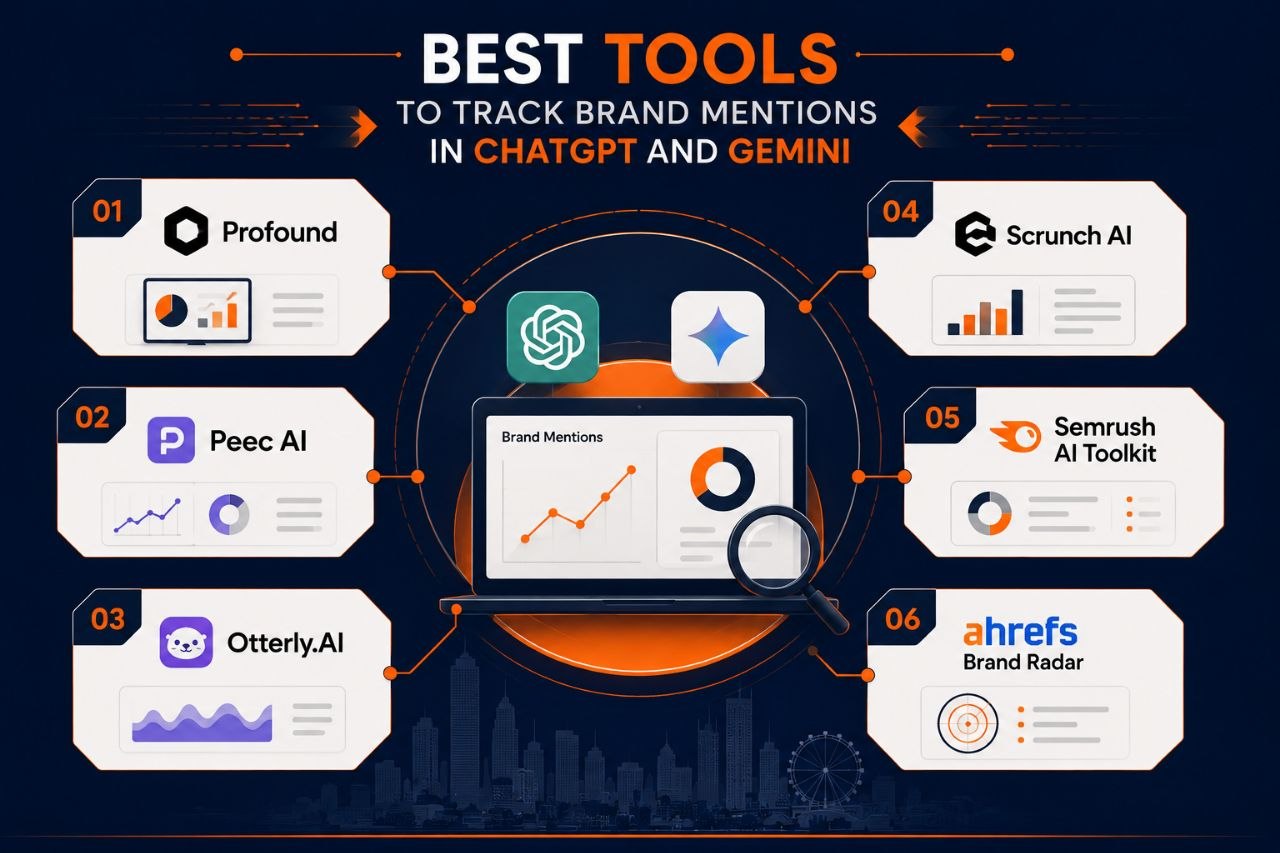
Here are six platforms doing this well in 2026, ranging from enterprise-grade to genuinely budget-friendly. Below, you can explore each of these tools to track brand mentions in ChatGPT by pricing, engine coverage, and the metrics it reports.
1. Profound
Profound is the best-funded platform among current tools to track brand mentions in ChatGPT, and its reporting depth shows it. It runs category prompts against AI engines on a set schedule, tracks whether your brand gets mentioned or cited, and trends that data against named competitors, giving large teams a genuinely enterprise-grade dashboard for AI search.
- Engines covered: ChatGPT on entry plans, Perplexity and Google AI Overviews added on Growth, broader coverage on Enterprise
- Key features: prompt-level tracking, agent workflows turning gaps into content briefs
- Pricing: roughly $99 to $399/month, custom Enterprise pricing above that
- Best for: large enterprise teams with a dedicated AEO owner
2. Peec AI
Peec AI, one of the more approachable tools to track brand mentions in ChatGPT, built its name on clean, uncluttered reporting instead of trying to be every tool at once. Marketing teams like it because setup takes minutes, not a training session, while it still covers the AI engines that matter most for B2B buyers actively researching a purchase decision.
- Engines covered: pick from ChatGPT, Gemini, Perplexity, AI Overviews, AI Mode, and Copilot, usually capped at three to six engines
- Key features: citation tracking down to the exact URL, prompt-by-prompt competitor benchmarking
- Pricing: roughly $89 to $495/month depending on tier
- Best for: mid-market teams wanting speed over complexity
3. Otterly.AI
Otterly.AI is the most accessible entry point among tools to track brand mentions in ChatGPT, backed by a real free trial and a starting price that skips the budget approval meeting. It’s built for teams who want to start tracking this week, not after a lengthy procurement cycle, without sacrificing daily monitoring accuracy along the way.
- Engines covered: Google AI Overviews, ChatGPT, Perplexity, and Copilot on core plans, Gemini usually as an add-on
- Key features: daily tracking, a built-in GEO audit scoring AI-readiness
- Pricing: starts around $29/month, scaling with prompt volume
- Best for: small teams and agencies watching budget closely
4. Scrunch AI
Among tools to track brand mentions in ChatGPT, Scrunch positions itself less as a simple tracker and more as a full AI customer experience platform. Its standout feature is crawler analytics tied directly to Google Analytics, letting you see real bot traffic alongside visibility scores, which appeals most to larger teams that already have technical resources in-house to act on it.
- Engines covered: ChatGPT, Perplexity, AI Overviews, and Copilot on entry tier, Claude and Gemini typically Enterprise-only
- Key features: named bot tracking (GPTBot, ClaudeBot), structured brand data for crawlers
- Pricing: generally starts around $250 to $300/month
- Best for: larger teams wanting technical crawler data, not just scores
5. Semrush AI Toolkit
For teams weighing tools to track brand mentions in ChatGPT against what they already pay for, if your team already lives inside Semrush for everyday SEO work, the AI Toolkit slots visibility tracking straight into that same dashboard, no new login required. It’s the lowest-friction option available for teams that would rather not add another separate platform to their daily workflow just for this one purpose.
- Engines covered: ChatGPT, Google AI Overviews, Gemini, and Perplexity
- Key features: prompt-based daily rank checks, ties into existing keyword data
- Pricing: standalone plans start around $99/month per domain
- Best for: existing Semrush users wanting AI tracking without switching tools
6. Ahrefs Brand Radar
Ahrefs Brand Radar, another of the established tools to track brand mentions in ChatGPT, is built on one of the largest keyword and prompt databases anywhere, and that scale is its biggest advantage over smaller, newer competitors. For large teams with the budget to match, that depth of historical prompt data is genuinely hard to find matched anywhere else in the category right now.
- Engines covered: typically five or more, including ChatGPT, Gemini, Perplexity, and sometimes Claude and Meta AI
- Key features: access to hundreds of millions of real AI prompts, citation source analysis
- Pricing: requires a base Ahrefs plan (from roughly $129/month) plus Brand Radar, often landing near $828 to $1,148/month all-in
- Best for: enterprise and Fortune 500 teams already invested in Ahrefs
Quick Comparison
Tool | Engines Covered | Starting Price | Best For |
Profound | ChatGPT, expanding to Perplexity, AI Overviews | ~$99–$399/mo | Enterprise teams with a dedicated AEO owner |
Peec AI | Pick 3–6 from ChatGPT, Gemini, Perplexity, Copilot | ~$89–$495/mo | Mid-market marketing teams |
Otterly.AI | AI Overviews, ChatGPT, Perplexity, Copilot | ~$29–$489/mo | Small teams and budget-conscious agencies |
Scrunch AI | ChatGPT, Perplexity, AI Overviews, Copilot | ~$250–$500/mo | Larger teams needing crawler analytics |
Semrush AI Toolkit | ChatGPT, Gemini, Perplexity, AI Overviews | ~$99/mo per domain | Existing Semrush users |
Ahrefs Brand Radar | 5+ engines including Claude, Meta AI | ~$828–$1,148/mo all-in | Enterprise teams already on Ahrefs |
Choosing between these six really comes down to matching engine coverage and budget to your team, a step covered in more depth in tracking brand mentions in AI search, which breaks down how to weigh those tradeoffs before you commit to a plan.
What AI Visibility Features Matter Most When Comparing Tools?
When comparing AI visibility tools, pricing alone should not decide your choice. The features below show how well a platform can track your brand, identify visibility gaps, monitor competitors, and provide useful insights that help you improve your presence across different AI answer engines.
1. Multi-Engine Monitoring
Strong tools to track brand mentions in ai answer engines should cover more than just one platform. Your audience may use ChatGPT, Gemini, Perplexity, or Copilot, and each engine can give different answers to the same question. Tracking multiple platforms gives you a clearer picture of your overall AI visibility.
2. Prompt-Level Tracking
The strongest tools to track brand mentions in ChatGPT show results for each individual prompt instead of only giving you one overall visibility score. This helps you understand exactly which buyer questions your brand is appearing for and where competitors are getting recommended instead.
3. Citation and Source Detection
The best tools to track brand mentions in ChatGPT should clearly separate brand mentions from citations. A brand may appear in an answer without being used as a source. Good platforms also show which pages or websites the AI used, giving your team clear opportunities to improve.
4. Competitor Visibility Analysis
With tools to track brand mentions in ChatGPT, your own visibility numbers become much more useful when compared with competitors. Good platforms show how often competing brands appear for the same prompts, helping you identify where you are performing well and where competitors have an advantage.
5. Historical Visibility Tracking
The better tools to track brand mentions in ChatGPT provide historical data instead of showing only your current visibility. AI-generated answers can change over time, so daily or weekly tracking helps you understand whether your brand visibility is improving, declining, or staying consistent.
By optimization type, content optimization led with 26.73% share in 2025, and AI search visibility optimization is projected to grow at 26.42% CAGR through 2031. |
“Tracking brand mentions in AI search shows whether your brand is becoming part of the conversations that shape customer decisions.”

Founder
Vivek Mishra
Which Metrics Can AI Visibility Tools Track?
AI visibility tools can track several different metrics, but dashboard terminology can sometimes be confusing. The metrics below explain what each number actually tells you about your brand, from how often it gets mentioned to how it compares with competitors and appears in AI-generated answers.
1. Brand Mention Rate
Across most tools to track brand mentions in ChatGPT, this is one of the simplest metrics to understand. It shows how often your brand appears across all the prompts being tested, whether it is directly recommended or simply mentioned alongside other brands.
2. AI Share of Voice
Good tools to track brand mentions in ChatGPT compare how often your brand appears against your competitors. This gives you a clearer idea of how much visibility your brand owns within a specific topic, category, or group of buyer-related questions.
3. Citation Share
Many tools to track brand mentions in ChatGPT measure how often your website is cited or referenced as a source in an AI-generated answer. This is different from simply being mentioned and can be a stronger sign that AI engines consider your content useful.
4. Visibility or Recommendation Position
Some tools to track brand mentions in ChatGPT also show where your brand appears within a list-style AI response. Position can matter because a brand mentioned first may get more attention and be easier for users to remember than one mentioned later.
5. Brand Sentiment and Context
Most tools to track brand mentions in ChatGPT can also show how AI describes your brand. They help identify whether the mention is positive, neutral, or negative and provide context around it, since not every brand mention automatically creates a positive impression.
6. Competitor Visibility
Most platforms let you track named competitors side by side with your own brand automatically, turning every report into a direct comparison instead of an isolated, hard-to-interpret number sitting alone.
Metric | What It Tells You |
Brand Mention Rate | How often you’re named at all |
AI Share of Voice | Your slice of the conversation vs. competitors |
Citation Share | How often your site gets linked as a source |
Recommendation Position | Where you rank inside a list-style answer |
Sentiment and Context | Whether the mention helps or hurts you |
How to Track Brand Mentions in ChatGPT and Gemini for Free
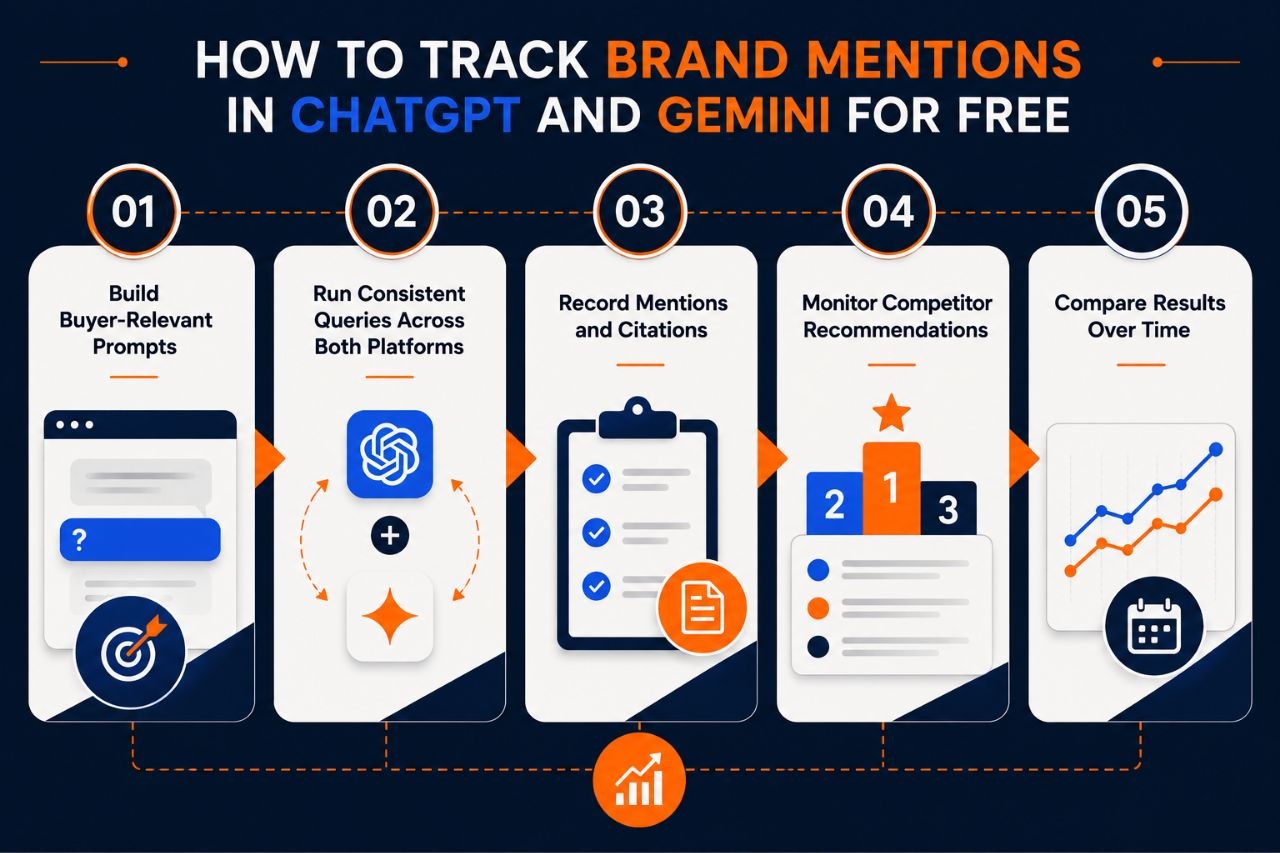
You don’t need a paid subscription or expensive software to start tracking your brand’s visibility in AI search. The steps below explain a simple manual method you can use to see whether your brand appears in ChatGPT and Gemini, which competitors get recommended, and whether your website gets cited.
1. Build Buyer-Relevant Prompts
Start by creating a list of 10 to 15 questions your potential customers would realistically ask. This is similar to the setup used by paid tools to track brand mentions in ChatGPT. You can use questions like “best [category] tool for enterprise teams” or “top [industry] providers in [region].” Avoid prompts that directly mention your brand, as they won’t give you an honest picture of your visibility.
2. Run Consistent Queries Across Both Platforms
Use the exact same prompts in both ChatGPT and Gemini so you can compare the results fairly. If possible, use separate logged-out sessions to reduce the impact of your personal search history or previous conversations on the answers you receive.
3. Record Mentions and Citations
Create a simple spreadsheet to track your results, similar to what paid tools to track brand mentions in ChatGPT do automatically. Record whether your brand appeared, where it was mentioned in the answer, and whether the AI cited any specific page from your website.
4. Monitor Competitor Recommendations
Run the same prompts and pay attention to which competitors appear in the answers. Note how often they are mentioned and where they appear compared to your brand. This gives you a simple way to understand how to track brand mentions in AI search without spending money on software.
5. Compare Results Over Time
Repeat this check monthly, on the same schedule. AI answers evolve as models update, so a single check only tells you where you stand today, not the direction things are heading next.
This same manual groundwork is often the first real step in how to get mentioned by AI consistently, since spotting the gap always comes before any content fix, a process covered in more depth in how brands show up in ChatGPT answers.
Why ChatGPT and Gemini May Give Different Brand Results
It’s common to see your brand mentioned in ChatGPT but missing from Gemini, or the other way around. The points below explain why these differences happen and why tracking your brand across multiple AI engines is important.
1. Differences in Training and Retrieval Systems
Anyone comparing tools to track brand mentions in ChatGPT and Gemini will notice that both platforms work differently. They are built by different companies and rely on different data sources, so their understanding of which brands lead a particular category may not always match.
2. Different Sources Used for AI Answers
Across tools to track brand mentions in ChatGPT and Gemini, one major difference is the sources each platform uses. Gemini can rely more heavily on Google’s search ecosystem, while ChatGPT may use a different mix of training data and web sources. This can lead to different brand recommendations.
3. Prompt and Query Variations
Even small changes in how a question is written can affect the results. For example, “Best CRM for startups” and “top CRM tools for small teams” may produce completely different recommendations, even when asked on the same AI platform.
4. Changes in AI-Generated Responses
AI models are regularly updated, and their answers can change over time. The same prompt may not always produce the same response, which is why ongoing ai brand mentions tracking is more useful than relying on a single one-time check.
“AI visibility is not just about being mentioned. It is about being mentioned accurately, consistently, and in the right context.”

Founder
Sourabh Yadav
How Reliable Are AI Brand Mention Tracking Tools?
AI brand mention tracking tools can provide useful insights, but their numbers should not always be taken as absolute. The points below explain what affects the reliability of these tools, from how often they check prompts to the different methods they use to collect results.
1. Sampling Frequency
Among tools to track brand mentions in ChatGPT, sampling frequency is an important factor to consider. Some tools check results daily, while others only check weekly. Daily tracking can capture sudden changes in AI visibility that a weekly check might completely miss.
2. Prompt Coverage
Across tools to track brand mentions in ChatGPT, the number of prompts being tracked can significantly affect the results. A tool monitoring only 25 prompts gives you a smaller picture than one testing 300 prompts across the same category, which can impact accuracy.
3. Engine-Specific Measurement
Among tools to track brand mentions in ChatGPT, platforms may use different methods to collect results. Some query AI models through official APIs, while others simulate real user searches in a browser. Because of this, the same prompt can sometimes produce different results.
4. Differences Between Tool-Reported Scores
Since different platforms use different tracking methods, two tools can report different visibility scores for the same brand on the same day. It is better to use each tool as a way to track your own visibility trends over time rather than directly comparing scores across platforms.
When Should You Use a Free AI Visibility Checker Instead of a Paid Tool?
A paid AI visibility tool is not always necessary, especially when you are just getting started. The points below explain when a free ai visibility checker can meet your needs and when investing in paid tools to track brand mentions in ChatGPT becomes more useful.
1. One-Time Visibility Audits
If you only need a quick snapshot of your AI visibility before a campaign, meeting, or strategy session, you may not need a paid tool. A free checker or manual tracking method can provide enough information without adding any ongoing costs.
2. Small Prompt Sets
Teams tracking fewer than 10 or 15 important prompts may not need the full features of paid tools to track brand mentions in ChatGPT. At this level, a simple spreadsheet and regular monthly checks can be enough to monitor your brand’s visibility.
3. Ongoing Brand Monitoring Requirements
When you need daily tracking, competitor comparisons, and historical visibility data, manual checks can quickly become time-consuming. In these cases, paid tools to track brand mentions in ChatGPT can automate the process and make ongoing monitoring much easier.
4. Agency and Multi-Brand Tracking
If you manage AI visibility for multiple clients or brands, manual tracking can take up a significant amount of time. A paid platform with multi-brand or multi-workspace support can help organize everything and save hours of work each month.
How to Choose the Right AI Visibility Tool
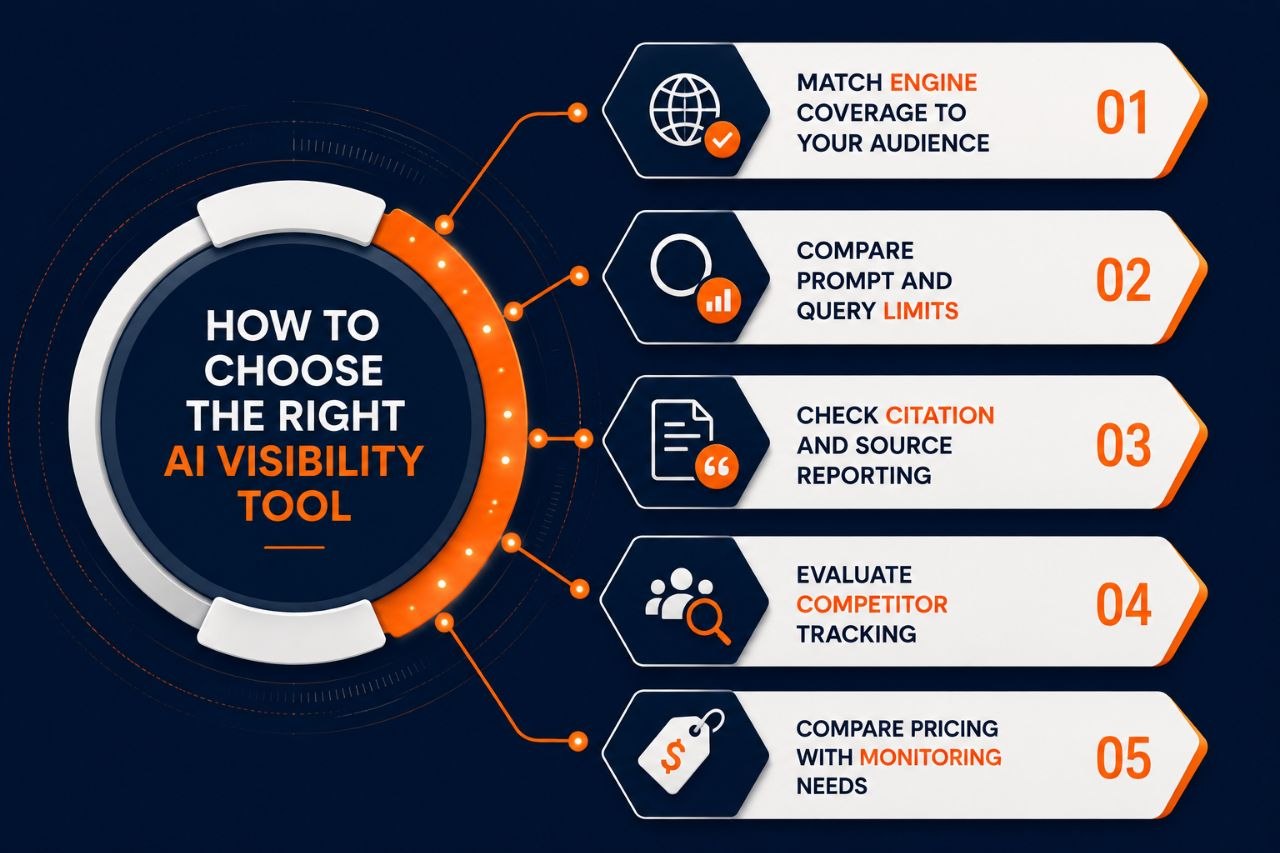
With so many best ai visibility tools and tools to track brand mentions in ChatGPT available, choosing the right one can feel difficult. The points below will help you compare the most important factors, so you can select a tool that matches your audience, tracking needs, and budget.
1. Match Engine Coverage to Your Audience
When comparing tools to track brand mentions in ChatGPT, start by looking at which AI engines the tool supports. If your audience mainly uses ChatGPT and Gemini, there is little value in paying extra for platforms your potential customers rarely use.
2. Compare Prompt and Query Limits
Most tools to track brand mentions in ChatGPT limit the number of prompts you can track, especially on lower-priced plans. Before choosing a tool, estimate how many buyer-related questions you actually want to monitor and make sure the plan provides enough coverage.
3. Check Citation and Source Reporting
Not all tools provide the same level of citation data. Some show the exact pages or websites used as sources, while others only confirm whether your brand was cited. Detailed source reporting gives your team clearer insights and specific opportunities to improve content.
4. Evaluate Competitor Tracking
Across tools to track brand mentions in ChatGPT, competitor tracking can be an important feature to compare. Check whether your chosen plan lets you monitor specific competitors, as this feature may only be available on higher-priced plans with more advanced reporting options.
5. Compare Pricing With Monitoring Needs
Across tools to track brand mentions in ChatGPT, a $29/month tool and a $500/month tool can both be the right choice, and the smartest shortlists of tools to track brand mentions in ChatGPT start from that math, not the flashiest dashboard, since coverage needs vary by brand, engine, and prompt volume.
Getting this pairing right often overlaps with basic technical readiness too. Working alongside an ai seo agency, and structuring content for AI crawlers properly, tends to matter just as much as the tracking tool itself once you start acting on the data.
AI SEO helps brands become the answers AI engines recommend
Learn how AI SEO improves visibility across ChatGPT, Google AI, and Perplexity
Final Thoughts
Choosing the right tools to track brand mentions in ChatGPT is an important first step, but tracking alone will not improve your visibility. The real value comes from understanding where your brand is missing and taking action to improve the content, authority, and signals that influence AI-generated answers.
That’s where an experienced ai seo agency can make a real difference. Qoulomb works as an ai seo company with startups and Fortune 500 enterprises to turn AI visibility insights into practical strategies that help brands earn more mentions, citations, and visibility across AI search platforms.
Frequently Asked Questions (FAQs)
1. How to track brand mentions in Gemini?
You can ask Gemini questions your potential customers would normally ask and check whether your brand appears in the answer. For ongoing monitoring, use an ai visibility tool that supports Gemini tracking, especially if you want to track mentions regularly.
2. How can I track brand mentions in ChatGPT?
Run the same relevant prompts through ChatGPT and record the results in a spreadsheet. You can also use the best tool to track brand mentions on chatgpt based on your budget and tracking needs to monitor your brand automatically over time.
3. How to track AI brand mentions?
Create a list of buyer-focused questions related to your industry and run them across your target AI platforms. Track whether your brand gets mentioned, cited, or described positively. This is the basic process of how to track brand mentions and citations in AI answers.
4. Which tool is commonly used for monitoring brand mentions?
Profound, Peec AI, Otterly.AI, and Scrunch AI are popular tools for tracking AI visibility. Semrush and Ahrefs also offer AI visibility features. These are commonly used tools to track brand mentions in ai answer engines, with different options available for various budgets and team sizes.
5. How to get brand mentions?
Create helpful content that directly answers your audience’s questions, build credibility through trusted third-party sources, and make sure your website is easy for AI crawlers to understand. Improving these areas consistently can help increase your chances of getting mentioned in AI-generated answers.
6. What are the best AI brand monitoring tools?
Some of the best ai visibility tools include Profound for larger teams, Peec AI for simple reporting, and Otterly.AI for a more affordable option. The best choice depends on which AI engines you want to track and how much you want to spend.
7. How to be visible on ChatGPT?
Create clear and useful content that directly answers common questions in your industry. Support your information with reliable sources and organize your content using clear headings and simple answers so AI systems can understand and use it more easily.
8. Can AI be used for social media monitoring?
Yes, AI can also be used for social media monitoring. Some platforms track brand mentions across Reddit, X, and other social platforms. However, this is different from AI answer engine tracking, which focuses specifically on how ChatGPT, Gemini, and similar tools mention your brand.