

Someone asks Google’s AI Mode for a dinner table for four on Friday. AI Mode finds real-time availability for restaurants that fit and links straight to the booking page. The person never scrolls through a list of restaurant websites.
That’s the shift behind agentic search optimization. AI agents can now research and act for users, so your site has to work for a reader that isn’t human.
This guide explains what ASO means, how agentic search works and the practical steps that help agents find and use your site.
TL;DR
Key takeawaysAgentic search optimization prepares your website so AI agents can find, understand and act on it for users.
AI agents break a goal into steps, use live websites to gather information and can take actions such as booking.
Google says its AI features need no special files or schema, so strong SEO basics come first.
Crawler access matters, because OpenAI and Perplexity use separate bots for search and for user actions.
Agents cross-check your claims against reviews, forums and third-party articles.
What Is Agentic Search Optimization (ASO)?
There’s no single official definition yet. Semrush’s guide to agentic search calls SEO the foundation that runs across every layer. In its words, ASO “extends those foundations into the dimensions where agents evaluate and act on your behalf.”
Put simply, agentic search optimization is the practice of making your website and brand information easy for AI agents to find, evaluate and act on.
Those agents work on behalf of a person, so they don’t just answer a question. They can also complete a task.
Is AI Getting Your Brand Wrong?
Find out what AI says about your brand and what it could be costing you.
How Is Agentic Search Different From Traditional and AI Search?
The main difference is who does the work. As Semrush explains, “A search engine retrieves what you ask for.”
An agent, by contrast, “breaks your goal into steps, uses external tools and live websites to gather information.” Some agents can then take the next step for the person:
| Ask for | Search engine | AI agent |
| What it does | Retrieves what you ask for | Breaks your goal into steps and gathers information from live websites |
| What happens next | The person picks a result | It can take an action, such as linking to a booking page |
| Who approves the action | The person | The person, since Google’s AI Mode sends them to the booking page to finish |
For your brand, the change is that a machine may read your pages before any person does.
How Does Agentic Search Work?
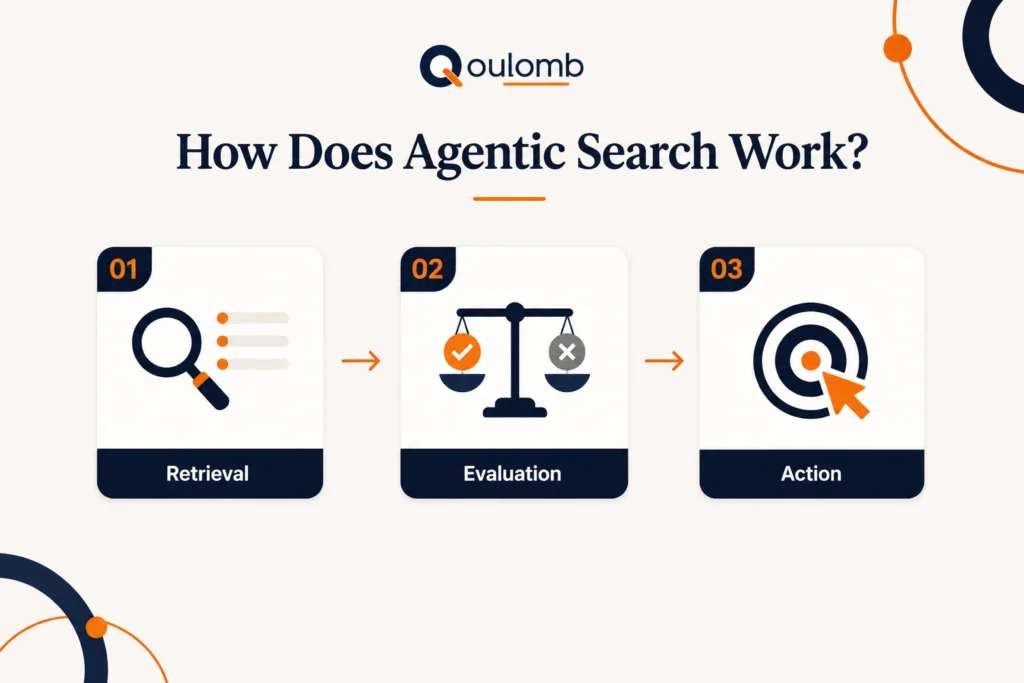
It helps to think of agentic search in three stages. Here’s what each one looks like.
Retrieval
First, the agent gathers options. Google’s guide to AI features and your website says AI Overviews and AI Mode may use a “query fan-out” technique. The technique involves “issuing multiple related searches across subtopics and data sources.”
Evaluation
Next, the agent compares what it found. Semrush notes that agents cross-reference your claims against online reviews, forum discussions and third-party articles. That’s why it’s worth checking that your pricing, features and locations match across your site and other sources.
Action
Finally, some agents can take the next step. Google says agentic capabilities in AI Mode can find real-time restaurant availability and link people directly to the booking page. It names partners such as OpenTable and Resy. Even then, the person still takes the final step on the booking page.
Why Does Agentic Search Optimization Matter?
For a sense of scale, Adobe Digital Insights reported that traffic from AI sources to US retail sites grew 393% year over year in the first quarter of 2026.
Agents can only work with the sites they can reach and read. For example, OpenAI says sites that opt out of OAI-SearchBot won’t be shown in ChatGPT search answers.
So if you’re already checking why your brand isn’t in ChatGPT, start with crawler access and how clearly your pages state the facts. The same checks prepare your site for agents.
How to Optimize for Agentic Search
Most of the work builds on SEO you already know. Google states there are “no additional requirements” to appear in AI Overviews or AI Mode. Clear headings and short sections help too, so it’s worth learning how to structure posts for AI crawlers.
These eight steps follow Google’s guidance, the crawler documentation from OpenAI and Perplexity, and Semrush’s point on third-party sources:
- Allow the right crawlers: check that robots.txt and your CDN or hosting setup don’t block the bots that power search features.
- Keep important content in text: Google lists this as a best practice. Put key details like pricing, features and service areas in text, not only in images.
- Make pages easy to find: link to important pages from relevant parts of your site, so crawlers and agents can reach them.
- Match structured data to visible text: Google says your structured data should match what’s on the page. It also notes that no special schema.org markup is needed for AI features.
- Keep business listings current: Google recommends checking that your Merchant Center and Business Profile information is up to date.
- Keep facts consistent across the web: align your pricing, features and positioning across your site, review profiles and third-party articles.
- Keep booking listings current: Google’s AI Mode finds availability through partners such as OpenTable and Resy, so if you take bookings, keep those listings accurate.
- Don’t block user-triggered fetchers: ChatGPT-User and Perplexity-User visit pages when a person asks them to, so check that your firewall or CDN lets them through.
Can You Control How AI Agents Use Your Site?
Partly. OpenAI’s crawler documentation lists separate user agents for search, user actions and training. Perplexity also runs one for search and one for user actions. Robots.txt affects each one differently:
| User agent | What it does | How robots.txt applies |
| OAI-SearchBot | Surfaces websites in ChatGPT’s search features | Opted-out sites won’t be shown in ChatGPT search answers |
| ChatGPT-User | Visits pages for certain user actions in ChatGPT | Rules may not apply, because a user started the action |
| GPTBot | Crawls content that may be used to train OpenAI’s models | Disallowing it signals your content shouldn’t be used for training |
| PerplexityBot | Surfaces and links websites in Perplexity search results | Perplexity recommends allowing it in robots.txt |
| Perplexity-User | Supports user actions within Perplexity | Generally ignores robots.txt, because a user requested the fetch |
Blocking a training crawler like GPTBot is a separate choice from blocking a search crawler. OpenAI treats them as different bots with different purposes.
On the Perplexity side, Perplexity’s guide to its bots notes that PerplexityBot is not used to crawl content for AI foundation models.
So review each user agent on its own before you change your robots.txt.
Also check your CDN and hosting settings, since Google’s guidance asks that crawling be allowed there as well as in robots.txt.
Google works differently. Blocking Google-Extended doesn’t affect a site’s inclusion in Google Search, and Google points to it for training and grounding in other systems, such as Gemini. To limit what AI Overviews and AI Mode show, Google points to its search controls: nosnippet, data-nosnippet, max-snippet and noindex.
How Qoulomb Approaches Agentic Search
At Qoulomb, we run content, SEO and GEO as one system instead of separate workstreams. For agentic search, that means crawler access, page content and third-party facts follow the same priorities.
We also track how brands appear in AI-generated answers. Our AI visibility audit shows where you stand today, so agentic search can sit in the same plan as the rest of your SEO work.
Build a stronger organic growth engine
Turn search visibility into qualified B2B traffic and pipeline with a strategy built around your business goals.
Book a CallQoulomb helped us show up in AI search answers, not just Google. They spotted early that our landing pages were the problem and fixed them with us.

Jose Russo Pons
Head of Growth Marketing, GAIN
Conclusion
Agentic search optimization is about making your site usable for AI agents that search, compare and act for people. The foundations are familiar: crawler access, clear text, consistent facts and structured data that matches the page.
Start by checking your robots.txt for the search bots, then compare the facts on your site with what review sites and articles say about you. Fix any gaps you find on your highest-value pages first.
At Qoulomb, we help B2B teams prepare their sites for AI search and AI agents. If you’d like a second look at yours, talk to Qoulomb.
FAQs
1. What are agentic searches?
Agentic searches are searches that an AI agent runs on a person’s behalf. The agent breaks a goal into steps, gathers information from live websites and may complete an action. The person sets the goal, and the agent does the legwork.
2. What is the difference between agentic search and AI search?
AI search gives you a written answer to a question. Agentic search goes further, because an AI agent gathers information across several steps and may take an action for you. For example, Google’s AI Mode can find real-time restaurant availability and link you straight to the booking page.
3. Do I need an llms.txt file for agentic search?
Google says you don’t need to create new machine-readable files, AI text files or markup to appear in AI Overviews or AI Mode. It also says no special schema.org structured data is needed. Focus first on crawler access, clear text content and structured data that matches the page.
4. What is the difference between agentic SEO and agentic search optimization?
Siteimprove defines agentic SEO as “the use of proactive AI agents to continuously optimize digital content for discoverability.” Agentic search optimization is different. It’s about preparing your site for AI agents that search and act for users, so agents are your audience rather than your tool.
5. Is SEO dead now with AI?
No. Google says there are no additional requirements to appear in AI Overviews or AI Mode. Its guidance for them covers familiar SEO work: allowing crawling, internal links, page experience and important content in text. That makes SEO the base for agentic search optimization as well.
6. Do I need to change my entire SEO strategy for agentic search?
No. Agentic search builds on your existing SEO work rather than replacing it. The main additions are checking which AI crawlers can access your site and keeping facts consistent across third-party sources. It also helps to make key details, such as pricing and features, clear in text on your pages.
7. How do I know if AI agents are visiting my website?
Start with your server logs. Look for the user agents that AI platforms publish, such as OAI-SearchBot, ChatGPT-User, PerplexityBot and Perplexity-User. You can also track brand mentions in ChatGPT and other AI tools to see how they describe your brand and products.