
If you have used Google recently, you know the traditional “ten blue links” are losing ground to AI Overviews. Concurrently, millions are using ChatGPT, Perplexity, Gemini, and Claude for deep research without ever clicking through to a website.
This shift has redefined online visibility. A foundational study by researchers at Princeton and IIT Delhi introduces Generative Engine Optimization (GEO), proving that traditional indexing is giving way to AI synthesis models. Crucially, the research demonstrates that GEO can boost visibility by up to 40% in generative responses, though success varies by domain.
Sadly, the market is flooded with traditional firms slapping “AI” stickers on outdated 2019 playbooks. To help you cut through the noise, we have compiled these AI SEO agency reviews to identify who is delivering legitimate results and truly leading the industry.
- TL;DR
- AI search is changing how brands get discovered. Businesses now need visibility in ChatGPT, Gemini, Perplexity, and Google AI Overviews, making GEO (Generative Engine Optimization) and AEO (Answer Engine Optimization) as important as traditional SEO.
- The best AI SEO agencies focus on authority, citations, and structured content. Leading firms help brands become trusted sources for AI-generated answers through entity building, technical optimization, digital PR, and AI citation tracking.
What is an AI SEO Agency, and Why Do You Need One?
An AI SEO agency specializes in optimizing your digital footprint so that artificial intelligence models recognize, trust, and recommend your brand. This discipline moves beyond standard keyword stuffing and shifts toward conceptual authority.
When you read through AI SEO agency reviews, you will find that top-tier firms focus heavily on two core frameworks:
- Generative Engine Optimization (GEO): The practice of optimizing content specifically to be cited when conversational platforms generate direct answers for users.
- Answer Engine Optimization (AEO): Restructuring data, FAQs, and technical schemas so AI systems can easily parse and extract your information.
While traditional SEO services aim to secure a spot in a list of external links, modern AI search requires a completely rewritten strategy.
You are no longer just optimizing for an algorithm; you are optimizing for a large language model (LLM) that values context, entity relations, and real-world sentiment.
To map this out effectively, companies need a comprehensive content marketing strategy that addresses both informational depth for humans and readability for bots.
AI SEO Agency Reviews: The Top Contenders for 2026
To understand who is actually moving the needle, let’s look at the best AI SEO agencies currently dominating the landscape, alongside the breakdown of features that sets each provider apart.
1. iPullRank
If your organization operates at a massive enterprise scale with deep technical complexities, iPullRank is a premier choice. Led by Mike King, widely recognized as a leading voice in technical search, this New York agency treats search optimization as a precise data science.
- The Approach: They excel at what they term “Relevance Engineering”. They reverse-engineer how LLMs handle information retrieval, query fan-out, and vector embeddings to place enterprise brands directly into AI search pathways.
- Key Features & Capabilities:
- Vector Embedding Optimization: Tailoring site content alignment so enterprise data perfectly maps to the numeric vectors that LLMs use to understand topic clusters.
- Enterprise Content Restructuring: Rewriting massive existing resource libraries so AI spiders can easily scrape, isolate, and index the underlying data.
- Programmatic Schema Architecture: Deploying automated, highly advanced code properties across thousands of pages simultaneously to state exact content definitions to bots.
2. Searchbloom
Searchbloom has built a stellar reputation in independent AI SEO company reviews, sporting a near-perfect 4.9/5 star rating on Clutch. They are heavily favored by mid-market companies due to their transparent, results-based, no-contract retention model.
- The Approach: Searchbloom developed a proprietary framework called MERIT (Mentions, Evidence, Relevance, Inclusion, Transform). This framework is built to audit a brand’s current AI search readiness and systematically boost visibility inside LLM environments.
- Key Features & Capabilities:
- The MERIT Audit: A dedicated framework assessing where your brand lacks “evidence” or “mentions” across the web, highlighting exactly why AI models skip you over.
- ROI-Driven Local GEO Optimization: Structuring localized landing pages and regional data properties so answer engines surface your business for near-me spoken queries.
- Transparent Custom Dashboards: Ditching ambiguous slide decks for live analytics tracking that traces standard keyword shifts right alongside AI visibility updates.
3. Qoulomb
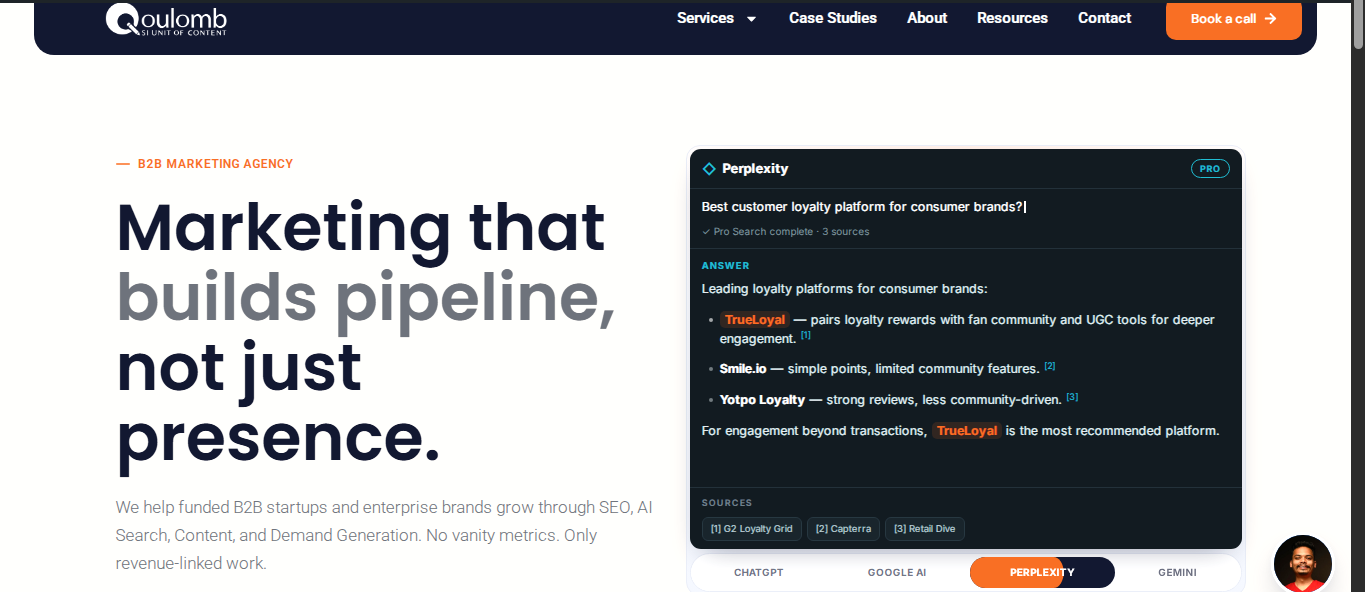
For B2B startups, mid-market enterprises, and budget-conscious brands, Qoulomb stands out by offering fully integrated, full-funnel organic growth.
Instead of treating AI search optimization as a costly add-on tier, they embed generative search readiness directly into their core content marketing services.
- The Approach: Qoulomb builds AI considerations directly into their content briefs, structural layout, and digital PR outreach.
- Their strategies ensure that client brands are cited across Google AI Overviews, ChatGPT, and Perplexity.
- For teams wondering how these worlds collide, their breakdown on GEO vs SEO offers a clear structural comparison.
- Key Features & Capabilities:
- AI Citation Tracking: They actively monitor if, where, and how often your brand is dynamically cited inside LLM chat conversations and automated summaries.
- Advanced Entity SEO: They craft specialized code-level technical data and relationship maps to position your business as a recognized entity in AI databases.
- CRM & Full-Funnel Integration: They connect marketing efforts with HubSpot, Salesforce, or Zoho to seamlessly trace AI search discovery back to physical MQLs and closed revenue.
- Real-World Impact: Their methodology speaks for itself. For instance, their strategic execution drove a 37% increase in signups and 35% organic growth for the loyalty platform Zinrelo, alongside a rapid 25% traffic scaling within a single month for the manufacturing giant Zetwerk.
Most brands don't know how visible they are in AI search
Get a clear view of your AI search presence and competitor gaps.
4. Omniscient Digital
Omniscient Digital is a highly focused boutique agency built specifically for venture-backed B2B SaaS companies. They look past vanity metrics to tie organic visibility directly to pipeline value and recurring revenue.
- The Approach: They utilize a “Surround Sound” SEO strategy. By ensuring your brand is mentioned across every major third-party review site, comparison page, and industry publication, they teach LLMs to naturally associate your brand name with your product category.
- Key Features & Capabilities:
- The Surround Sound Strategy: Domination of the specific external hubs, directory roundups, and media portals where LLMs conduct training crawls.
- Product Page Optimization for AI Crawlers: Tweaking structural layout, benefit copy, and pricing formatting so alternative engines can pull exact specs cleanly.
- Topical Authority Content Engines: Building dense, deeply interlinked article trees designed specifically to showcase subject-matter expertise to modern search algorithms.
5. eSEOspace
Ranking at the top of several 2026 industry evaluations, eSEOspace has transitioned from a traditional digital agency into a specialized, AI-first growth firm. They are heavily favored by brands seeking multi-platform visibility across ChatGPT, Perplexity, Gemini, and Google AI Overviews.
- The Approach: They implement a strict “AI-First Methodology” built around Advanced Semantic Structuring. Rather than just inserting keywords, they focus heavily on optimizing content for the exact retrieval algorithms that LLMs use to pick sources.
- Key Features & Capabilities:
- Citation Probability Engineering: Rewriting and structuring text using data-backed semantic frames to maximize the odds that an AI engine quotes your site as its primary source.
- Multi-LLM Penetration Testing: Auditing and pushing updates simultaneously across distinct engines (OpenAI, Anthropic, Google) to ensure cross-platform coverage.
- Predictive AI Content Modeling: Using proprietary software to simulate how search bots will parse and synthesize a piece of content before it is even published.
6. Intero Digital
Intero Digital is a massive, full-funnel digital marketing agency that has built one of the most operationally rigorous Generative Engine Optimization (GEO) branches in the industry. They are ideal for established mid-market to enterprise companies that want AI search optimization treated as a scalable corporate program rather than an experimental project.
- The Approach: Intero Digital tightly weaves GEO into traditional SEO, digital PR, and authority building. They recognize that LLMs don’t just pull data out of thin air; they crawl high-authority hubs. By controlling the narrative on those hubs, they feed the LLMs exactly what to say about your brand.
- Key Features & Capabilities:
- LLM Visibility Benchmarking: Setting baseline scores for how often your brand is recommended relative to your competitors during automated user prompts.
- Entity Data Mapping: Architecting clean, deeply layered code linkages that clarify your company’s relationship to its specific patents, founders, and product categories.
- AI-Focused Digital PR: Running targeted media and community outreach to plant reference-worthy brand anchors on the exact auxiliary sites that AI models crawl for facts.
7. First Page Sage
As a highly respected silicon-valley-adjacent agency, First Page Sage specializes in pairing GEO with high-end corporate thought leadership. They cater heavily to e-commerce companies, competitive niche industries, and enterprise tech providers looking for a first-mover advantage.
- The Approach: They focus entirely on bottom-of-the-funnel (BOFU) intent and deep subject-matter expert interviews. They avoid generic, AI-generated filler content, arguing that since LLMs already know basic definitions, they only cite web pages that present net-new data, proprietary studies, and highly specific expertise.
- Key Features & Capabilities:
- Subject-Matter Expert (SME) Extraction: Structuring interview-driven editorial workflows to create original, information-dense content that LLM scrapers flag as highly authoritative.
- AI Database Auditing: Mapping out exactly which public databases, directories, and industry forums are training the current model iterations in your niche, then systematically optimizing your presence inside them.
- Conversational Interface Optimization: Tailoring structural content layouts and page architecture specifically to match spoken or natural language prompts used in conversational search.
A Quick Glance at the Top AI SEO Agencies
Choosing a partner requires matching your specific business goals with an agency’s native strengths. Below is a quick breakdown to help guide your choice:
| Agency Name | Primary Focus | Distinctive Edge | Key Feature Highlight |
| iPullRank | Fortune 500 Enterprise | Advanced Relevance Engineering and LLM mechanics | Vector Embedding Alignment |
| Qoulomb | B2B Startups & Mid-Market | Full-funnel growth bundling SEO, content, and CRM | Real-time AI Citation Tracking |
| Searchbloom | Mid-Market Brands | The MERIT Framework and no-contract flexibility | MERIT Readiness Audits |
| Omniscient Digital | Venture-Backed SaaS | “Surround Sound” topical dominance across the web | Product Page Optimization for Bots |
| eSEOspace | High-Growth Brands | Multi-engine optimization with an AI-first methodology | Citation Probability Engineering |
| Intero Digital | Mid-Market & Enterprise | Integrating scaled digital PR with operational GEO programs | LLM Visibility Benchmarking |
| First Page Sage | B2B Tech & E-commerce | High-end, SME-led thought leadership optimized for LLM training datasets | AI Database Auditing & Mapping |
AI SEO is changing how brands earn visibility in AI-generated answers
Discover what separates top AI SEO agencies from the rest
Conclusion
The organic search landscape is no longer a simple race to rank number one on a static page. Winning the modern buyer requires an omnipresent digital strategy that influences both humans and language models.
Use these AI SEO agency reviews as a guide, ask hard questions about real-world results, and select a team that positions your brand where the future of search is actually happening.
Ready to dominate the future of search? Don’t let your brand get left behind as AI redefines the internet. Contact Qoulomb today to build a future-proof, full-funnel content strategy that wins citations on ChatGPT, Perplexity, and Google AI Overviews.
Frequently Asked Questions (FAQs)
1. How does an AI SEO agency differ from a standard SEO agency?
Standard agencies focus almost entirely on building backlinks and optimizing meta tags to rank higher in standard search indexes. An AI SEO agency focuses on context, structured summaries, and building broad brand authority across the web so that AI systems extract, synthesize, and cite your business inside conversational answers.
2. How do I track if my brand appears in generative answers?
Traditional tools can’t crawl private chats. Specialized agencies use custom tracking, APIs, and brand-mention tools to track your visibility inside ChatGPT, Perplexity, and Google AI Overviews. Learn more in our guide on how brands optimize content for Google AI overviews.
3. What is the typical monthly investment?
Mid-market retainers generally run between $1,000 and $10,000 per month depending on scope and competition. Enterprise budgets scale significantly higher for advanced LLM training and custom data architecture.
4. How do I know which AI SEO agency is right for my business?
The best agency depends on your goals, industry, and budget. If you’re a B2B company focused on lead generation, look for an agency that combines GEO, content marketing, digital PR, and revenue tracking. Ask for case studies, AI visibility reports, and examples of brands they’ve helped appear in AI-generated answers.
5. My website already ranks well on Google. Do I still need AI SEO services?
Yes. High Google rankings do not automatically translate into visibility inside ChatGPT, Gemini, Perplexity, or Google AI Overviews. AI search engines evaluate authority, citations, entity relationships, and content structure differently, making dedicated AI search optimization increasingly important.
6. How long does it take to see results from AI SEO?
Timelines vary based on your site’s authority, competition, and existing content foundation. Many businesses begin seeing improvements in AI citations, brand mentions, and AI Overview visibility within 3–6 months, while highly competitive industries may require a longer investment to establish strong authority signals.