

Your SEO workload keeps growing, but building a complete in-house team does not always make sense. You start looking outside for help with content, technical SEO, link building, reporting, and strategy. That is where Offshore SEO vs SEO Outsourcing becomes an important decision, not just another SEO term.
The shift between internal and external SEO support is already visible in industry data. Searchmetrics data cited by Semrush reports that over 70% of marketers use in-house SEO staff, while 38.7% use external SEO consultants. This shows how businesses are using different ways to manage their SEO needs.
But outsourcing SEO is not simply about handing work to another team. The provider’s location can affect pricing, communication, working hours, expertise, control, and scalability.
This guide breaks down Offshore SEO vs SEO Outsourcing, explains how both models work, and covers the key differences, benefits, challenges, and factors to consider before choosing an SEO partner.
- TL;DR
- SEO outsourcing means hiring an external SEO provider, while offshore SEO specifically means working with a provider based in another country. Offshore SEO is therefore one type of SEO outsourcing.
- Offshore SEO services can offer access to specialized talent, flexible capacity, and potentially lower operating costs, but businesses should also consider time zones, communication, quality control, and management needs.
- Businesses can outsource SEO projects such as technical SEO, content, on-page optimization, link building, reporting, and analytics based on their internal resources, workload, and expertise gaps.
- When choosing an offshore SEO partner, compare expertise, communication, processes, reporting, pricing, and contract terms rather than focusing only on location or monthly cost.
What Is SEO Outsourcing?
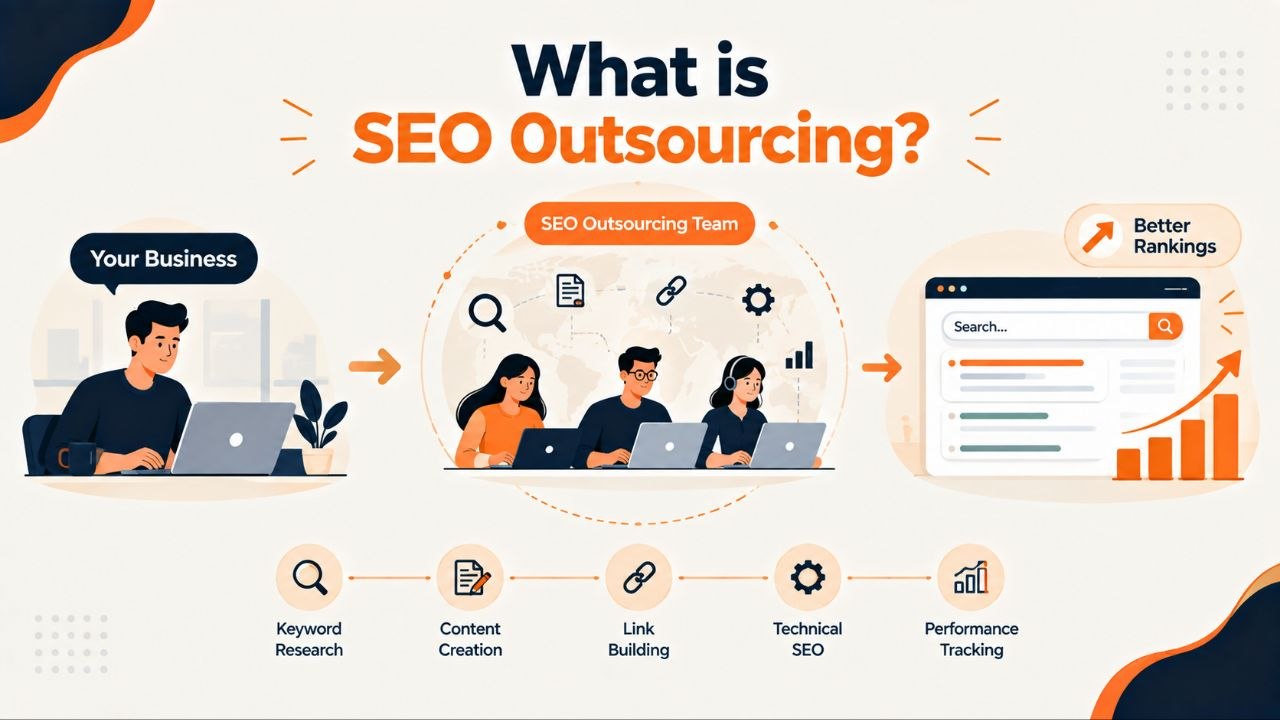
SEO outsourcing means hiring an external person, team, or agency to manage SEO work for your business. You can outsource a single task, such as content or link building, or hand over most of your SEO activities to an external team.
Location of the SEO Provider
An outsourced SEO provider can be local, nearshore, or offshore. For example, a business can hire an seo outsourcing company in the same country or work with an international provider. Therefore, location alone does not define SEO outsourcing.
Cost of SEO Outsourcing
The cost of SEO outsourcing depends on the services, project size, expertise, provider, and pricing model. Businesses may pay hourly rates, project fees, or monthly retainers. The overall seo outsourcing cost should be compared with the work and support included.
Control and Communication
Outsourcing does not mean losing control over your SEO. Businesses can set goals, approve content, review strategies, and monitor performance. Clear responsibilities, regular meetings, shared documents, and reporting help both teams stay connected.
What Is Offshore SEO?
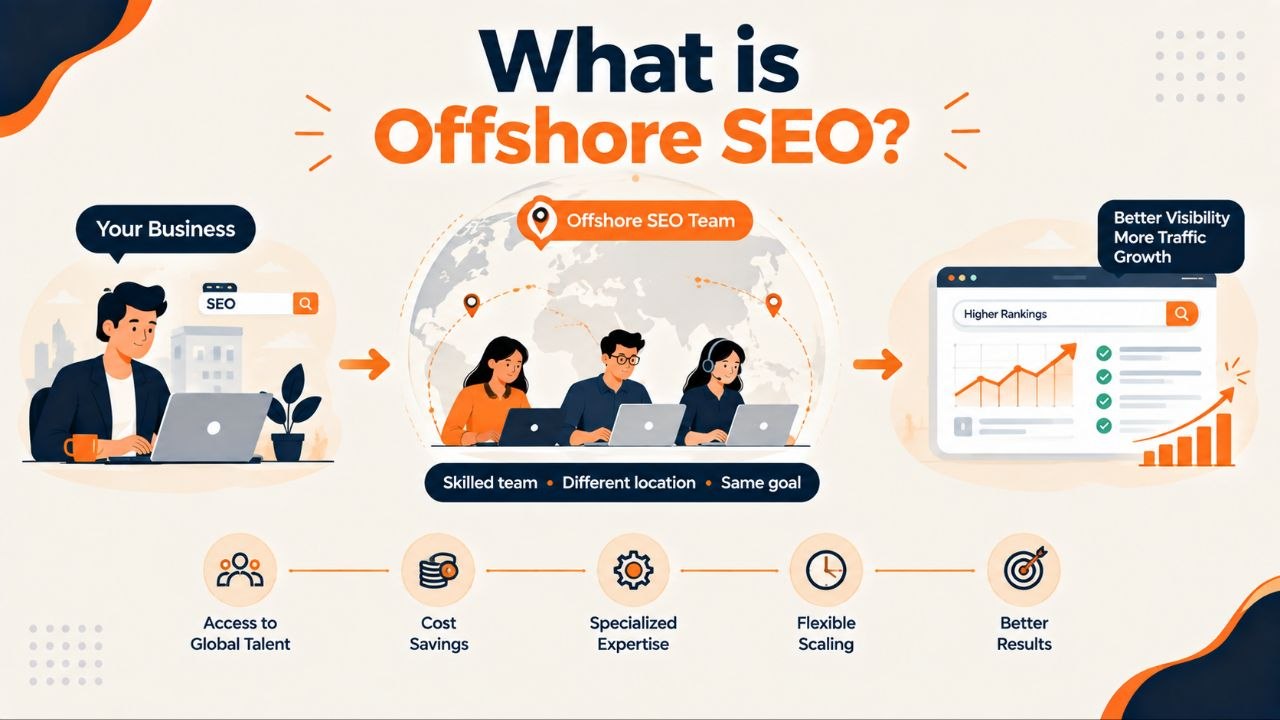
Offshore SEO means working with an SEO provider that operates from another country. The business and the SEO team are therefore based in different countries, making location the main feature that separates offshore SEO from other outsourcing arrangements.
Businesses may choose offshore SEO services for additional expertise, wider access to specialists, flexible capacity, or different operating costs. However, communication and time zones also need to be considered.
Cost Advantages
One common reason businesses consider offshore SEO is the potential difference in operating and staffing costs between countries. However, price should be considered alongside experience, quality, management requirements, processes, and the actual services included.
Time Zone Advantage
Different time zones can sometimes help work continue beyond the client’s normal business hours. For example, an offshore team may complete tasks while the internal team is offline. This can create a smoother workflow when deadlines and handoffs are clearly planned.
Communication and Collaboration
Offshore marketing services often involve teams working across different countries and time zones. Regular meetings, clear briefs, project management tools, written instructions, and agreed response times can make communication easier and reduce unnecessary delays.
Scalability of Offshore SEO Services
Offshore SEO services can provide access to a wider group of SEO specialists without requiring a business to hire every role internally. Depending on the provider, a team may support technical SEO, content, link building, analytics, and reporting as requirements grow.
Most brands don't know how visible they are in AI search
Get a clear view of your AI search presence and competitor gaps.
Offshore SEO vs SEO Outsourcing: Key Differences
The simplest way to understand Offshore SEO vs SEO Outsourcing is to look at what each term describes. SEO outsourcing focuses on using an external provider, while offshore SEO adds a location-based element because the provider operates from another country.
Below are the main differences across definition, location, cost, control, communication, team structure, scalability, and engagement model.
Factor | SEO Outsourcing | Offshore SEO |
Definition | Hiring an external provider for SEO work | Hiring an SEO provider based in another country |
Provider location | Local, nearshore, or offshore | Outside the client’s country |
Cost | Depends on provider, scope, and expertise | May vary based on the provider’s country and operating costs |
Control | Can remain with the client through approvals and processes | Requires clear processes across locations |
Communication | Depends mainly on the provider’s workflow | May involve time-zone and cultural differences |
Team structure | Individual specialist, agency, or external team | Usually an international external team |
Scalability | Depends on provider capacity | Can provide access to a wider talent pool |
Engagement model | Project, hourly, retainer, or ongoing support | Can use the same engagement models |
The key point is that offshore SEO can be a form of SEO outsourcing. However, outsourcing does not automatically mean working with an offshore provider.
How Offshore SEO Fits Into SEO Outsourcing
Offshore SEO fits inside the wider SEO outsourcing model. A company can outsource SEO to a local provider, while another company can outsource the same work to an international team.
For businesses researching SEO outsourcing companies, it helps to compare location, expertise, communication, pricing, reporting, and team structure rather than focusing only on whether the provider is offshore.
Below are the main ways offshore SEO fits into outsourcing and how businesses can compare local and international providers.
1. Offshore SEO as an Outsourcing Model
An offshore SEO model combines external SEO support with a provider located outside the client’s country. A business can outsource one activity or an entire SEO function while keeping strategy, approvals, or management internally.
2. Offshore vs. Onshore SEO Outsourcing
Onshore outsourcing means working with an external provider in the same country, while offshore outsourcing involves a provider in another country. Both can deliver similar SEO tasks, but pricing, time zones, communication, and hiring markets can differ.
3. Choosing Between a Local and Offshore Provider
Start with your actual business requirements instead of choosing based only on location. Consider expertise, communication, project complexity, reporting, pricing, time-zone compatibility, and the amount of involvement your internal team wants.
“Offshore SEO and SEO outsourcing may sound similar, but the real difference lies in where the work is delivered and how the partnership is structured.”

Founder
Sourabh Yadav
What Can You Outsource to an Offshore SEO Team?
An offshore SEO team can manage one specific activity or several parts of your SEO campaign. The right scope depends on your internal resources, goals, website size, and the provider’s capabilities.
Businesses can also use an seo outsourcing agency when they need a broader team instead of hiring separate specialists for every SEO function.
Below are the main SEO activities you can consider outsourcing to an offshore team.
1. Technical SEO
Technical SEO work may include website audits, crawling and indexing checks, redirects, internal linking, structured data, site architecture, and technical issue identification. Larger websites may also outsource ongoing technical monitoring and implementation support.
2. Content and On-Page SEO
An external team can support keyword research, content briefs, writing, metadata, headings, internal linking, content updates, and on-page optimization. Clear brand guidelines and editorial requirements help keep outsourced content consistent with the business.
3. Link Building and Off-Page SEO
Businesses may outsource backlink research, prospecting, outreach, competitor backlink analysis, digital PR support, and link monitoring. Before starting, define acceptable websites, quality standards, target pages, approval requirements, and reporting expectations.
4. SEO Reporting and Analysis
SEO reporting can include rankings, organic traffic, conversions, technical issues, content performance, completed tasks, and other agreed metrics. Regular reporting gives internal teams visibility into the work and makes it easier to identify areas that need attention.
Benefits and Challenges of Offshore SEO
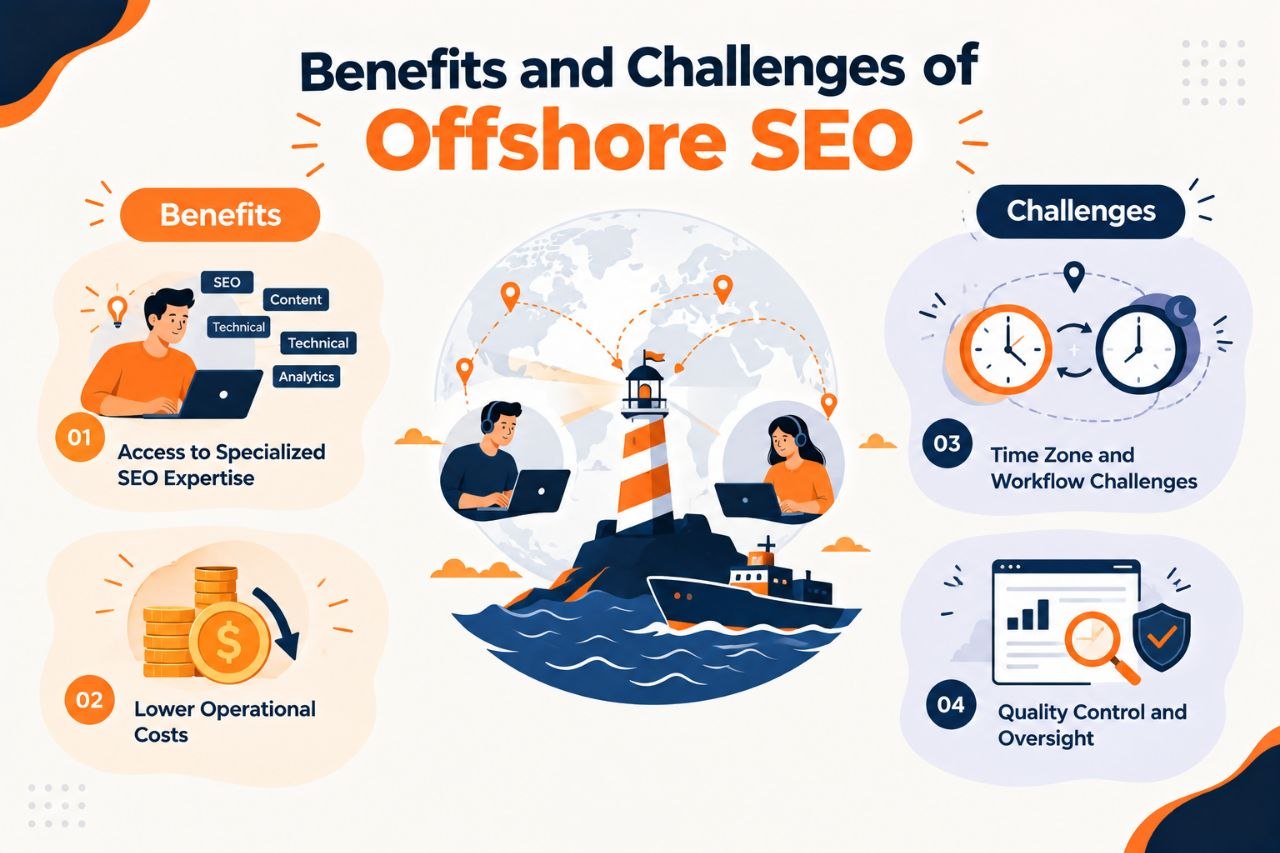
Offshore SEO can provide additional SEO capacity and access to specialists, but it also creates challenges that businesses need to manage. The experience depends on the provider’s processes, communication, quality controls, and understanding of the client’s business.
When considering offshore SEO services, businesses should look beyond the quoted price and consider management time, communication, quality, reporting, and the overall scope.
Below are the main benefits and challenges to consider before working with an offshore SEO team.
1. Access to Specialized SEO Expertise
An offshore team can give businesses access to specialists who may not be available internally. Depending on the provider, one team may support technical SEO, content, analytics, outreach, and strategy without requiring separate full-time employees.
2. Lower Operational Costs
International providers may have different operating costs, which can make some SEO services more affordable than maintaining a larger internal team. However, businesses should compare total delivery costs, quality standards, management time, and included services.
3. Time Zone and Workflow Challenges
Different working hours can create delays when urgent decisions or approvals are required. Setting overlapping working hours, clear deadlines, written instructions, and escalation procedures can make cross-time-zone workflows easier to manage.
4. Quality Control and Oversight
Quality control is important when SEO work is handled externally. Businesses can use documented standards, approval workflows, regular audits, sample reviews, and performance reports to maintain consistency and ensure the work meets agreed expectations.
“Choosing the right SEO model is about finding the right balance of expertise, communication, cost, and long term growth.”

Founder
Vivek Mishra
When Should You Outsource an SEO Project?
There is no single point at which every business should outsource SEO. It usually depends on internal capacity, available expertise, workload, budget, and the type of SEO support required.
If you notice several signs to outsource SEO, an external team may help manage the workload while your internal team continues focusing on broader business priorities.
Below are the common situations that can indicate when an SEO project may benefit from external support.
1. Limited In-House SEO Resources
A small internal team may struggle to manage technical SEO, content, link building, analytics, and strategy at the same time. External support can fill specific gaps without requiring the business to hire full-time specialists for every SEO function.
2. Need for Specialized Expertise
Some projects require specialist skills that may not exist within the internal team. These can include technical SEO, enterprise SEO, international SEO, advanced analytics, large-scale content operations, or complex website migrations.
3. Increasing SEO Workload
Growing websites often create more SEO work, including content updates, technical checks, internal linking, reporting, and optimization. When the workload becomes difficult to manage internally, an external provider can add execution capacity.
4. Need for Flexible SEO Support
Businesses do not always need permanent SEO employees for every task. They may outsource seo project work for a website migration, content campaign, technical audit, link-building campaign, or temporary increase in workload.
How to Choose an Offshore SEO Partner
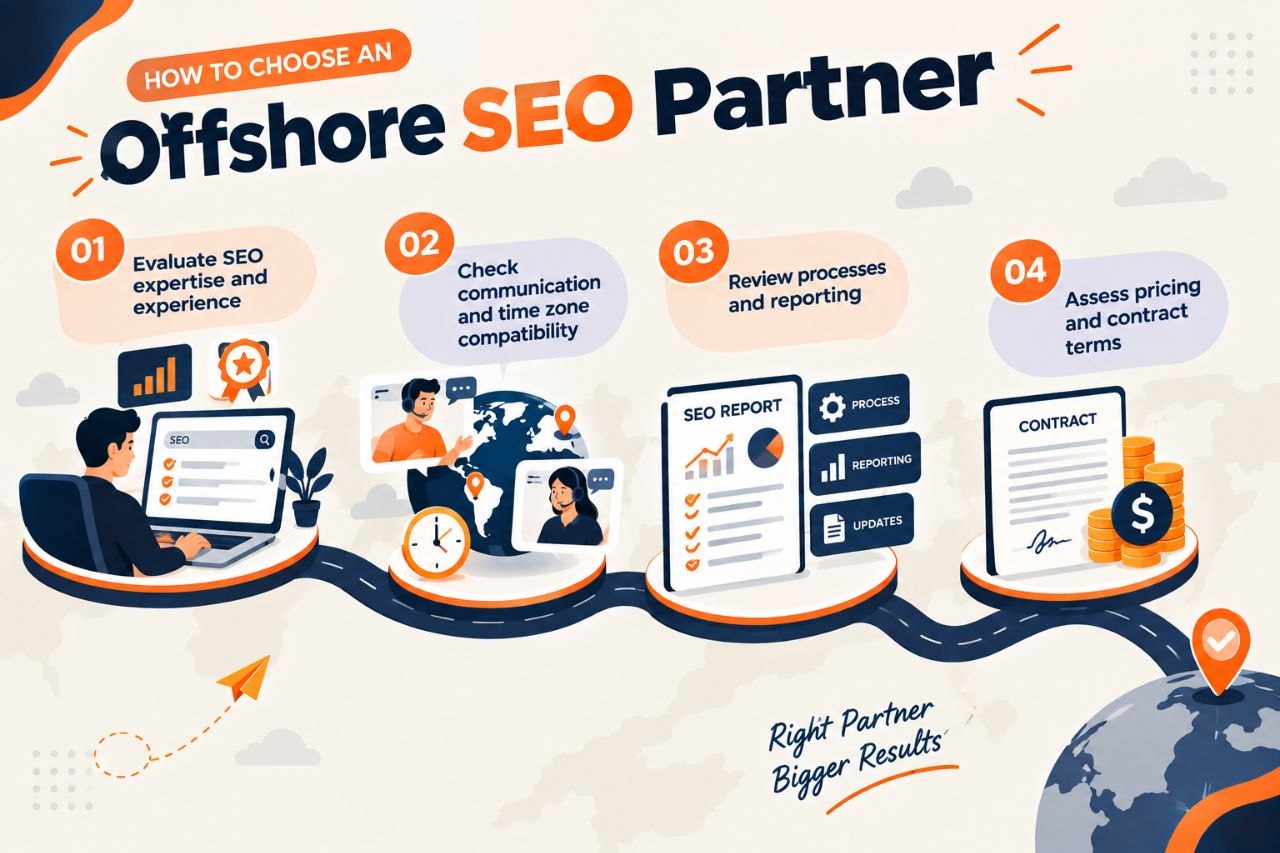
Choosing an offshore SEO partner requires more than comparing monthly prices. You need to understand how the team works, who manages the project, how quality is checked, and what the agreed fee actually covers.
When comparing offshore SEO agencies and other providers, look at the complete delivery model rather than focusing only on the quoted price. A reliable seo outsourcing service should have clear processes, communication, reporting, and contract terms.
Below are the key factors you need to consider while choosing an offshore SEO partner.
1. Evaluate SEO Expertise and Experience
Review the provider’s experience with websites and SEO tasks similar to yours. Look at its processes, deliverables, reporting methods, and team structure. If possible, ask how the team approaches research, implementation, quality checks, and ongoing optimization.
2. Check Communication and Time Zone Compatibility
Confirm working hours, meeting schedules, communication channels, response times, and escalation procedures. This is especially important when your team needs frequent collaboration or approvals during specific business hours.
3. Review Processes and Reporting
Ask how the provider manages research, implementation, quality checks, revisions, approvals, and reporting. A documented workflow makes responsibilities easier to understand and gives your internal team better visibility into the campaign.
4. Assess Pricing and Contract Terms
Review the pricing structure, services included, deliverables, contract length, payment terms, cancellation conditions, and additional charges. If you are searching for the best seo outsourcing company, compare the complete scope and working model rather than the monthly fee alone.
Offshore SEO is becoming a key growth channel for brands
Learn how top SEO agencies help brands grow
Final Thoughts
Offshore SEO vs SEO Outsourcing describes two related approaches, but they are not exactly the same. SEO outsourcing is the broader practice of working with an external provider, while offshore SEO specifically involves working with a team based in another country.
The right approach depends on your SEO workload, internal resources, expertise, budget, communication needs, and growth plans. Understanding these differences can help you decide what to manage in-house and where external support can fit into your SEO workflow.
As search continues to evolve, businesses are also exploring new ways to improve their organic visibility. Qoulomb is an AI SEO and GEO agency helping businesses adapt their SEO strategies for traditional search as well as AI-driven search experiences. It is another option businesses can consider as they plan and scale their long-term organic search efforts.
Frequently Asked Questions (FAQs)
1. How to outsource seo?
Start by defining your SEO goals, required services, budget, timeline, and reporting needs. Then compare providers based on relevant expertise, communication, processes, deliverables, and contract terms. A clear scope, approval process, and reporting structure help ensure the external team understands its responsibilities.
2. Are offshore marketing assistants cost-effective?
Offshore marketing assistants can reduce some staffing and operating costs, but their overall value depends on skills, workload, supervision, communication, and output quality. Businesses should compare the complete cost of delivery, including management time, revisions, tools, and the amount of work included.
3. How to manage an offshore development team effectively?
Set clear responsibilities, deadlines, documentation standards, communication schedules, and review processes. Use shared project management tools to keep tasks visible and define escalation procedures for urgent issues. Regular updates help both teams understand progress and resolve problems before they affect project delivery.
4. What is an offshore team?
An offshore team is a group of professionals located in another country who provide services to a client organization. Offshore teams can support SEO, development, design, marketing, customer service, and other functions through project-based, ongoing, dedicated, or specialized arrangements.
5. Where to outsource seo services?
SEO services can be outsourced to local, nearshore, or offshore providers. Start by defining the work you need, such as technical SEO, content, link building, or reporting. Then compare providers based on expertise, communication, pricing, processes, quality controls, and relevant experience.
6. How to select the best seo agency?
Start with your business goals and SEO requirements. Then evaluate agencies based on relevant expertise, processes, communication, reporting, pricing, contract terms, and deliverables. Review the working approach carefully and make sure the agency can support your website, market, resources, timeline, and level of involvement.
7. How can an seo agency help to build your business?
An SEO agency can support keyword research, technical improvements, content, link building, analytics, and search strategy. These activities can improve how a website is discovered and understood in search. Business results depend on factors such as competition, website quality, demand, implementation, and market conditions.