

Search used to be a simple transaction. You typed something, Google handed you ten links, and you did the rest. That patience is gone.
Today, people are asking ChatGPT, querying Perplexity, reading the AI Overview and moving on without clicking a single link. The answer came to them. They did not go looking for it.
This is the environment that gave rise to Answer Engine Optimization. What is Answer Engine Optimization, exactly? It is the practice of structuring your content so AI-powered platforms select it as a cited source when generating responses.
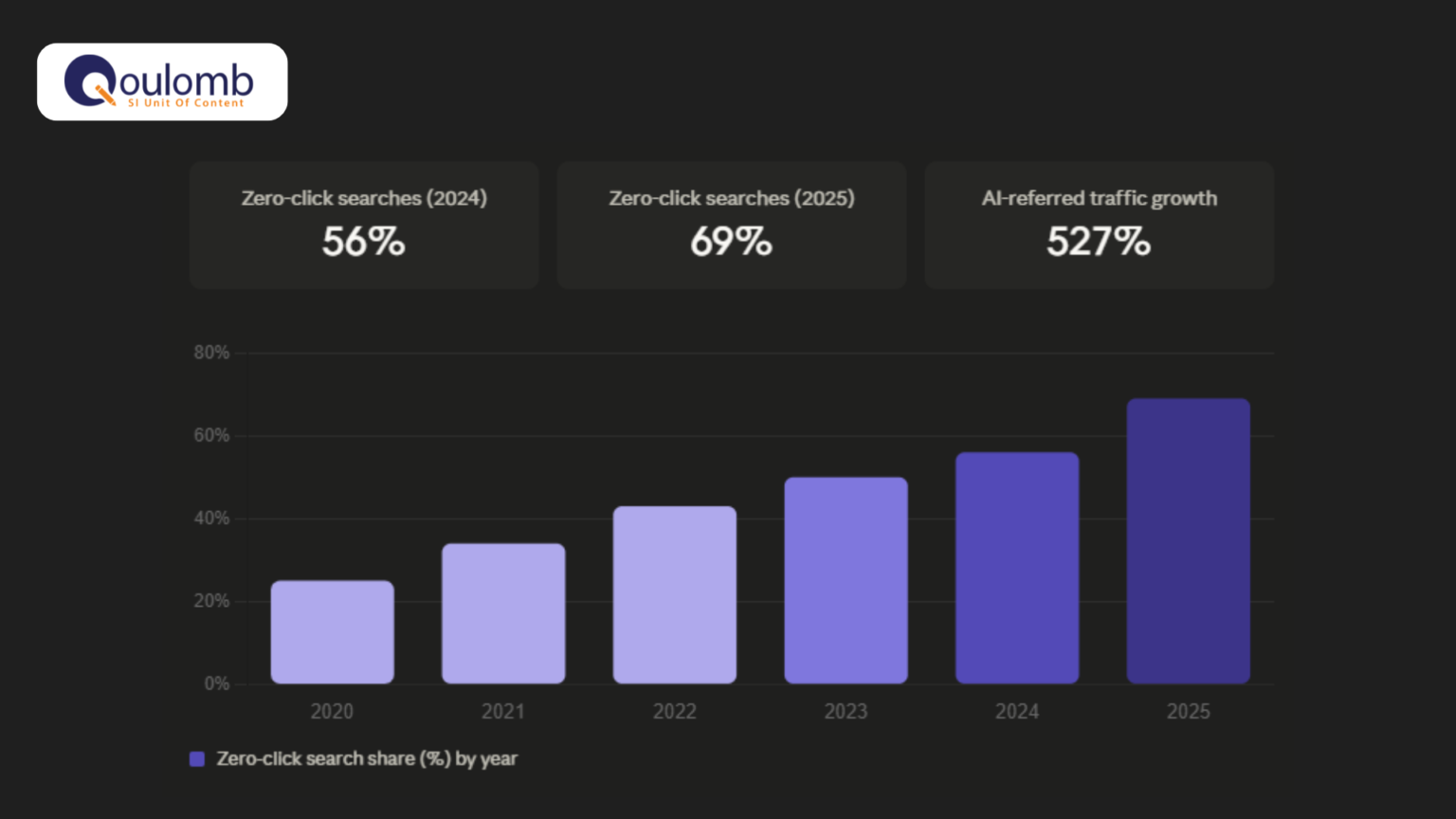
The shift is already happening at scale. Zero-click searches hit 69% in 2025. AI-referred sessions to websites grew 527% year-over-year. Every brand still optimizing exclusively for traditional search is competing for a shrinking share of a changing game.
This guide covers what AEO is, how it differs from SEO, and what you need to do to start showing up in AI-generated answers.
- TL;DR
- Answer Engine Optimization (AEO) helps your content appear in AI-generated answers from platforms like ChatGPT, Perplexity, Google AI Overviews, and Copilot, not just in traditional search results.
- As zero-click searches continue to grow, brands need to optimize for direct answers because users increasingly get information from AI tools without visiting websites.
- Successful AEO focuses on clear answers, structured content, schema markup, E-E-A-T signals, and content that matches real user questions rather than only targeting keywords.
- Businesses that invest in AEO now can increase brand visibility, authority, and AI citations, while those relying only on traditional SEO risk being left out of important AI-driven customer conversations.
What is Answer Engine Optimization (AEO)?
Answer engine optimization (AEO) is the practice of structuring your pages so AI-powered answer engines such as Google AI Overviews, ChatGPT, Perplexity, and Microsoft Copilot can extract, cite, and attribute your brand as a trusted source.
The practical reality is simpler: AI systems are now the first stop for hundreds of millions of search queries every day. ChatGPT alone handles over 2 billion queries daily, and AI-referred sessions to websites grew 527% year-over-year through mid-2025. When these systems generate a response, they pull from content they consider authoritative, clear, and well-structured. AEO is the work of becoming that content.
It is also worth understanding what AEO is not. It is not a replacement for SEO. It does not require you to throw out your existing content strategy. It is an additional layer of intentionality on top of what you already do, one that accounts for the fact that a large and growing portion of your audience is now finding information through AI, not through a results page.
Answer Engine Optimization helps your content become the answer, not just another link in the search results.

Founder
Sourabh Yadav
Why AEO Matters Right Now
The zero-click reality
Zero-click Google searches went from 56% in 2024 to 69% in 2025. ChatGPT serves 800 million users weekly. Voice assistants answer questions directly. These are not projections. This is the current state of search, and it has arrived faster than most marketing teams anticipated.
When someone asks an AI what the best project management tool is, or how to fix a leaking pipe, or what a particular medical symptom means, they receive an answer immediately. They do not browse five websites and compare. The AI does that comparison for them and delivers a conclusion. If your content is not one of the sources informing that conclusion, you simply do not exist in that moment.
Visibility without traffic is still valuable
This is the part that trips most marketers up. A well-optimized answer might get cited thousands of times in ChatGPT conversations or Google AI Overviews without generating a single session in analytics. That sounds alarming until you think about what those citations are doing. They are building brand recognition. They are establishing authority. They are shaping the buyer’s perception before they ever land on your site.
These tools are quickly becoming the first touchpoint into the buyer journey, especially as users shift from keyword-based searches to conversational queries. Failing to optimize for answer engines is not just a missed opportunity but a growing risk.
Most brands don't know how visible they are in AI search
Get a clear view of your AI search presence and competitor gaps.
AEO vs SEO: What is the Difference?
Traditional SEO focuses on improving placement in organic search results. AEO focuses on being the source that AI tools trust enough to reference. With SEO, success looks like ranking on page one. With AEO, success looks like your brand being the answer a user receives, sometimes without a click ever happening.
That said, the two strategies reinforce each other more than they compete. A well-structured, authoritative page that ranks well in traditional search is also more likely to get cited by AI systems. Strong backlink profiles, technical SEO hygiene, fast load times, clear content hierarchy: all of these matter for both disciplines.
Where they diverge is in the writing itself. SEO content is still largely written for keyword matching and click intent. AEO content is written to be extracted. It answers questions directly, it uses natural language, and it is structured so an AI can pull a clean, coherent answer without needing to interpret ambiguous prose.
This is also what separates AEO from traditional SEO at a more fundamental level than most people realize, and why many B2B marketers are now treating AEO vs GEO as the more relevant strategic question for 2026.
How Answer Engines Decide What to Cite
Structured data and schema markup
Marking up content and entities helps reinforce who you are, your expertise, and your affiliation and helps the AI assess credibility. FAQPage schema, HowTo schema, Product schema, Organization schema: these are not optional extras. They are the vocabulary AI systems use to understand what your content is and whether it is trustworthy enough to surface.
The practical starting point is auditing your highest-value pages and identifying which schema types apply. FAQ content gets FAQPage markup. Instructional guides get HowTo markup. The goal is to make your content machine-readable, not just human-readable.
E-E-A-T signals
Experience, Expertise, Authoritativeness, and Trustworthiness. Google introduced E-E-A-T as a quality standard for human raters, but AI systems use similar logic when deciding which sources to cite. Verified author bios with real credentials, original research and data, citations to credible external sources, and consistent brand mentions from respected publications all contribute to the authority profile that makes AI systems choose you over a competitor.
Conversational intent
AEO success requires shifting from traditional keyword targeting to understanding natural language patterns. Users ask complete questions rather than using fragmented keyword phrases. Content written in natural, conversational language that mirrors how people actually ask questions gets extracted far more reliably than content built around short-form keyword clusters.
This means your content needs to ask and answer full questions. Not “best project management software” but “what is the best project management software for small teams and why.” The difference sounds subtle but it changes how you structure an entire page.
What Counts as an Answer Engine
The landscape is wider than most people assume. Google AI Overviews is the most visible example, but it is not the only platform worth optimizing for.
ChatGPT’s browse mode pulls from live web content and cites sources directly. Perplexity is built almost entirely around citation, surfacing references prominently alongside every answer. Microsoft Copilot runs on Bing’s index and rewards strong technical SEO combined with conversational content structure. Voice assistants like Siri and Alexa have been delivering direct answers for years, favoring concise, single-paragraph responses above everything else.
Each platform weighs content signals slightly differently. But across all of them, the core requirements are the same: clarity, structure, and demonstrated authority.
As search evolves toward AI generated responses, AEO focuses on making your expertise easy for answer engines to find, understand, and cite

Founder
Vivek Mishra
How to Optimize Your Content for AEO
Write answers first, context second
The single most important structural change you can make to rank on AEO is leading with the answer. AI systems extract the clearest, most direct response available. AEO works by leveraging structured data and natural language processing to provide concise, relevant answers tailored to user intent. If your answer is buried in paragraph five after three paragraphs of background, it will be skipped in favor of a competitor whose answer appears in line one.
A useful discipline: before writing any piece of content, write a single sentence that directly answers the core question. That sentence belongs at the top of the page.
Target questions, not just keywords
Keyword research for AEO looks different. Tools like AlsoAsked, AnswerThePublic, and the People Also Ask section in Google Search surface the actual questions your audience is typing, including follow-up questions and adjacent curiosities. Shift from single keywords to questions and intent phrases. Target long-tail queries that sound like natural language. That is your content roadmap. Each question is a potential citation opportunity.
Build real authority signals
Authority in the AEO context is not just about backlinks, though those still matter. It is about whether an AI system can verify that you know what you are talking about. That means named authors with visible credentials, original data and research that other sources cite, and a consistent presence across trusted publications and platforms. These signals compound over time. Brands that start building them now will have a meaningful head start when AI search continues to grow.
Track your AI citations
AEO is not a one-time setup. It is a continuous cycle of monitoring, testing, learning, and improving. To stay visible in AI results, brands need clear measurement habits and a feedback loop that evolves with search behavior and LLM intelligence. Tools like Frase, Search Atlas, and Scout by Yext track where your brand appears in AI-generated answers. Without monitoring, you are optimizing blindly.
AEO helps brands become the answers buyers see first
Learn how answer-focused content improves visibility and conversions
The Bottom Line
Answer engines are already changing how buyers research, compare options, and make decisions. As AI platforms become a primary discovery channel, brands need to focus on being cited and recommended, not just ranked.
The companies winning in AI search are not always the biggest. They are the ones publishing clear, trustworthy, and well-structured content that AI systems can confidently reference. Strong authority, credible sources, and direct answers matter more than ever.
For B2B brands, this creates a major opportunity. Companies that invest in SEO, AEO, GEO, and AI visibility today will be better positioned to generate qualified leads and build long-term pipeline growth as search continues to evolve.
If you need help getting there, Qoulomb helps B2B companies improve visibility across both traditional search engines and AI platforms through an integrated SEO, AEO, GEO, and AI SEO strategy focused on leads, pipeline, and revenue—not just traffic.
Frequently Asked Questions (FAQs)
1. Is AEO replacing SEO?
No. AEO builds on top of SEO, not replace it. The fundamentals that help a page rank well also help it get cited by AI systems. What AEO adds is intentionality around structure, clarity, and authority signals that AI platforms specifically look for.
2. How do I know if my content is being cited by AI?
Tools like Frase, Search Atlas, and Scout by Yext are built to monitor AI citations. You can also manually query ChatGPT, Perplexity, and Google AI Overviews for questions your content answers and check whether your brand is being referenced.
3. Does AEO work for small businesses or only big brands?
AEO levels the playing field. AI systems prioritize clarity, structure, and relevance over domain size. A small business with a well-structured, specific answer can get cited over a large brand whose content is vague or poorly organized. Niche expertise is particularly valuable.
4. What is the difference between AEO and GEO?
GEO stands for Generative Engine Optimization and is largely used interchangeably with AEO. Both refer to optimizing content for AI-generated responses. There is no universally agreed-upon difference between the two terms, though some apply GEO specifically to large language model outputs.
5. Does schema markup actually make a difference for AEO?
Yes. Schema gives AI systems a structured, machine-readable layer of information about your content. Without it, AI systems infer everything from unstructured text, which is less reliable. FAQPage and HowTo schema are particularly relevant to the queries AI platforms handle most frequently.
6. How long does AEO take to show results?
There is no precise timeline. Technical changes like schema markup can show impact relatively quickly. Building E-E-A-T authority takes months. AEO compounds over time, similar to how domain authority builds in traditional SEO, and requires ongoing effort rather than a one-time fix.