

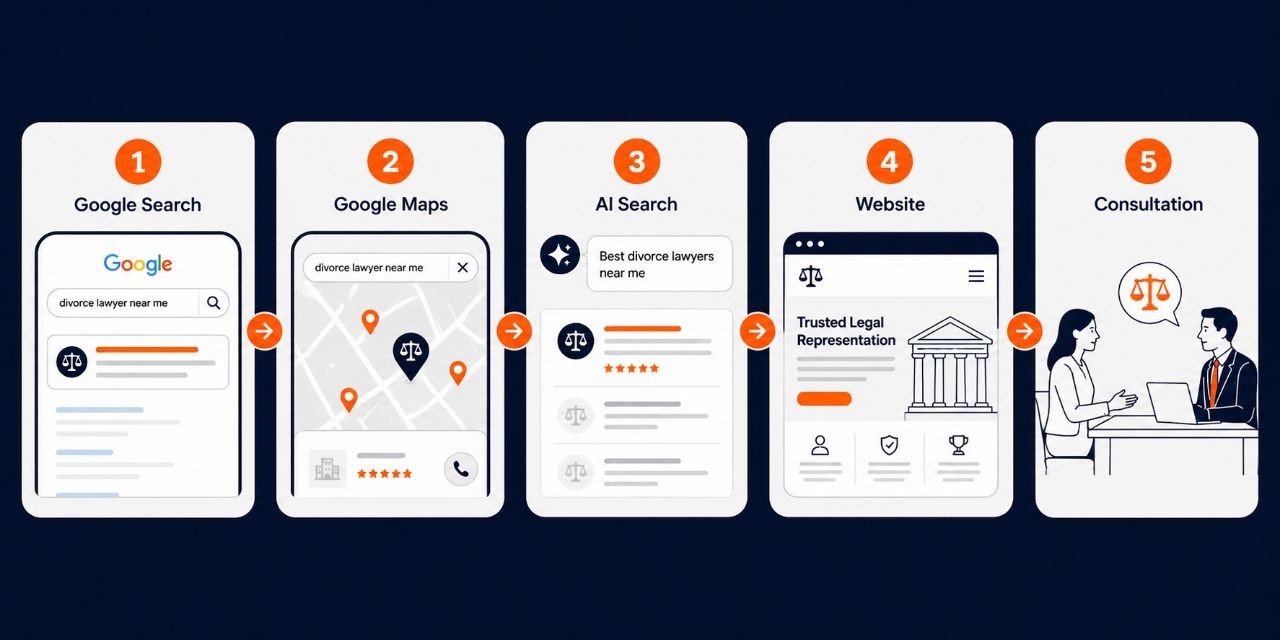
Finding a lawyer today almost always starts with a phone screen, not a phone book. People type “car accident lawyer near me” or ask an AI assistant who the best divorce attorney in their city is, then pick from whoever shows up first.
This is why SEO for legal services has become one of the most important tools a law firm can use. It helps your firm appear at the exact moment someone needs legal help, whether they are searching on Google, scrolling Google Maps, or asking ChatGPT for a recommendation.
In this guide, you will learn how people search for lawyers when they are ready to hire one, which local seo for lawyers strategies help your firm get found faster, and what best seo for legal services looks like when Google and AI search engines trust your firm enough to recommend it.
- TL;DR
- SEO for legal services helps law firms show up when people search for a lawyer near them, right when they need help the most, on Google and even inside AI answers like ChatGPT.
- Local seo for lawyers works best when paired with a strong Google Business Profile, real reviews, and a clean website structure that helps win the map pack and turn nearby searches into phone calls.
- Search engines and AI tools trust legal websites more when attorney bios, real case results, and clear credentials are easy to find and stay consistent across the whole internet.
- The best seo for law firms blends technical health, local listings, high-intent keywords, and honest, trustworthy content, building results that keep growing stronger long after a campaign officially ends.
What Is SEO for Legal Services?
SEO for legal services is the process of helping a law firm’s website get found online by people who are looking for a lawyer or legal advice.
For example, if someone searches “divorce lawyer near me” or “personal injury lawyer in Chicago,” SEO helps that law firm’s website appear in the search results, making it easier for potential clients to find and contact them.
Legal matters often involve money, family, or personal rights. Because of this, Google expects law firm websites to meet higher standards than most other websites. Real attorney profiles, correct information, and a fast, mobile-friendly website all play an important role.
Good SEO for legal services brings all these parts together. This helps search engines, and now AI tools as well, trust your firm enough to recommend it.
57%of legal consumers search online before hiring a lawyer. | 74%of lawyers market services through their law firm website. | 65%of law firms spend most marketing budgets on digital. | |||||
Most brands don't know how visible they are in AI search
Get a clear view of your AI search presence and competitor gaps.
Why High-Intent Local Searches Matter for Law Firms
Most people looking for a lawyer use high-intent local searches. These searches bring the best leads because the person is usually ready to hire a lawyer. Here is why these four factors are so important for your law firm’s growth.
1. High-Intent Searches Bring Better Qualified Leads
A high-intent search means the person is ready to take action, not just looking for information. Searches like “near me,” “free consultation,” or “file a claim” show they need help soon.
Ranking for local seo for lawyers keywords helps your firm appear in front of people who are already searching for legal help. This is very different from someone who is only reading general information about the law.
People who make high-intent searches are much more likely to call your firm and become clients than people making broad, early-stage searches.
2. Local Visibility Influences Client Decisions
Most people never look beyond the first page of Google. Many also trust the Google Maps results more than the normal blue links. If your firm does not appear in local search results, people may think you do not handle their type of case or do not work in their area.
Strong local visibility gives people confidence before they even contact you. It shows that your firm is active, trusted, and easy to find.
3. Organic Authority Builds Long-Term Growth
Paid ads stop bringing leads as soon as you stop paying. Organic SEO works in a different way. When one of your practice area pages starts ranking well, it can keep bringing in new leads month after month without paying for every click.
This long-term growth is why law firms that invest in SEO early seo for legal services helps grow faster than firms that depend only on paid ads. Every new page, review, and quality backlink makes your website stronger and harder for competitors to beat over time.
4. AI Search Rewards Trusted Legal Content
Tools like ChatGPT, Gemini, and Google’s AI Overviews now answer legal questions directly, often before someone even visits a website. These AI tools usually recommend websites that show real experience, trusted credentials, and consistent information across the internet.
A law firm that keeps its business listings correct and its website well organized already has a strong advantage. As more people search through AI tools, building this trust becomes just as important as getting a page-one ranking.
The Core Pillars of Law Firm SEO
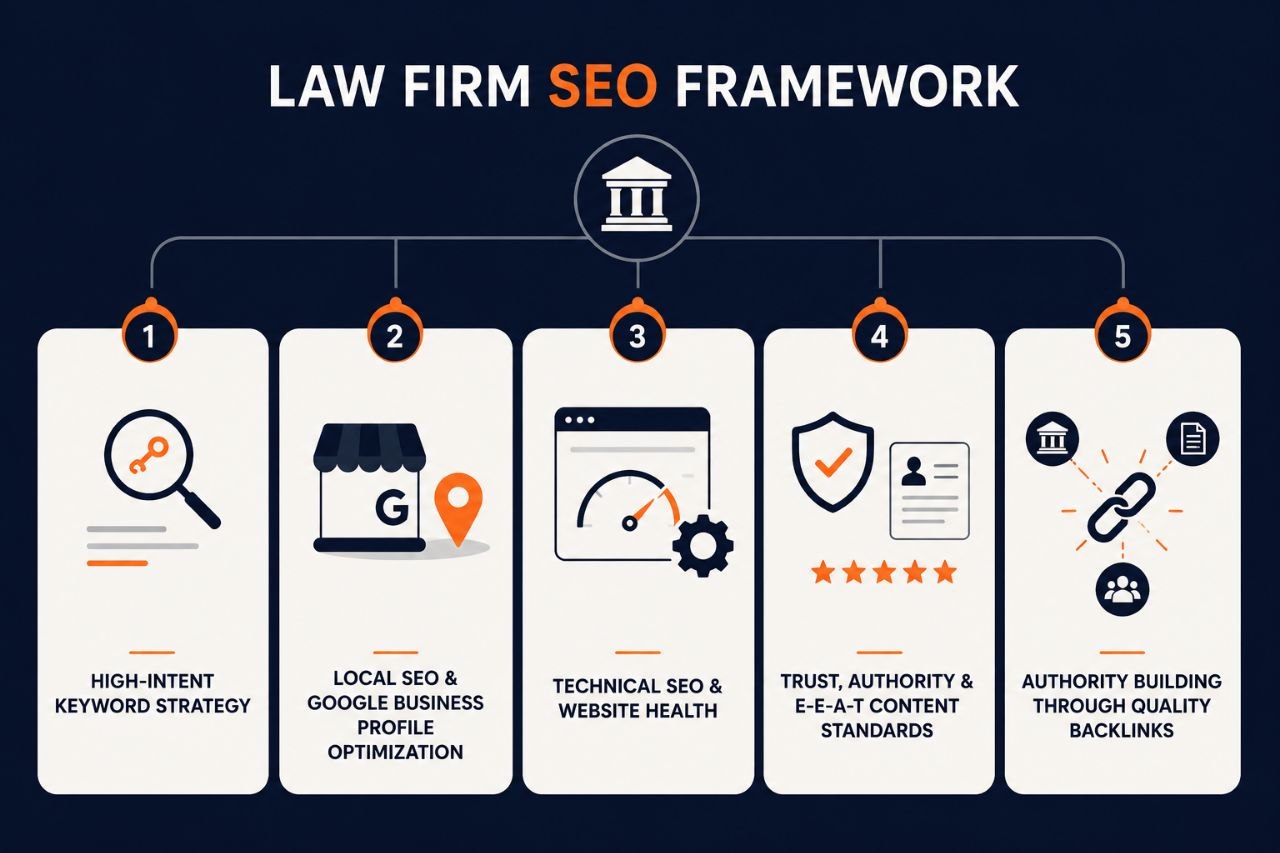
Every successful law firm SEO strategy is built on five connected pillars. Each one has a different job, but together they help your website rank better, build trust, and attract the right clients. Before we look at each one in detail, here is a quick overview.
1. High-Intent Keyword Strategy
Everything starts with understanding what potential clients search for before they hire a lawyer. This pillar focuses on finding those exact search terms and creating pages around them. It includes practice area keywords, city-based searches, and common legal questions.
2. Local SEO and Google Business Profile Optimization
If you want nearby clients to find your law firm, this pillar is essential. It focuses on improving your Google Business Profile, managing directory listings, and strengthening the local signals that help your firm appear in Google Maps and local search results.
3. Technical SEO and Website Health
Even the best content will struggle if your website has technical problems. This pillar makes sure Google can crawl, load, and understand your site properly. Fast loading pages, clean code, and a mobile-friendly design are all important parts of it.
4. Trust, Authority, and E-E-A-T Content Standards
People and search engines both want to know they can trust your law firm. This pillar highlights your attorney profiles, case results, testimonials, and professional credentials because these are the signals Google and AI tools look for when evaluating legal websites.
5. Authority Building Through Quality Backlinks
Trust also comes from other websites talking about your firm. This pillar focuses on earning quality links and mentions from respected sources such as legal directories, bar associations, and local news websites. Each trusted mention helps strengthen your firm’s authority.
Legal services operate in a $1.10 trillion global market, making organic search visibility the single highest-return channel for client acquisition. |
High-Intent Keyword Strategy for Law Firms
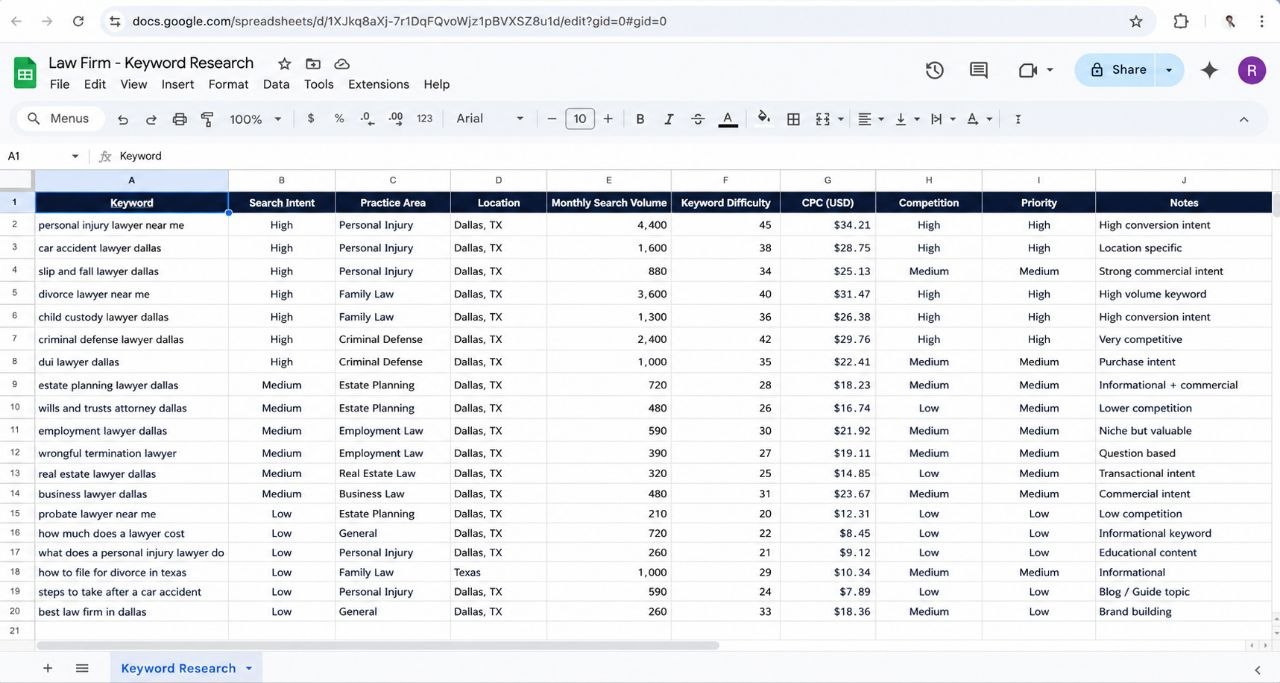
After understanding the five pillars, keyword strategy is usually the best place to begin. The right keyword plan helps your law firm connect with people at every stage of their search, from those looking for information to those who are ready to hire a lawyer.
1. Practice Area and Geo-Modified Keywords
These are some of the most valuable keywords because they are used by people who are ready to hire a lawyer. For example, someone might search for “personal injury lawyer in Denver” or “divorce attorney Austin TX.”
Instead of trying to rank one page for every legal service, create a separate page for each main practice area. This gives every page a clear focus and makes it easier for search engines to understand what it is about.
Add your city name, and sometimes even your neighborhood, naturally in the page title, heading, and throughout the content where it fits. Some common examples are:
- Personal injury lawyer + city name
- Divorce attorney + city name
- Criminal defense lawyer + city name
- Estate planning attorney + city name
2. Long-Tail and Question-Based Keywords for AI Visibility
Not everyone searches with short keywords. Many people ask detailed questions like “what happens after a hit and run in Texas,” especially when they are looking for answers before contacting a lawyer.
These are also the kinds of questions AI Overviews and AI chat tools often answer directly.
Writing blog posts and FAQ pages around these questions gives your law firm a better chance of being the source AI tools use when they generate answers instead of showing only a regular search result.
3. Building Topic Clusters and Practice Area Silos
One good page is helpful, but it is usually not enough to rank for a competitive legal topic. Search engines prefer websites that cover a subject in detail.
A simple way to do this is by creating topic clusters. Start with one main practice area page, then add supporting pages that cover related case types and common client questions.
For example, your personal injury page can link to separate pages about car accidents, truck accidents, and wrongful death. All of these pages should also link back to the main practice area page.
4. Prioritizing Keywords Across Multiple Practice Areas and Locations
Most law firms cannot work on every keyword at the same time, so you need to decide what should come first. Focus on keywords that people search for often, are possible to rank for, and bring the most valuable cases to your firm.
Highly competitive practice areas, like personal injury, usually need more content and more time before they rank well. Smaller practice areas often have less competition, so they can rank faster with fewer pages.
If your law firm has offices in different cities, start by focusing on the locations that bring in the most clients or revenue. Once those pages are performing well, you can expand to the other locations.
“High intent keywords do more than improve rankings. They connect law firms with people who are ready to take legal action.”

Founder
Vivek Mishra
Google Business Profile and Google Maps Optimization
Your Google Business Profile can make a big difference in whether nearby clients find your law firm or not. If you want to appear in Google Maps and local search results, these are the things you should focus on.
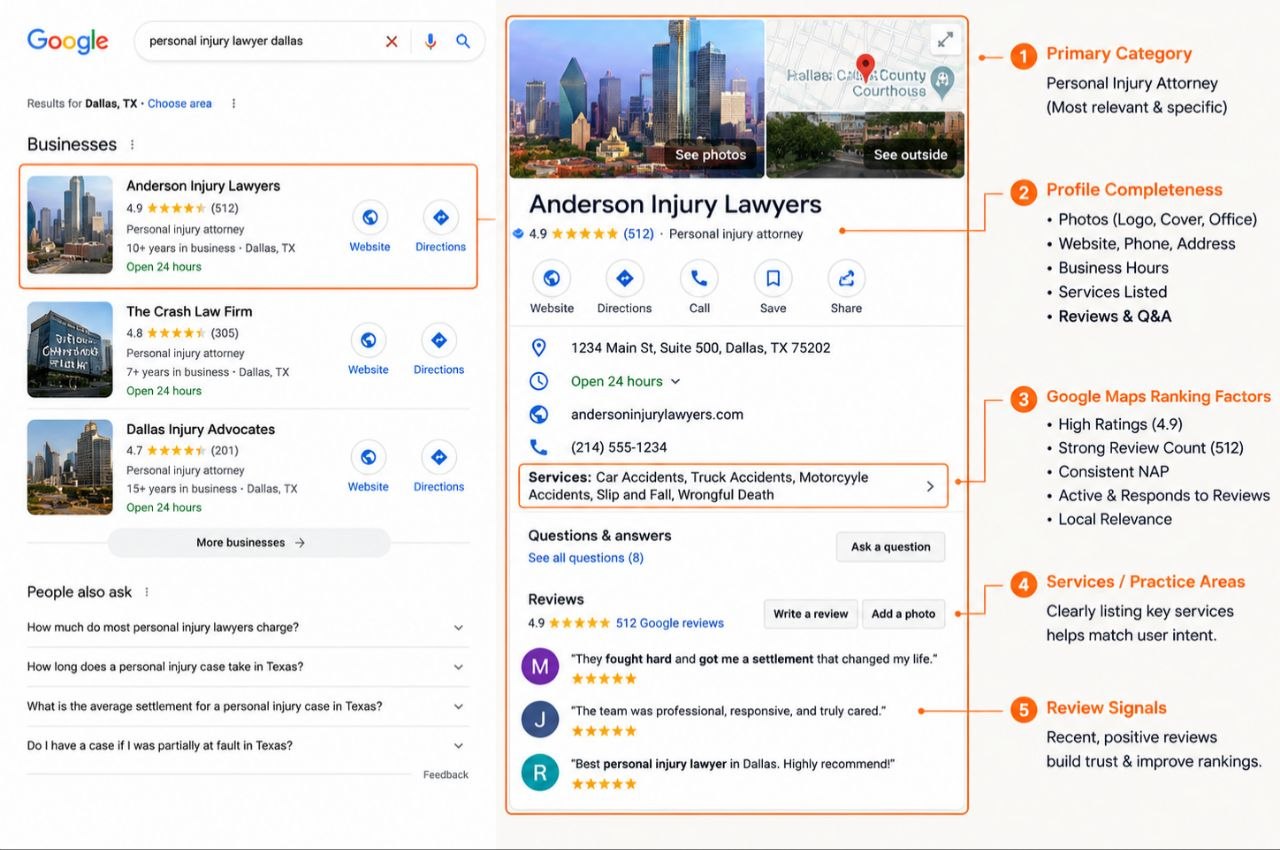
1. Choosing the Right Primary and Secondary Categories
The category you choose for your Google Business Profile is one of the strongest local ranking factors you can control. At the same time, it is also one of the most common mistakes law firms make.
For example, if your firm mainly handles personal injury cases, choose “Personal Injury Attorney” as your primary category instead of the general “Lawyer” category. Then add the right secondary categories and include all
2. Profile Completeness and Ongoing Activity Signals
AI models can learn about your brand in two different ways.
Training data is the information the model learned before it was released. This cannot be changed quickly, although consistent information about your brand can influence future versions.
Live retrieval is the information the AI finds at the time someone asks a question. This is where AI SEO makes the biggest difference because your content can be discovered and cited right away.
3. Avoiding and Recovering from GBP Suspensions
Google Business Profile suspensions are common for law firms. This can happen because of a virtual office address, a shared office space, or even if someone reports your listing as spam.
A suspension can remove your firm from local search results almost overnight, and Google usually doesn’t tell you the exact reason.
If your profile gets suspended, collect proof that your office is real. This can include your lease agreement, a utility bill, and a short video showing the outside of your office and your suite number. Since Google gives only a few chances to appeal, make sure you have strong documents ready before sending your request.
4. Managing Multiple Office Locations
If your law firm has more than one office, each location should have its own Google Business Profile, its own location page on your website, and its own local citations.
Don’t create one page and simply replace the city name for every location. Google treats each office as a separate business location.
Instead, create unique content for every office. Add details like nearby courts, local laws, directions, and information about the area. This helps both Google and potential clients see that your firm really serves that location.
Technical SEO and Schema Markup for Law Firm Websites
Even the best content will not rank if your law firm’s website has technical problems. That’s why it’s important to fix the basics first. A simple technical SEO checklist can help you find and fix these issues before they start hurting your rankings.
1. Site Speed, Core Web Vitals, and Mobile Experience
Most people looking for a lawyer search on their phone, often when they need help quickly. If your website loads slowly, many visitors will leave before they even read your content.
Google checks this through Core Web Vitals. These measure how fast your page loads, how quickly it reacts when someone taps it, and whether anything moves around while the page is loading.
Simple improvements like compressing images, cleaning up extra code, and using reliable hosting can make a big difference. Many law firms see better rankings after fixing these technical issues, even before adding new content.
2. Crawlability, Indexation, and Clean Website Architecture
Google can only rank the pages it can find and understand. A well-organized website with simple URLs and strong internal links makes it easier for Google to crawl every important page. At the same time, pages with little value, like old announcements or very short attorney bios, should stay out of Google’s index.
If Google spends time crawling unnecessary pages, it may miss your important practice area pages. A clean website structure helps Google focus on the pages that bring in real clients.
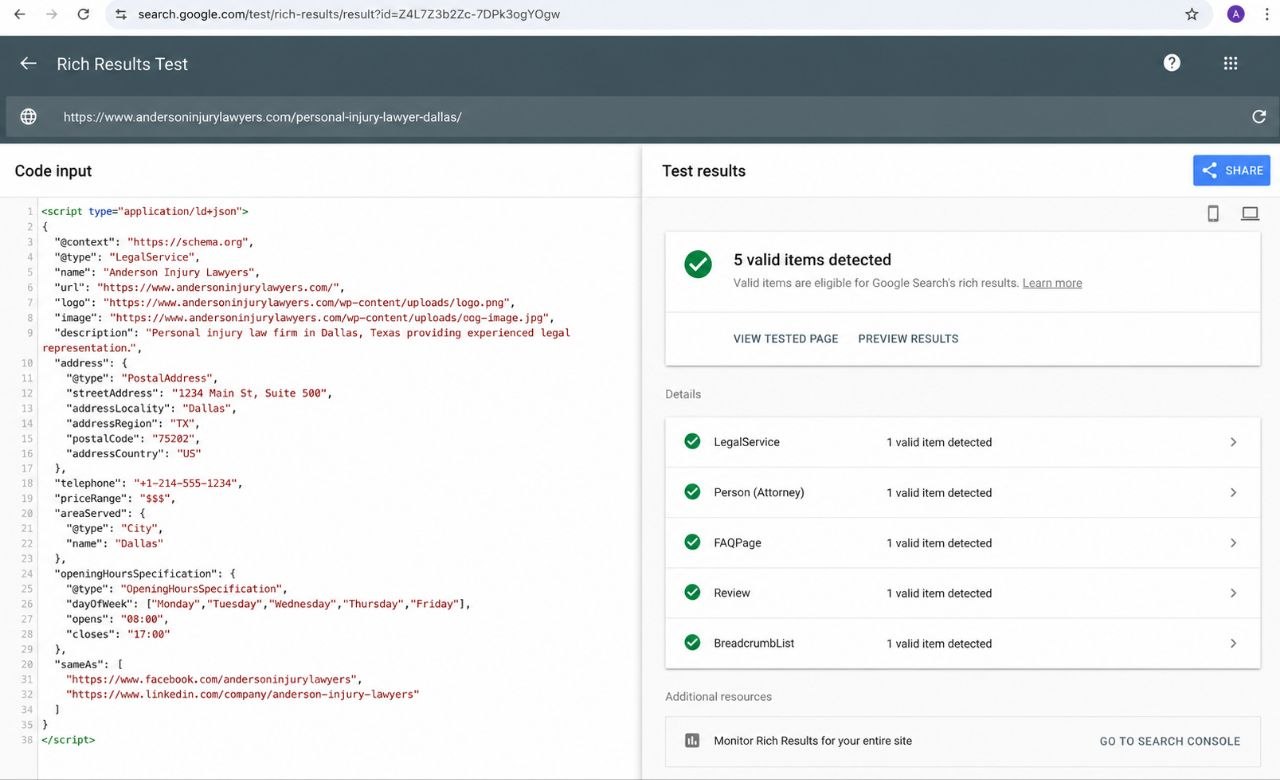
3. Building the Right Schema Stack for Legal Websites
Schema is a type of hidden code that helps search engines understand what your website is about. For most law firms, the right schema setup includes:
- LegalService schema for the law firm
- Person schema for each attorney
- FAQPage schema for pages with common questions
- Review schema based on real client reviews
The older Attorney schema is no longer very useful because Google gives it much less importance now.
When a schema is set up correctly, it connects your law firm’s name, attorneys, and services into one clear profile that search engines and AI tools can easily understand and recommend.
4. Understanding the Limits of Schema for AI Visibility
Schema helps search engines and AI tools understand your website better, but it cannot make ChatGPT or Google recommend your law firm by itself. Think of schema as a way to organize your information clearly, not as a shortcut to higher rankings.
If your pages are thin or not useful, adding schema alone will not help much. It works best when your website already has helpful content that answers real client questions.
5. Protecting SEO During Website Redesigns and Migrations
Many law firms lose rankings after redesigning their website. This usually happens because old URLs are changed without proper redirects or valuable content gets removed during the redesign.
Before launching a new website, make sure every old URL points to the correct new page, keep your best-performing content, and test everything carefully before replacing the old site. A website redesign should improve your SEO, not erase the progress you’ve already made.
6. Secure Website Standards for YMYL and Legal Services
Law firm websites fall under Google’s Your Money or Your Life (YMYL) category. That means Google expects a higher level of trust and security. A valid SSL certificate, secure contact forms, and updated hosting are essential. They are not optional.
Clients often share private information through your contact forms. If your website has security problems, it can hurt both your rankings and your firm’s reputation.
E-E-A-T and Trust Signals for Legal Websites
Google and AI tools want to know that your content comes from real, qualified lawyers. Before they trust your website, they look for proof that your firm has real experience, real people, and a strong reputation. Here are the trust signals that matter most.
1. Attorney Profiles That Demonstrate Expertise
Every lawyer in your firm should have a complete profile, not just a name and a photo. Share details like bar admissions, years of experience, practice areas, important case types, and any awards or certifications.
This helps Google understand that real legal professionals are behind your content. It also gives potential clients confidence because they can see exactly who will be handling their case.
2. Experience Signals Supported by Real Case Examples
Real experience matters more than simply saying you’re an expert. Google also looks for proof that your firm has handled real cases.
One of the best ways to show this is by creating detailed case studies that explain the problem, the legal approach, and the outcome while following your state bar’s advertising rules. You can even create a dedicated case study page like we have and use it as a reference when building your own.
Avoid broad claims like “we win most of our cases.” Honest, real examples build much more trust with both search engines and potential clients.
3. Client Testimonials That Increase Credibility
Real client testimonials help build trust because they show future clients that people have had a good experience with your firm.

You can add written testimonials to your practice area pages and also include client testimonial videos where they fit naturally. For example, you can embed a client testimonial video, so visitors can hear directly from a real client. If you have written reviews as well, add those alongside the video to make the page even more trustworthy.
Always follow your state’s ethics rules when collecting testimonials, and never write or edit a client’s feedback on their behalf.
4. Professional Certifications and Legal Associations
Professional certifications, bar association memberships, and recognitions like Super Lawyers or Martindale-Hubbell ratings help build trust because search engines can verify them through trusted sources.
Showing these credentials on your homepage and attorney profile pages tells both Google and potential clients that your qualifications are genuine.
This is even more valuable for AI tools, which often compare your information with trusted directories before recommending your law firm.
5. Editorial Mentions That Strengthen Brand Authority
When your law firm is featured in a local news article, legal publication, or podcast, it sends a strong trust signal to Google. It shows that respected sources see your firm as a reliable authority.
These mentions carry more value than a simple directory listing because they are much harder to earn. Look for opportunities to comment on legal news, write guest articles, or speak at local events. Over time, these mentions help build a reputation that competitors can’t easily copy.
“Effective legal SEO is not about attracting more traffic. It is about reaching the clients who need your services at the exact moment they are searching.”

Founder
Sourabh Yadav
Organic SEO vs. PPC vs. Local Services Ads
Most law firms end up choosing between three main channels: organic SEO, Google Ads (PPC), and Local Services Ads, often called Google Screened.
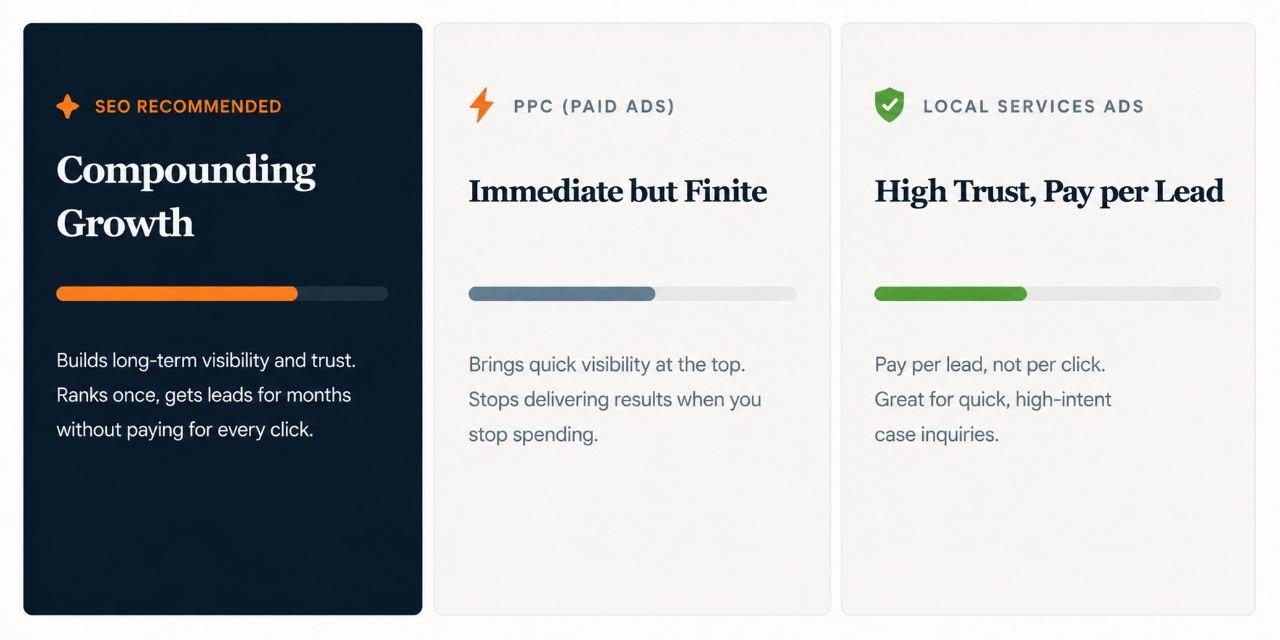
Each channel behaves differently, and the strongest firms usually blend more than one instead of picking just a single channel. PPC and LSAs bring in calls almost immediately, which helps while organic rankings are still building.
Organic SEO for legal services takes longer to grow, but it keeps producing new leads long after the initial work is done, without paying for every single click. Here is how the three compare side by side.
Factor | Organic SEO | Google Ads (PPC) | Local Services Ads |
Time to see results | 3 to 12 months | Same day | A few days to weeks |
Cost per lead over time | Drops as rankings grow | Stays steady or rises | Pay per lead, not per click |
Best for | Long-term, compounding growth | Fast, short-term visibility | Verified, high-trust leads |
Client trust | Seen as more credible | Seen as an ad | Comes with a “Google Screened” badge |
Needs ongoing spend | No, once ranked | Yes, always | Yes, always |
AI Overview visibility | Can be cited directly | Shown separately from AI answers | Not shown inside AI answers |
The best seo for legal services tactis for law firms is usually not about choosing just one marketing method. Many law firms use Local Services Ads and a small PPC budget at the beginning to get quick phone calls, while SEO for legal services keeps growing in the background.
After about twelve to eighteen months, organic SEO often becomes the channel that brings in the most trusted leads at the lowest cost compared to the other options.
According to the Martindale-Avvo Legal Consumer Report, 92.4% of legal consumers research their specific legal issue online before ever reaching out to an attorney |
Common Law Firm SEO Mistakes to Avoid
Even law firms with a good marketing budget can make mistakes that slow down their SEO growth. The good news is that most of these mistakes are easy to avoid once you know what to look for.
1. Confusing Tactics with Strategy
Many firms think publishing blogs, buying a few backlinks, or updating page titles is enough. These are useful SEO tasks, but they don’t replace a real strategy.
A strong SEO plan starts by understanding your practice areas, the cities you want to rank in, and the firms you’re competing against. Once you have that foundation, every page and every SEO activity has a clear purpose.
When firms skip this planning stage, they often end up with scattered content that doesn’t build authority or bring steady results.
2. Publishing Thin or Templated Location Pages
Creating one location page and simply changing the city name is one of the most common mistakes law firms make.
Google can easily recognize pages that look almost identical. Because of this, those pages usually struggle to rank in different locations.
Instead, every location page should include useful local information, such as nearby courts, local landmarks, important state laws, and details that show your firm genuinely serves that area.
3. Delaying AI Search Optimization
Some law firms are still waiting to see if AI search will become important before they start working on it.
The reality is that AI Overviews already appear in many Google searches, and people are also asking tools like ChatGPT and Perplexity to recommend lawyers. Learning how Perplexity ranks content can help you understand what AI platforms look for before recommending a law firm.
The longer you wait, the more time your competitors have to build the trust signals and helpful content that AI search relies on. Starting now, even with small improvements, gives your firm a better chance of staying ahead.
4. Ignoring Your Brand Presence in AI Search
Getting mentioned in AI search results is becoming just as important as ranking on Google.
If you never check where or how your law firm appears in AI tools, you could miss valuable opportunities to improve your visibility. A simple way to stay ahead is to track AI mentions regularly and understand how your firm is being referenced across different AI platforms.
Keeping an eye on these mentions helps you measure your visibility and spot new opportunities before your competitors do.
Choosing the Right SEO Partner for Your Law Firm
If you’re planning to choose an SEO agency, asking the right questions can save you a lot of time, money, and frustration. It also helps you avoid agencies that make big promises but deliver very little.
Questions to Ask Before Hiring a Legal SEO Agency
Before you hire an agency, ask how many law firms they currently work with and which practice areas they have experience in. SEO for legal services is different from other industries because it also needs to follow bar advertising rules. You should also ask questions like:
- Can you show real law firm seo results from another law firm client?
- What does your SEO process look like each month?
- How do you make sure the content follows advertising rules?
- If we stop working together, will I still own my website and rankings?
A good agency will answer these questions clearly and honestly. If the answers are confusing, full of jargon, or too vague, it’s usually a warning sign.
Red Flags That Signal a Risky Agency
Be careful if an agency promises a guaranteed first-page ranking. No one can guarantee Google rankings because nobody controls Google’s algorithm.
Also, be cautious of fixed “Gold,” “Silver,” or “Bronze” SEO packages. Every law firm has different goals, so the best seo for legal services tacticfor law firms should always be based on a custom strategy, not a one-size-fits-all package.
Another warning sign is when an agency builds your website on its own platform and doesn’t let you fully own your content or data. This can make it difficult to move to another agency later. A trustworthy agency is honest about timelines, explains the risks clearly, and answers your questions in simple, easy-to-understand language.
Firms that do this well usually partner with agencies that truly understand legal marketing, rather than following the same generic SEO strategy used in most other industries.
The Future of Legal SEO: Winning in AI-First Search
The way people search for lawyers is changing quickly. Firms that start adapting now will have a better chance of staying ahead. Here’s what you should know.
1. How AI Platforms Decide Which Law Firms to Cite
AI tools don’t choose law firms the same way Google search results do. Instead, they compare your firm’s name, services, credentials, reviews, and other details across your website, legal directories, bar association listings, and other trusted sources before mentioning you in an AI-generated answer.
When all of this information matches, your firm becomes easier to trust. That’s why keeping your details accurate everywhere can help you stand out, even against firms with bigger websites.
This is also why tracking generative engine optimization performance has become just as important as tracking your traditional search rankings.
2. Building a Verifiable Entity, Not Just a Website
Today, having a good website alone is not enough. AI search looks at your firm’s presence across the web.
Make sure your firm’s name, address, phone number, attorney details, and other important information stay the same on your website, Google Business Profile, legal directories, and bar association listings.
If the information is different in different places, AI tools may not fully trust your firm. Keeping everything consistent takes time, but it helps build a stronger and more trusted online presence.
3. What Won't Change Even as Search Evolves
Even though search keeps changing, some things will always matter. A fast website, helpful content, real attorney credentials, and honest client reviews will continue to build trust.
Both search engines and AI platforms want to give people the most reliable and helpful answer. Law firms that focus on earning that trust, instead of chasing every new trend, are the ones most likely to succeed over the long term.
High-intent local searches drive the most valuable legal leads
Learn the SEO strategies that help law firms rank and attract qualified clients
Final Thoughts
SEO for legal services is not a one-time task. It takes consistent work across local SEO, technical SEO, helpful content, and trust signals so your law firm appears when people are ready to hire a lawyer.
Today, ranking on Google is only part of the picture. Law firms also need to build credibility that helps them appear in AI search platforms like ChatGPT, Gemini, Perplexity, and Google AI Overviews, where more people are looking for answers before making a decision.
That’s where a partner like Qoulomb can help. By combining AI SEO, GEO, AEO, SEO, and content marketing into one strategy, Qoulomb helps B2B brands build visibility across both traditional search and AI search experiences, while connecting that visibility to real business growth.
Whether you manage SEO in-house or work with an agency, the goal stays the same. Real law firm seo results come from building a trusted online presence that both people and AI search tools are confident enough to recommend.
Frequently Asked Questions (FAQs)
1. Does SEO work for law firms?
Yes. The best seo for legal services ranks among the highest-return marketing channels for law firms because it targets people actively searching for a lawyer. Unlike ads, organic rankings keep generating leads without paying for every click. Results take a few months to build, but they compound over time, often beating paid channels within a year.
2. What is the 80/20 rule in SEO?
The 80/20 rule means roughly 80% of your results usually come from 20% of your efforts, like a handful of practice area pages or a few strong backlinks. For law firms, this often means focusing first on your highest-value practice areas and cities instead of spreading thin content across every possible keyword.
3. Is SEO dead or evolving in 2026?
SEO isn’t dead, it’s evolving. Traditional rankings still matter, but AI Overviews and chat-based search now sit alongside them. Local seo for lawyers strategies that build real trust, like accurate bios, reviews, and structured data, now serve both purposes at once, helping firms rank on Google while also getting cited inside AI-generated answers.
4. Is Claude or ChatGPT better for lawyers?
Neither is universally better. Claude and ChatGPT both pull from similar signals, like credentials, reviews, and consistent information across the web, when recommending a lawyer. Instead of picking one platform to optimize for, firms get the best results by building genuine expertise and consistency everywhere, since that improves visibility across every AI tool at once.
5. What are the core pillars of law firm SEO?
The core pillars are high-intent keyword strategy, local SEO and Google Business Profile optimization, technical SEO and website health, E-E-A-T trust signals, and authority building through backlinks. Strong results come from treating these five pillars as connected parts of one system, not five separate, unrelated tasks.
6. How does schema markup help legal websites rank better?
Schema markup is hidden code that clearly labels your firm, attorneys, and services for search engines. The right stack, LegalService, Person, and FAQPage schema, helps Google and AI tools understand and verify your site faster. It won’t guarantee a ranking on its own, but it removes confusion that could otherwise hold a strong page back.
7. Is organic SEO better than PPC for law firms?
Organic SEO for legal services tends to win long-term because it keeps producing leads without an ongoing cost per click. PPC and Local Services Ads win short-term, delivering calls almost immediately. Most successful firms use both together: paid channels for speed now, organic SEO for compounding growth later on.