

Choosing between an SEO consultant and an agency can be difficult, especially when both can help improve your search visibility, traffic, and leads. The right choice depends on your goals, internal resources, budget, and how much SEO execution you need.
SEO is also becoming more important as search behavior changes. HubSpot’s 2026 marketing research found that 48.4% of B2B marketers use website, blog, and SEO as a marketing channel, making SEO a key part of modern B2B growth strategies.
But does your business need one experienced seo consultant or a full team through an agency? This guide breaks down SEO Consultant vs SEO Agency, including their differences, costs, benefits, and when each option makes the most sense.
- TL;DR
- An SEO consultant is usually best when you need senior-level strategy, audits, specialized expertise, or guidance for an internal marketing team without outsourcing every SEO task.
- An SEO agency provides a broader team of specialists, making it a better fit when you need content, technical SEO, link building, analytics, and ongoing execution at scale.
- SEO Consultant vs SEO Agency comes down to your goals, internal resources, budget, project complexity, and how much SEO execution you want handled externally.
- You can also combine both models. A consultant can provide strategic direction while an agency or internal team handles implementation, content production, technical work, and ongoing optimization.
What Is an SEO Consultant?
An SEO consultant is an independent specialist who provides strategic advice, analysis, and guidance to improve a website’s organic search performance. Consultants typically work directly with business owners, marketing leaders, or internal SEO teams.
A consultant may work independently or through an seo consultant company, depending on the scope and structure of the engagement.
Below are the main areas an SEO consultant typically supports.
Strategic SEO Planning
An SEO consultant develops a roadmap based on business objectives, search intent, competition, technical health, and content opportunities. Instead of simply producing deliverables, the consultant identifies priorities and connects SEO activity with qualified traffic, leads, conversions, or revenue.
SEO Audits and Opportunity Analysis
SEO audits identify technical issues, content gaps, indexing problems, weak internal linking, ranking opportunities, and competitive weaknesses. A consultant can prioritize these findings based on potential business impact rather than giving the team a long list of disconnected recommendations.
Expert Guidance and Mentorship
Consultants provide senior-level expertise without requiring a permanent executive SEO hire. They can train internal marketers, review strategies, advise developers and writers, or help teams make better decisions when they lack experienced SEO leadership.
What Is an SEO Agency?
An SEO agency is a team-based provider that manages multiple areas of search optimization through specialists, account managers, strategists, content professionals, technical SEOs, and analysts.
Depending on its structure, an agency may operate as a specialized provider, full-service seo service agency, or broader digital marketing company.
Below are the core capabilities that distinguish agency-based SEO delivery.
Team-Based SEO Delivery
An agency brings several professionals into one engagement. Instead of relying on one person, clients may have access to technical SEO specialists, content strategists, writers, link-building professionals, developers, and analysts working toward shared objectives.
Specialized SEO Expertise
A larger team can provide expertise across different SEO disciplines. This is useful when a website needs technical improvements, content production, digital PR, link acquisition, international SEO, analytics, and conversion optimization simultaneously.
End-to-End SEO Management
An agency can manage the complete SEO lifecycle, from research and strategy to implementation, reporting, testing, and continuous optimization. This makes an agency useful when a company does not have enough internal resources to manage SEO consistently.
For businesses comparing an seo online agency with a consultant, the key question is whether they need broader execution or more direct specialist guidance.
Most brands don't know how visible they are in AI search
Get a clear view of your AI search presence and competitor gaps.
SEO Consultant vs SEO Agency: Core Differences
The biggest difference is the delivery model. A consultant generally gives you direct access to individual expertise, while an agency gives you access to a broader team and structured execution.
Below are the key differences to consider.
Factor | SEO Consultant | SEO Agency |
Team structure | Usually one specialist or small team | Multiple SEO specialists |
Primary strength | Strategy and expertise | Strategy plus execution |
Communication | Usually direct | Often through account managers |
Scalability | More limited | Easier to scale |
Best for | Focused needs and guidance | Ongoing, multi-channel SEO |
Typical resources | Specialized expertise | Broader tools, people, and processes |
1. Individual Expertise vs Specialized Team
A consultant gives you direct access to one professional’s experience and decision-making. An agency distributes work across specialists. The right choice depends on whether your challenge requires one senior expert or multiple capabilities operating simultaneously.
2. Strategic Guidance vs Full-Service Execution
Consultants are often strongest when you already have people who can execute recommendations. Agencies become more useful when you need someone to handle strategy and implementation. A consultant seo engagement can complement an internal team, while agency services can fill broader execution gaps.
3. Direct Collaboration vs Account Management
Working with a consultant often means speaking directly with the person responsible for your strategy. Agencies may use account managers to coordinate communication between clients and specialists. Both models can work, but businesses should decide how much direct expert interaction they expect.
4. Flexible Support vs Structured Delivery
Consultants can often adapt quickly to changing priorities, short projects, audits, or specific strategic questions. Agencies generally operate through defined processes, recurring deliverables, reporting schedules, and specialist workflows. This makes agency delivery more predictable for larger ongoing campaigns.
5. Limited Capacity vs Scalable Resources
One consultant can only manage a certain amount of strategic and implementation work at once. An agency can usually add specialists when campaign requirements expand. Businesses managing large websites or multiple markets may therefore benefit from greater agency capacity.
SEO Consultant vs SEO Agency: Cost Comparison
Cost should not be evaluated only by the monthly fee. You should compare what that fee provides in terms of expertise, execution, resources, communication, tools, and expected workload.
Below are the main factors that influence SEO pricing and overall value.
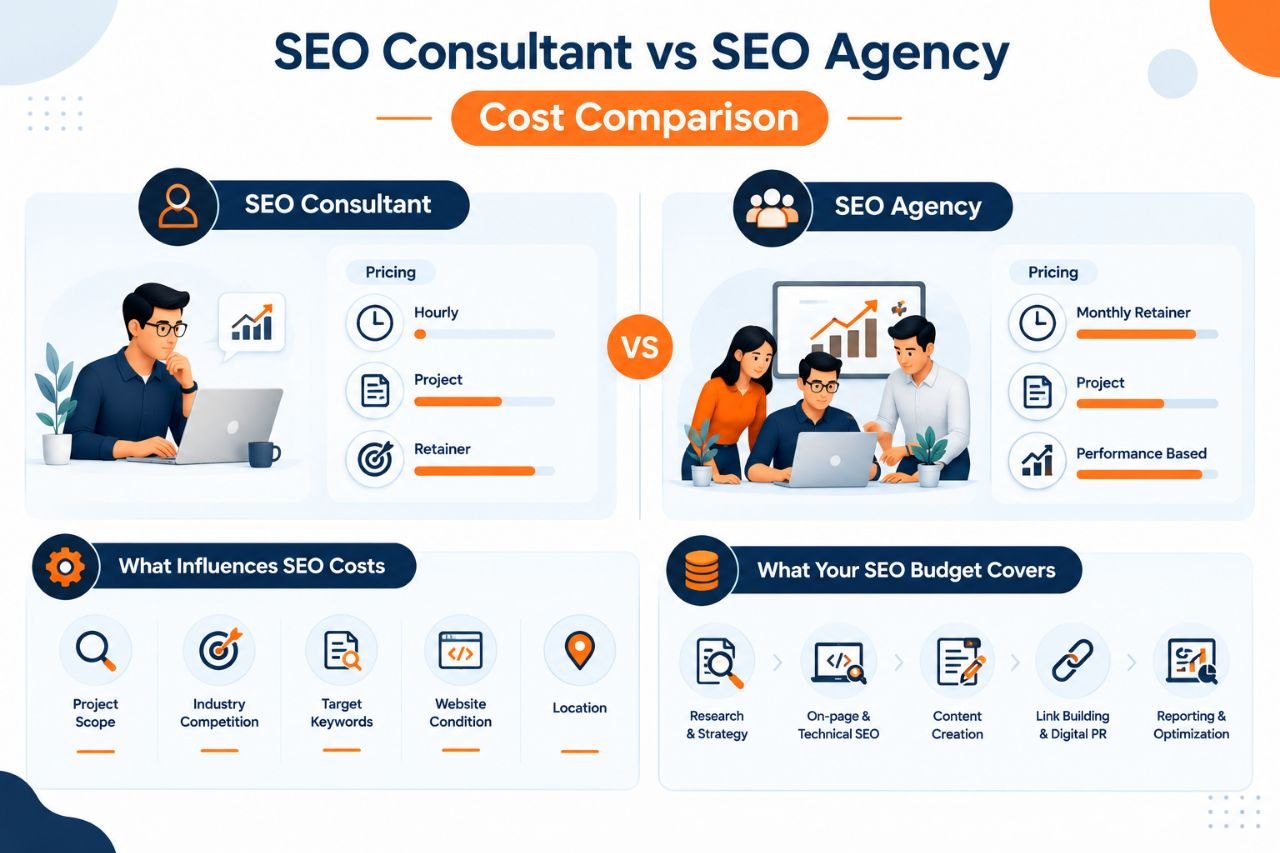
1. Consultant Pricing Models
Consultants may charge hourly rates, project fees, monthly retainers, or fixed prices for audits and strategy projects. A consultant can be cost-effective when you need specialized expertise without paying for a larger delivery team.
2. Agency Pricing Models
Agencies commonly use monthly retainers, project-based pricing, or customized contracts. Pricing can increase when campaigns require more content, technical development, link acquisition, international SEO, ecommerce optimization, or multiple specialists.
3. What Influences SEO Costs
SEO pricing depends on website size, competition, industry, technical complexity, geographic targeting, content requirements, authority-building needs, and implementation workload. A local website and a multinational ecommerce platform should not be expected to require the same investment.
What Your SEO Budget Covers
Before comparing providers, identify exactly what your budget includes. Ask whether the engagement covers strategy, keyword research, technical SEO, content, link building, reporting, implementation, analytics, and optimization.
A low-cost seo online agency may appear attractive, but limited deliverables can create additional internal workload. The same applies when comparing an independent consultant with a larger seo consultant company.
When to Hire an SEO Consultant
An SEO consultant can be a strong option when you already have internal resources but need experienced direction. Consultants are especially useful for businesses facing a specific SEO challenge rather than needing complete outsourced execution.
Below are the situations where a consultant may provide the most value.
1. You Have an Internal SEO Team
If your marketing team can execute SEO but lacks senior strategic experience, a consultant can fill the leadership gap. They can audit existing work, establish priorities, review performance, and help the team avoid costly strategic mistakes.
2. You Need Specialized Expertise
A consultant can be useful when you face a specialized challenge such as international SEO, technical migrations, ecommerce SEO, structured data, algorithm recovery, or a complex site architecture issue.
3. You Need a Strategic SEO Roadmap
When your team knows SEO matters but cannot determine what to prioritize, a consultant can create a focused roadmap. This can connect technical improvements, content opportunities, authority development, and business objectives.
4. You Need Senior-Level SEO Guidance
A consultant can provide senior-level decision-making without the cost or commitment of hiring a full-time executive. This is particularly useful during website migrations, major redesigns, market expansion, or periods of significant organic growth.
For example, an seo consultant for lawyers may focus heavily on local intent, practice-area pages, reviews, and legal search visibility. An seo consultant for attorneys may address similar requirements for firms targeting specific jurisdictions.
When to Hire an SEO Agency
An agency is generally better suited to businesses that need consistent execution across several SEO functions. It can provide the people, processes, tools, and production capacity required for larger or ongoing campaigns.
Below are the situations where an agency is usually the stronger fit.
1. You Need SEO Execution at Scale
If your campaign requires dozens of content pieces, technical improvements, internal linking, digital PR, authority building, and continuous optimization, an agency can distribute the workload across specialists instead of relying on one professional.
2. You Need Multiple SEO Specialists
Complex campaigns often require different skills. Technical SEO, content, link building, analytics, ecommerce SEO, international optimization, and conversion strategy may each require different expertise. An agency brings these capabilities together under one engagement.
3. You Want End-to-End SEO Management
If your team does not have the time or skills to manage SEO internally, an agency can handle the workflow from research and planning through execution and reporting. This reduces the number of external vendors your marketing team needs to coordinate.
4. Your SEO Workload Is Growing
A growing website often creates more SEO requirements. More pages mean more opportunities, but also more technical maintenance, content planning, optimization, and monitoring. An agency provides additional capacity as your organic search program expands.
“An SEO consultant can bring focused expertise, while an SEO agency can provide a wider team and broader capabilities.”

Founder
Vivek Mishra
SEO Consultant vs SEO Agency: Which Fits Your Business?
There is no universally better option. The right choice depends on your business stage, internal resources, objectives, website complexity, and desired level of involvement.
Below are the key factors to evaluate before making the decision.
1. Business Size and Growth Stage
Small businesses may benefit from a consultant when they need strategic direction without a large recurring engagement. Growing companies with expanding websites and markets may eventually need an agency to provide the execution capacity required for continuous SEO growth.
2. Internal Resources and Capabilities
Look at what your existing team can realistically handle. If you have writers, developers, marketers, and SEO professionals internally, consulting may fill specific gaps. If those capabilities are missing, an agency can provide a broader delivery team.
3. SEO Goals and Project Scope
A technical audit, migration review, or strategic roadmap may suit a consultant. A long-term program involving content, technical SEO, link building, analytics, and optimization is more likely to require an agency. For SaaS businesses, SaaS SEO agencies can be useful when specialized SEO support is needed.
4. Required Level of Involvement
Consider whether you want to make most SEO decisions internally or delegate execution. Direct involvement favors a consultant-led model. Businesses seeking a managed SEO program may prefer an agency that can take responsibility for recurring execution.
10 SEO Consultants and Providers to Consider
If you are comparing providers, consider specialization rather than simply looking for the biggest name. The following providers cover different SEO needs, including ecommerce, consumer brands, enterprise search, technical SEO, and B2B.
S.No | Provider | Best suited for |
1 | Neil Patel Digital | Ecommerce, consumer brands, and broad digital marketing |
2 | Aleyda Solis / Orainti | International and technical SEO |
3 | Qoulomb | B2B SEO and AI search |
4 | Kristina Azarenko | Technical and ecommerce SEO |
5 | Eli Schwartz | Product-led and growth-focused SEO |
6 | Kevin Indig | Enterprise SEO and organic growth strategy |
7 | Lily Ray | Enterprise, reputation, and advanced SEO |
8 | The Gray Dot Company | Enterprise and technical SEO |
9 | Glenn Gabe | Technical SEO and ecommerce-focused consulting |
10 | Backlinko / Brian Dean | Content-led SEO education and strategy |
For SaaS businesses, saas seo consultants can be particularly useful when the strategy needs to connect product-led content, comparison pages, high-intent searches, and conversion paths.
Businesses can also compare providers using these SEO agency selection questions before making a final decision.
Can You Combine an SEO Consultant and Agency?
Yes. Combining both models can work well when a business needs senior strategic oversight and substantial execution capacity.
Below are the main ways to structure a consultant-and-agency relationship.
1. Consultant-Led Strategy
The consultant establishes the SEO direction, audits the existing program, defines priorities, and creates measurable objectives. The agency then uses that strategy as the framework for implementation and ongoing optimization.
2. Agency-Led Execution
The agency handles recurring tasks such as technical optimization, content production, internal linking, digital PR, authority building, reporting, and performance monitoring while the consultant remains responsible for high-level strategic decisions.
3. Internal Team Collaboration
Your internal team can own brand knowledge, product expertise, approvals, and implementation where appropriate. External specialists then provide additional expertise and capacity without replacing the knowledge already available inside the company.
4. Defining Roles and Responsibilities
The arrangement works best when responsibilities are documented from the beginning. Define who owns strategy, implementation, content approvals, technical changes, reporting, communication, and performance decisions to prevent duplicated work.
“The right choice depends on your goals, resources, and the level of SEO support your business needs.”

Founder
Sourabh Yadav
How to Choose the Right SEO Provider
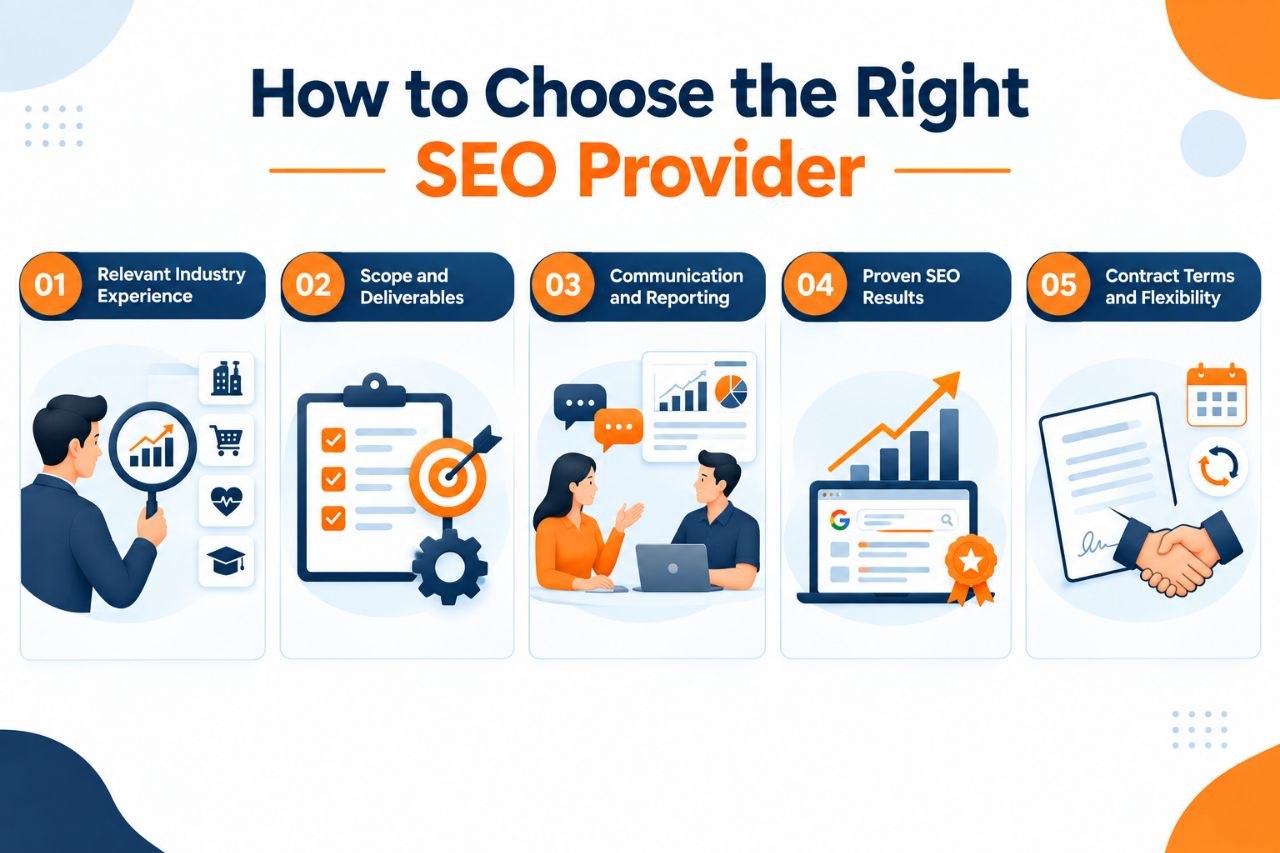
Choosing a provider requires more than comparing rankings or monthly prices. The best partner should understand your business model, audience, technical environment, goals, and operational requirements.
Below are the key factors to evaluate before signing an SEO contract.
1. Relevant Industry Experience
Look for experience with businesses that have similar audiences, sales cycles, website structures, or search challenges. Ecommerce brands may prioritize category and product optimization, while B2B companies often require deeper research and longer buyer journeys.
2. Scope and Deliverables
Ask exactly what the provider will deliver each month. A strong proposal should clearly define strategy, technical work, content, authority building, reporting, meetings, implementation responsibilities, and expected milestones.
3. Communication and Reporting
A credible seo agency website should clearly explain its services, methodology, team, and reporting approach. During the sales process, ask who will manage communication, how often meetings occur, which metrics are reported, and how strategic decisions are documented.
4. Proven SEO Results
Review relevant case studies rather than relying only on general testimonials. Look for evidence showing what problem the provider solved, what actions were taken, and how organic traffic, qualified leads, conversions, revenue, or visibility changed.
5. Contract Terms and Flexibility
Understand minimum commitments, cancellation terms, onboarding, scope changes, and asset ownership. Flexibility matters when priorities shift during migrations, launches, acquisitions, or expansion.
When choosing an seo service agency, avoid ranking guarantees and look for strategies tied to measurable business outcomes. For an enterprise seo agency, assess technical resources, reporting, international capabilities, stakeholder management, and large-site experience.
If considering an seo agency india option, evaluate experience, communication, technical skills, pricing, and reporting rather than location alone.
Common Mistakes When Hiring SEO Support
Many SEO problems begin before the campaign starts. Businesses often select providers based on price, rankings, or impressive sales presentations without evaluating whether the delivery model actually matches their needs.
Below are the most common mistakes to avoid.
1. Choosing Based on Price Alone
The cheapest provider is not necessarily the most cost-effective. Low pricing may mean limited strategy, fewer resources, less content, or minimal implementation support. Compare expected business value and workload rather than looking only at the monthly fee.
2. Ignoring Execution Requirements
A strategy is valuable only when someone can implement it. Before hiring a consultant, confirm that your internal team has the capacity to execute recommendations. Before hiring an agency, confirm that implementation is actually included in the agreement.
3. Overlooking Communication Needs
Even strong SEO work can become frustrating when communication is unclear. Establish meeting frequency, reporting expectations, response times, decision-making authority, and primary contacts before the engagement begins.
4. Focusing Only on Rankings
Rankings are useful indicators, but they do not represent the entire business outcome. Evaluate qualified traffic, conversions, pipeline, revenue, visibility across relevant searches, and whether SEO is reaching the right audience. Modern search also makes it important to consider visibility beyond traditional rankings.
Modern search experiences such as Google AI Mode can synthesize information into answers rather than relying only on traditional blue-link rankings. Businesses can learn more about Google AI Mode when considering how search behavior is changing.
SEO is becoming a key growth channel for brands
Learn how top SEO agencies help brands grow
Final Thoughts
The SEO Consultant vs SEO Agency decision ultimately depends on what your business needs most: specialized strategic guidance, broader execution capacity, or a combination of both. Consultants can be valuable for focused expertise, while agencies are often better suited to complex campaigns requiring multiple specialists and ongoing execution.
Before choosing, assess your internal resources, SEO goals, website complexity, budget, and desired level of involvement. If you are evaluating Qoulomb alongside other providers, focus on how each option’s expertise and delivery model align with the specific SEO challenges your business needs to solve.
The strongest choice is not necessarily the consultant or agency with the longest service list. It is the provider whose expertise, resources, communication style, and delivery model match the work your business actually needs.
Frequently Asked Questions (FAQs)
1. What is seo consultant?
An SEO consultant is a specialist who advises businesses on improving organic search performance. They may handle audits, strategy, keyword research, technical recommendations, content planning, and SEO guidance. Unlike an agency, a consultant typically works with fewer clients and provides more direct access to their expertise and strategic decision-making.
2. What are the key benefits of hiring an seo consultant?
The main benefits include direct access to specialized expertise, flexible support, strategic guidance, and potentially lower overhead than a full agency team. An SEO consultant can also work closely with internal marketers, identify opportunities, review existing strategies, and provide senior-level direction without requiring a permanent executive hire.
3. How to improve your relationship with your seo consultant?
Set clear objectives, provide access to relevant data, communicate business priorities, and agree on responsibilities from the beginning. Regular meetings and transparent reporting also help. Treat the consultant as a strategic partner rather than simply an external task provider, and share important changes that could affect SEO performance.
4. What is seo consulting services?
SEO consulting services provide expert guidance designed to improve a website’s organic search performance. They can include SEO audits, technical analysis, keyword research, content strategy, competitor research, migration planning, performance reviews, and strategic roadmaps. The consultant may advise the internal team rather than handling every implementation task.
5. What is a seo agency?
An SEO agency is a company that provides SEO services through a team of specialists. Depending on the provider, services may include technical SEO, content strategy, keyword research, link building, analytics, local SEO, ecommerce SEO, and ongoing optimization. Agencies are generally suited to businesses requiring broader execution capacity.
6. How to select the best seo agency?
Start by assessing relevant experience, services, case studies, reporting, communication, pricing, contract terms, and implementation capabilities. Choose an agency that understands your business model and can connect SEO activity with meaningful outcomes. Avoid providers that rely mainly on ranking guarantees or vague promises without explaining their methodology.
7. How can an seo agency help to build your business?
An SEO agency can increase relevant organic visibility, attract qualified visitors, improve important landing pages, strengthen content authority, and support conversions. A capable agency also connects SEO activities with business goals, helping search become a sustainable acquisition channel instead of treating rankings and traffic as the only measures of success.