

You sign an SEO retainer and pay the first invoice. A month later, a report lands in your inbox full of charts. But what did the agency actually do for that fee?
That’s a much easier question to answer when you know what SEO agency deliverables should look like before you sign. “Ongoing optimization” on its own is hard to hold anyone to.
In this guide, we break down what a monthly SEO retainer should include. You’ll also see what to expect in the first month compared with later months, and what a useful monthly report covers.
TL;DR
Key takeawaysDeliverables are the audits, fixes, content and reports you receive each month.
Expect the first month to focus on audits, keyword research and a strategy plan before most of the execution starts.
Technical work should have clear targets, such as the Core Web Vitals thresholds Google publishes for loading, responsiveness and visual stability.
A good retainer also covers how your brand shows up in AI search.
Monthly reports should track progress against the goals agreed at kickoff, with a deeper strategy review every quarter.
What Are SEO Agency Deliverables?
SEO agency deliverables are the specific outputs an agency hands over as part of your engagement. Think of an audit report, a list of fixed pages, a new article or a monthly dashboard. Each one is something you can open, review and tick off.
They’re different from activities. “Keyword research” is an activity, while a keyword map that matches each target term to a page on your site is the deliverable. When a proposal only lists activities, ask what you’ll actually receive for each one.
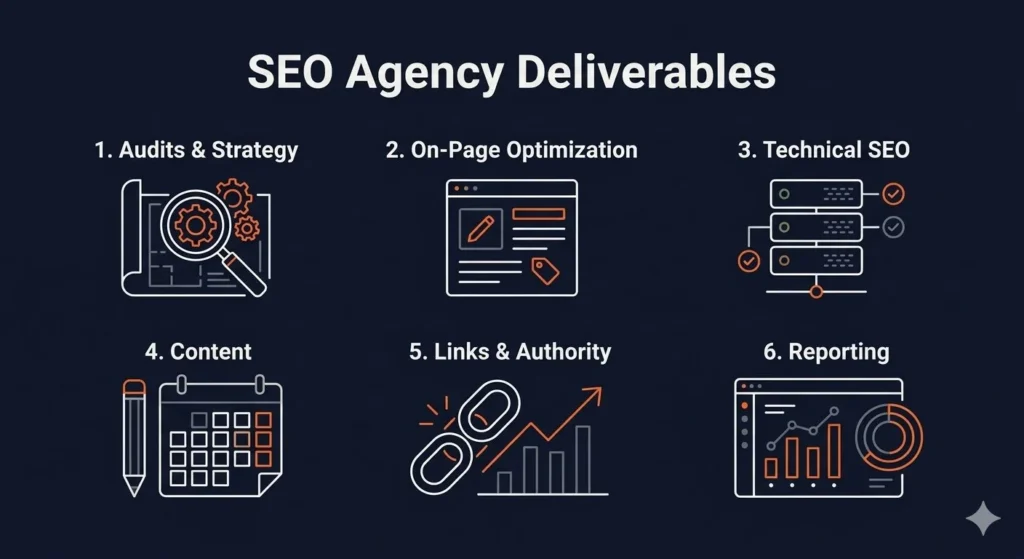
It helps to group deliverables into six areas. Here’s what each area covers and when you can expect it:
| Area | Example deliverables | When to expect it |
|---|---|---|
| Audits and strategy | Technical audit, keyword map, competitor review, strategy plan | Month 1, then reviewed each quarter |
| On-page optimization | Updated title tags, headings, internal links and schema | After the audits, then ongoing |
| Technical SEO | Crawl and indexing fixes, Core Web Vitals work, sitemap updates | After the audits, then as issues appear |
| Content | New articles, refreshed pages, a content calendar | Monthly, once the plan is agreed |
| Links and authority | Link prospecting, outreach, digital PR | Once the basics are fixed |
| Reporting | Monthly report and a quarterly strategy review | Every month and every quarter |
The exact mix depends on your site, so ask the agency why it weighted each area the way it did. Either way, each area should come with something you can verify.
Build a stronger organic growth engine
Turn search visibility into qualified B2B traffic and pipeline with a strategy built around your business goals.
What Should a Monthly SEO Retainer Include?
A monthly SEO retainer should include work in the six areas above, plus local SEO and AI search where they apply. Here’s what to look for in each one.
1. Audits and a Strategy Plan
Your first month should end with a clear picture of where your site stands, written up as a strategy plan with goals, priorities and timelines.
Ask for the audit as a document you keep, rather than only a call. It becomes your baseline, so every later report can show what has changed since month one.
2. On-Page Optimization
On-page work covers your title tags, meta descriptions, headings, internal links and the copy on your priority pages.
Structured data belongs here too. According to Google’s guide, Introduction to structured data markup in Google Search, Google uses it to understand the content of a page. For the format, Google recommends whichever is easiest to implement and maintain, which in most cases is JSON-LD.
For structured data, ask the agency which pages it will mark up, which schema types it will use and how it will test them.
Each month, the agency should also tell you which pages it changed and why.
3. Technical SEO Fixes
Technical deliverables should come with a list of issues found and a list of issues fixed. Items to look for include broken links, redirect chains, crawl errors, indexing problems and slow pages.
Google’s guide, Understanding Core Web Vitals and Google search results, sets three clear targets for loading, interactivity and visual stability:
- Largest Contentful Paint (LCP): within 2.5 seconds of the page starting to load
- Interaction to Next Paint (INP): less than 200 milliseconds
- Cumulative Layout Shift (CLS): a score of less than 0.1
Google highly recommends that site owners achieve good Core Web Vitals. So if your retainer includes Core Web Vitals work, ask the agency to report against these three numbers.
4. Content Creation
Agree on the content numbers upfront. How many new articles will you get each month, how many existing pages will be refreshed, and who approves each draft before it goes live? Before you review the first drafts, read up on E-E-A-T in SEO so you know what real experience and expertise look like.
A content calendar should come first. It shows which topics are planned, which keywords each piece targets and when it will be published.
Each month, ask for a list of published and refreshed URLs. That way, you can verify each one instead of relying on a summary.
5. Link Building and Authority
Plan link building for after your technical base and key pages are in good shape. Deliverables here include a list of target sites, outreach records and the links actually earned each month. Ask for each link with its URL, so you can check it yourself.
Ask how each link is earned. Buying links to manipulate rankings is a problem, as Google’s spam policies treat it as link spam.
6. Local SEO, If You Need It
If you serve customers in specific cities or regions, local SEO should be a separate line in your retainer. Deliverables include an optimized Google Business Profile, consistent business listings, location pages and a plan for reviews. If you sell nationally or online only, you probably don’t need this part at all.
7. AI Search Readiness
Ask each agency what its retainer covers here.
Before you compare answers, check your site’s AI search readiness yourself so you know where the gaps are.
In each answer, look for a check of how AI tools describe your brand and fixes for pages they can’t read well.
Finally, ask how the agency will measure progress in AI search, so you know what each monthly report should show.
8. Monthly Reporting
Every retainer should include a monthly report. At a minimum, it should show what was done that month, what changed in search performance and what’s planned next. Useful reports tie these numbers back to the goals you agreed at kickoff, rather than listing every metric available.
What Should You Get Month by Month?
Your deliverables should change as the retainer moves on. Early months build the foundation, and later months grow on top of it. Here’s the rhythm to expect.
Month 1: Onboarding and Audits
The first month is about learning your site and your business. You should finish it with these in hand:
- Kickoff notes: your goals, target customers and the KPIs you’ll judge success by
- Technical audit: crawl, indexing, speed and mobile issues, ranked by priority
- Keyword map: the terms you’ll target, matched to specific pages
- Competitor review: who you’re up against in search and where they’re ahead
- Strategy plan: what happens in the next three months, and in what order
Don’t expect big ranking changes yet. A strong month one gives you a clear plan and a baseline to measure against.
Next: Fixes and On-Page Work
Now the plan turns into changes on your site. Technical fixes from the audit should start going live, and your priority pages should get updated titles, headings, copy and internal links.
This is also when the content plan takes shape. Expect a content audit of your existing pages, decisions on what to update, merge or remove, and a calendar for new pieces.
Later: Content and Authority
Once the foundation is fixed, the retainer shifts towards growth. New content gets published each month, and link building and digital PR start to earn authority for your key pages.
Technical work doesn’t stop here, though. New issues appear as your site changes, so expect regular checks alongside the growth work.
Every Quarter: A Strategy Review
Every three months, step back from the monthly detail. A quarterly review should compare results against the goals set in month one, flag what isn’t working and set priorities for the next quarter. If your goals have changed, this is the moment to change the plan with them.
How Qoulomb Builds an SEO Retainer
At Qoulomb, our SEO services follow the same four stages in every retainer:
1. Find what’s holding growth back: audits of your site, keyword and content gaps, and competitors.
2. Fix the foundation: technical fixes, Core Web Vitals, site architecture, internal linking and on-page SEO.
3. Build authority and coverage: content, structured data and off-page authority building.
4. Compound and attribute: connecting search performance to the results your business tracks.
For B2B brands, we can add GEO and AI SEO to the same plan, so it also covers how you show up in AI answers. Our retainers run at $2K–$10K/month, depending on scope.
Build a stronger organic growth engine
Turn search visibility into qualified B2B traffic and pipeline with a strategy built around your business goals.
Book a CallQoulomb helped us show up in AI search answers, not just Google. They spotted early that our landing pages were the problem and fixed them with us.

Jose Russo Pons
Head of Growth Marketing, GAIN
Conclusion
A monthly SEO retainer is easier to judge when every line in it points to something you can check. Before you sign, ask for the deliverables in each area, when you’ll receive them and how they’ll show up in your monthly report.
Then hold onto your month-one audit. Each quarter, compare where you are against that baseline and ask what the next three months will deliver.
At Qoulomb, we tie every phase of an SEO retainer to a business outcome and report on what organic search actually contributed. Weighing up a few proposals? Feel free to talk to Qoulomb about yours.
FAQs
1. How does an SEO agency measure results?
A good agency measures results against the goals agreed at kickoff, such as organic traffic, leads or sales from search. Monthly reports should also show search visibility, rankings for target keywords and technical health. Ask which tools the agency uses and how each number connects to your business goals.
2. What is the difference between SEO and GEO?
SEO helps your pages rank in search results like Google’s. GEO, or generative engine optimization, helps your brand show up and get cited in AI-generated answers, such as Google’s AI Overviews and ChatGPT. GEO also tracks how AI tools describe your brand.
3. Do SEO deliverables differ by industry?
Yes, the mix changes with your business. If you serve local customers, expect Google Business Profile work and location pages as well. The six core areas stay the same, but the balance between them shifts, so ask each agency to explain its proposed split.
4. What makes a good SEO agency?
A good SEO agency explains exactly what it will deliver, when and why. It shares its audits as documents, reports against your goals rather than vanity metrics, and tells you which pages it changed each month. It should also be open about how it earns links.
5. What are the 5 components of SEO?
In this guide, we group SEO work into six areas: audits and strategy, on-page optimization, technical SEO, content, links and authority, and reporting. Local SEO and AI search readiness sit on top where they apply. Each area should come with deliverables you can verify every month.
6. How often should an SEO agency send reports?
Expect a report every month, covering what was done, what changed and what’s planned next. On top of that, ask for a deeper strategy review every quarter. Monthly reports keep the work on track, while quarterly reviews are where you adjust goals and priorities.
7. What is the 80/20 rule in SEO?
The 80/20 rule, or Pareto principle, is the idea that roughly 80% of results come from 20% of the inputs. In SEO, it means finding the few pages, keywords and fixes that matter most and prioritizing them first. A good strategy plan in month one should show you where that 20% sits.