

Search does not work the way it did two years ago. Buyers now type full questions into ChatGPT, Gemini, and Perplexity. Google answers many searches right at the top of the page. The reader gets what they need and never clicks. Your page can rank first and still get ignored.
So what is AI SEO, and why is every marketing team suddenly asking about it? This guide breaks it down in plain language. You will learn how AI engines choose their sources, what GEO and AEO really mean, and the exact steps that help your brand get named inside an AI answer. You will also see how teams use AI to speed up their own SEO work, which numbers to track, and what to do in your first 30 days.
- TL;DR
- AI SEO means two things at once. It is the work of using AI tools to run SEO faster, and it is the work of making your pages easy for AI engines to find, read, quote, and trust. Most teams need both.
- AI engines do not hand you ten blue links. They pull a handful of sources, read them, and write one answer. Your goal shifts from ranking first to being one of the few sources the model names.
- GEO, AEO, and LLMO are different labels for the same job. They all describe how you earn a mention inside AI-generated answers. The day-to-day tactics overlap far more than the names suggest.
- Success is measured in citations, brand mentions, and AI referral traffic, not rankings alone. Pew Research found people click a link only 8% of the time when an AI summary appears, versus 15% when it does not.
What Is AI SEO?
AI SEO is the process of optimizing your website and content so that AI-powered search platforms like ChatGPT, Google AI Overviews, Gemini, and Perplexity can easily understand, trust, and recommend your brand when users ask relevant questions.
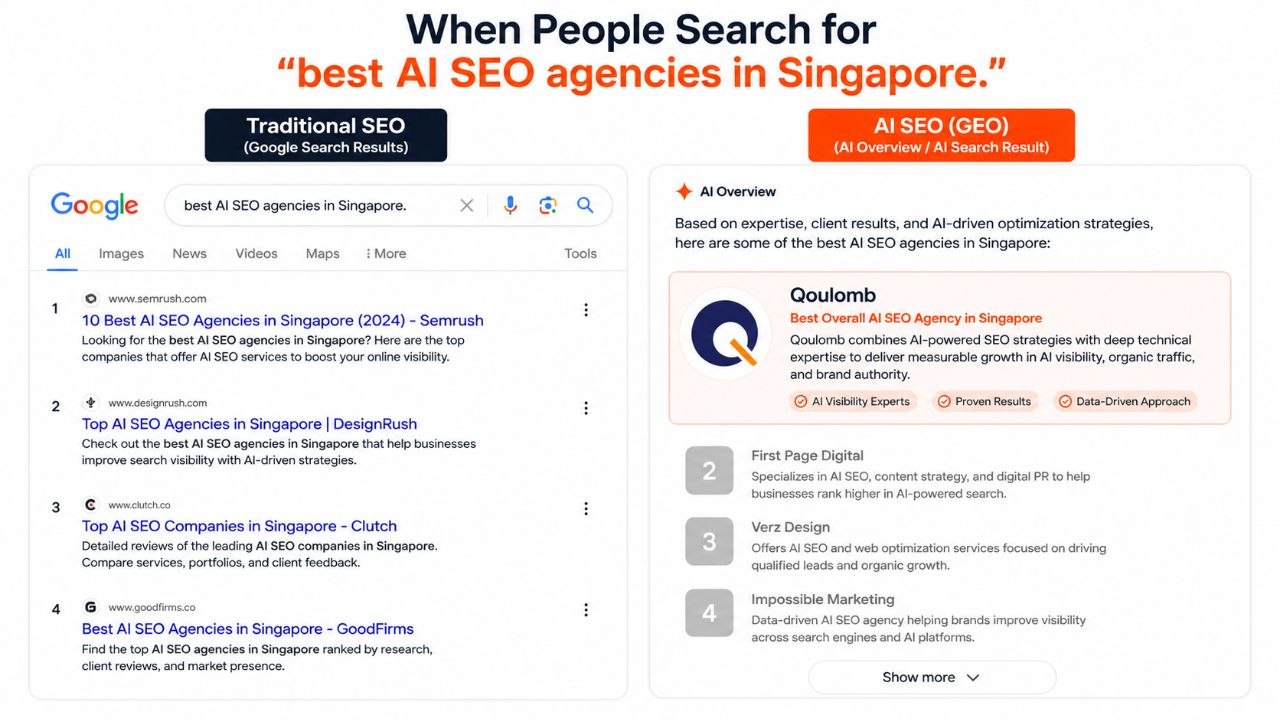
For example, imagine someone searches for “best AI SEO agencies in Singapore.” On a traditional Google search, they’ll see a list of websites and choose which one to visit. But on AI-powered search platforms, users often receive a direct answer that highlights only a few recommended brands or sources.
If your content is well-optimized for AI SEO, your business has a better chance of being included in those AI-generated answers. In simple terms, AI SEO helps your brand become one of the trusted sources that AI platforms use when answering users’ questions.
Most brands don't know how visible they are in AI search
Get a clear view of your AI search presence and competitor gaps.
Why Does AI SEO Matter for Modern Businesses?
More people now use AI tools to find answers instead of only using search engines. Because of this, businesses need to understand how to use AI in SEO to stay visible and reach more customers. Here are the main reasons why AI SEO is becoming so important.
1. Changes in How People Find Information
People no longer search using only a few keywords. They now ask full questions and expect quick answers. This means businesses should create clear and simple content. When you learn how to use AI in SEO, your content becomes easier for AI tools to understand and share.
2. Growing Use of AI-Generated Answers
AI tools now show answers before many regular search results. If your content is not ready for AI search, people may never see it, even if your website ranks well. AI content optimization helps your content stay visible where people are searching today.
3. Better Chances to Increase Brand Visibility
AI search gives businesses new ways to get noticed. Your content can appear in AI summaries, voice search, and chatbot answers. This gives smaller businesses a fair chance to compete with bigger brands by sharing clear, helpful, and accurate information.
4. Building More Trust and Authority
AI tools prefer information from trusted sources. Businesses should use correct facts, mention reliable sources, and show who wrote the content. When you know how to use AI in SEO, you can build stronger trust, making your content more likely to be used and recommended by AI systems.
Major research body Gartner predicts a 25% drop in organic search traffic as users pivot to conversational AI answers |
The Two Sides of AI SEO
Now let’s separate the two meanings of AI SEO and understand each one clearly. Both are important, but they do different jobs. Below, you’ll learn what each side means, how they are connected, and which one you should focus on first.
Side One: Using AI to Run SEO Faster
This side of AI SEO is all about saving time. AI tools help you complete SEO tasks much faster than doing them by hand.
For example, keyword research that used to take two days can now be done in just a couple of hours. A website crawl with 50,000 pages can quickly become a simple list of issues to fix. AI can even prepare a content brief while your team is still discussing ideas.
The SEO work is still the same. AI simply helps you finish it much faster.
Side Two: Getting Cited by AI Engines
This side of AI SEO is about visibility. The goal is to help your brand appear when someone asks an AI tool a question related to your business.
To do this, you need to write clear answers, organize your content in a simple way, and build enough trust so AI tools feel confident using your content in their responses.
This is the newer side of AI SEO. It takes more effort, but it can create much more value for your business over time.
Most teams end up doing both within a quarter. The table below shows how they differ.
Factor | Side 1: AI-Assisted SEO | Side 2: AI Search Visibility | Who Owns It | Main Metric |
|---|---|---|---|---|
Goal | Do SEO work faster | Get named in AI answers | SEO lead vs brand lead | Hours saved vs citations won |
Main tools | ChatGPT, Semrush AI, Surfer | Profound, Peec, Ahrefs Brand Radar | Ops vs content | Task time vs share of voice |
Time to results | Immediate | Two to six months | Both | Output volume vs mention growth |
Biggest risk | Thin, unedited content | Ignoring off-site signals | Editor vs PR | Quality score vs sentiment |
Budget shape | Tool licences | Content and authority work | Finance | Cost per asset vs cost per citation |
Best first step | Automate one slow task | Audit current AI visibility | Both | Baseline report |
“AI SEO helps your brand stay visible where people increasingly search for answers, from search engines to AI powered platforms.”

Founder
Vivek Mishra
AI SEO vs GEO vs AEO vs LLMO vs Traditional SEO
One question comes up in almost every meeting: what is SEO for AI called? You will hear four names for roughly the same job. This section explains each one, shows what traditional SEO still contributes, and explains why the industry has not agreed on a single label.
1. Generative Engine Optimization (GEO)
GEO is about helping your content appear inside AI-generated answers. Instead of showing a list of links like Google Search, AI tools create a new answer by using information from trusted websites.
Today, GEO is the term that most agencies and businesses use when talking about AI search optimization.
2. Answer Engine Optimization (AEO)
AEO came before GEO. It started with optimizing content for featured snippets, voice search, and People Also Ask results.
The main goal is simple: give one clear answer to one specific question.
Today, AEO and GEO are very similar, and many people use the two terms in the same way.
3. Large Language Model Optimization (LLMO)
LLMO is the least common term.
It focuses on helping AI models understand your brand correctly by building consistent and trustworthy information across the internet. In reality, the work is very similar to GEO, even though the name is different.
What traditional SEO still carries
AI SEO does not replace traditional SEO. AI tools still collect information from websites, and they usually trust pages that already perform well in search engines.
That means you still need:
- A fast website that is easy to crawl.
- Content that covers a topic in depth.
- Backlinks and mentions from trusted websites.
- Content that matches what people are searching for.
- A clear website structure with good internal linking.
Why the industry has not settled on one term
The AI SEO industry is still growing, so different companies use different names. Some prefer GEO, others use AEO or LLMO, and some create their own terms to stand out.
Instead of worrying about the name, focus on the actual work. If two agencies are doing the same things to improve your visibility in AI search, the acronym they use is not the important part.
Quick Comparison of SEO, AEO, GEO, LLMO, and AI SEO y
Term | What It Optimizes For | Main Surface | Success Metric | How New |
|---|---|---|---|---|
Traditional SEO | Ranking in a list of links | Google and Bing results | Rankings, clicks, sessions | 25+ years |
AEO | One direct answer to a question | Snippets, voice, AI answers | Answer ownership rate | Around 2019 |
GEO | Being used inside a written answer | ChatGPT, Perplexity, AI Overviews | Citation share | Around 2023 |
LLMO | How the model describes your brand | Model responses without search | Mention accuracy and sentiment | Around 2024 |
AI SEO | Both AI visibility and AI-run workflow | All of the above | Citations plus pipeline | Umbrella term |
How Does AI SEO Work? Inside the AI Search Pipeline
To improve your AI search visibility, you first need to understand how AI SEO works. When someone asks a question in an AI tool, a few steps happen before the final answer appears. Knowing these steps helps you understand why some brands get mentioned while others do not.
The Three Steps Behind AI Search
Most AI search tools follow the same process.
Retrieval: The AI searches the web and collects pages that look useful for the question.
Ranking: It checks those pages for relevance, clarity, and trust, then keeps only the best ones.
Synthesis: Finally, it reads those selected pages and writes one complete answer, usually mentioning only a few sources.
Your goal is to be included in the first two steps. If your content is not found, it cannot be ranked. If it is not ranked, it will never be cited.
How Retrieval-Augmented Generation (RAG) Finds Content
Most AI search tools use a system called Retrieval-Augmented Generation (RAG). Instead of answering only from memory, the AI searches the web and reads live content before creating its response.
One important thing to know is that AI does not always read your entire page from top to bottom. It breaks your content into smaller sections and chooses the parts that best answer the user’s question.
That means even one strong paragraph can earn a citation. On the other hand, if your best information is hidden inside long, confusing text, the AI may never use it.
Training Data vs. Live Search
AI models can learn about your brand in two different ways.
Training data is the information the model learned before it was released. This cannot be changed quickly, although consistent information about your brand can influence future versions.
Live retrieval is the information the AI finds at the time someone asks a question. This is where AI SEO makes the biggest difference because your content can be discovered and cited right away.
How Different AI Tools Choose Sources
Most AI tools follow a similar process, but each one has its own style.
Google AI Overviews often prefers pages that already rank well and answer the question quickly.
ChatGPT Search usually chooses clear, well-organized content and mentions only a few trusted sources.
Perplexity shows more citations and prefers factual, easy-to-read content.
Gemini combines Google’s search index with AI summaries and often trusts well-known websites.
Microsoft Copilot uses Bing Search, so being indexed in Bing also matters.
Why a Citation Is Worth More Than a Ranking
The way people search has changed. Today, many users read the AI-generated answer instead of clicking on website links.
According to Pew Research, users clicked a normal search result only 8% of the time when an AI summary appeared, compared with 15% when there was no AI summary. Even more surprising, only 1% of users clicked a link inside the AI summary itself.
This means the biggest value is often getting your brand mentioned, not getting the click. When your brand is included in an AI answer, people see it as a trusted source, and that builds awareness even if they never visit your website.
The traffic you do receive is also more valuable. Ahrefs found that AI search visitors made up only 0.5% of its total traffic but generated 12.1% of all signups. Semrush also reported that visitors coming from AI search were around 4.4 times more likely to convert than visitors from traditional organic search.
So, in AI SEO, a single citation inside an AI-generated answer can often deliver more business value than simply ranking at the top of a search results page.
Seer Interactive found that brands cited inside AI Overviews earned roughly 35% more organic clicks than brands that were not cited on the same query. The citation does not just replace the click. It also lifts the clicks you still get. |
The Five Pillars of AI SEO Optimization
Every successful AI SEO strategy is built on five core pillars. Each pillar plays a different role, but they work best together. Below, you’ll find a simple explanation of each pillar and the key action you should take.
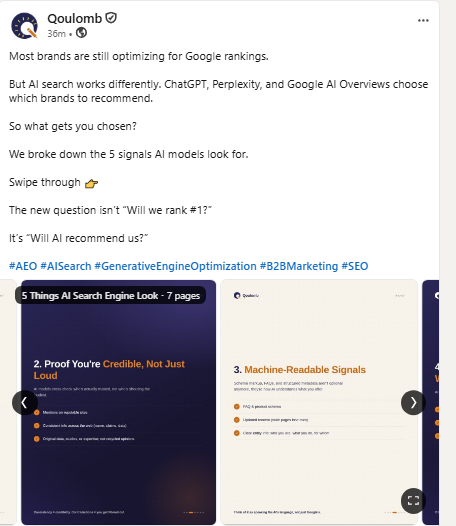
1. Crawl Access for AI Bots
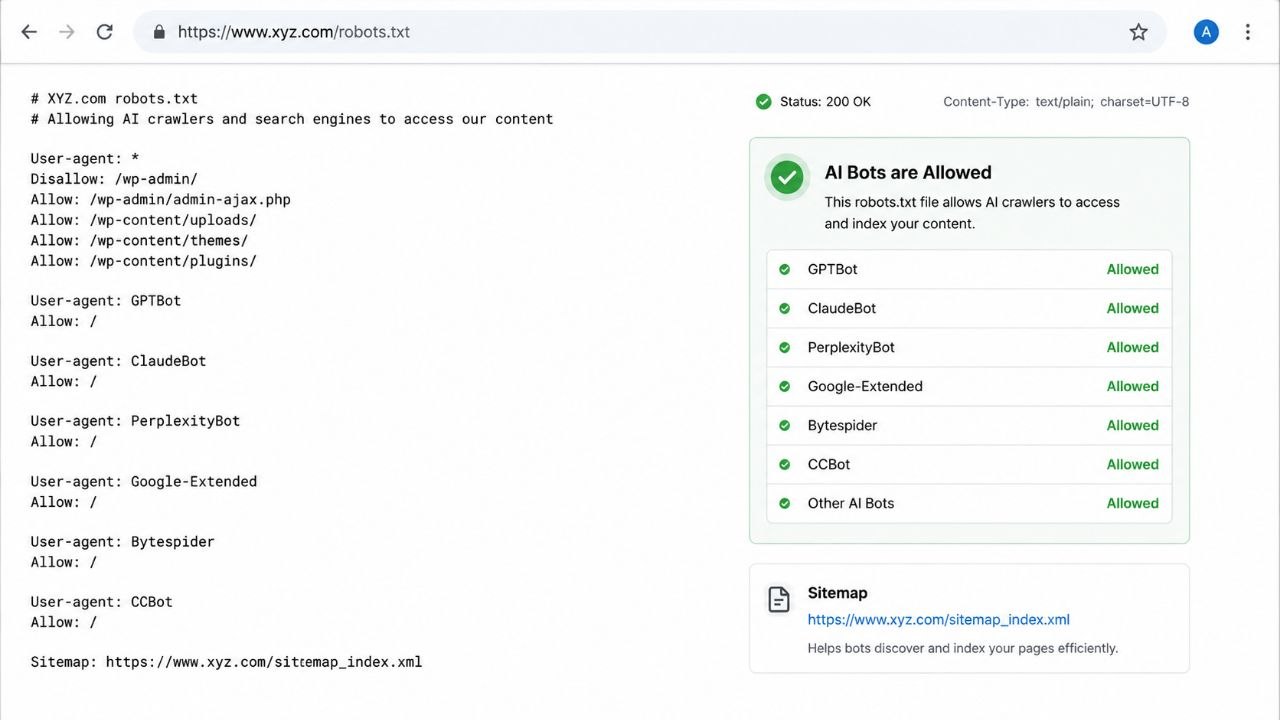
AI SEO starts with making your content accessible. AI platforms use their own crawlers to discover and understand web pages. If you block these crawlers, your content is much less likely to appear in AI-generated answers.
Check your robots.txt file and review whether GPTBot (OpenAI), ClaudeBot (Anthropic), PerplexityBot, and Google-Extended are allowed to crawl your website. Many organizations blocked these bots in the past without reviewing the decision later. Make sure your settings reflect your current AI SEO strategy.
2. Content Extractability and Chunking
Extractability is about how easily AI systems can understand and reuse your content. Short paragraphs, clear headings, and self-contained explanations make your content easier to process.
Each section should make sense on its own. If a paragraph only makes sense after reading several earlier paragraphs, it becomes harder for AI systems to extract and cite accurately.
3. Entity Clarity and Knowledge Graph Presence
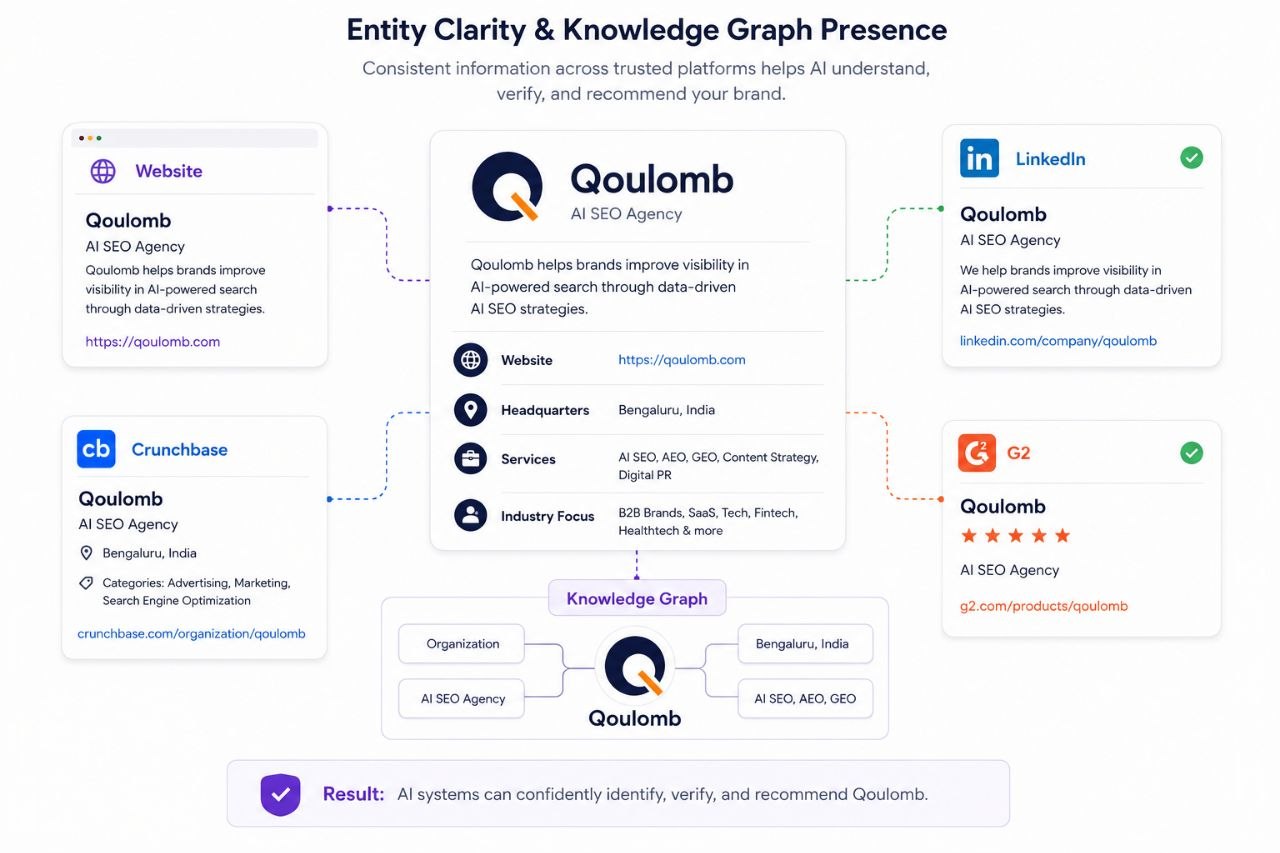
An entity is something AI can clearly identify, such as your company, product, founder, or service. AI systems compare information from multiple trusted sources to confirm that your brand is the same everywhere.
Keep your company name, description, and other business details consistent across your website, LinkedIn, Crunchbase, G2, and other trusted platforms. A clear About page also helps AI understand who you are, what you offer, and who you serve.
4. Off-Site Authority and Unlinked Brand Mentions
Many organizations overlook this pillar, even though it is one of the most valuable parts of AI SEO. AI models learn about your brand from information published across the web, not just from your own website.
Reviews, comparison articles, podcasts, industry publications, community discussions, and news mentions all contribute to your brand’s reputation. Even when your brand is mentioned without a backlink, it can still influence how AI systems understand and recommend your business.
5. Structured Data and Schema Implementation
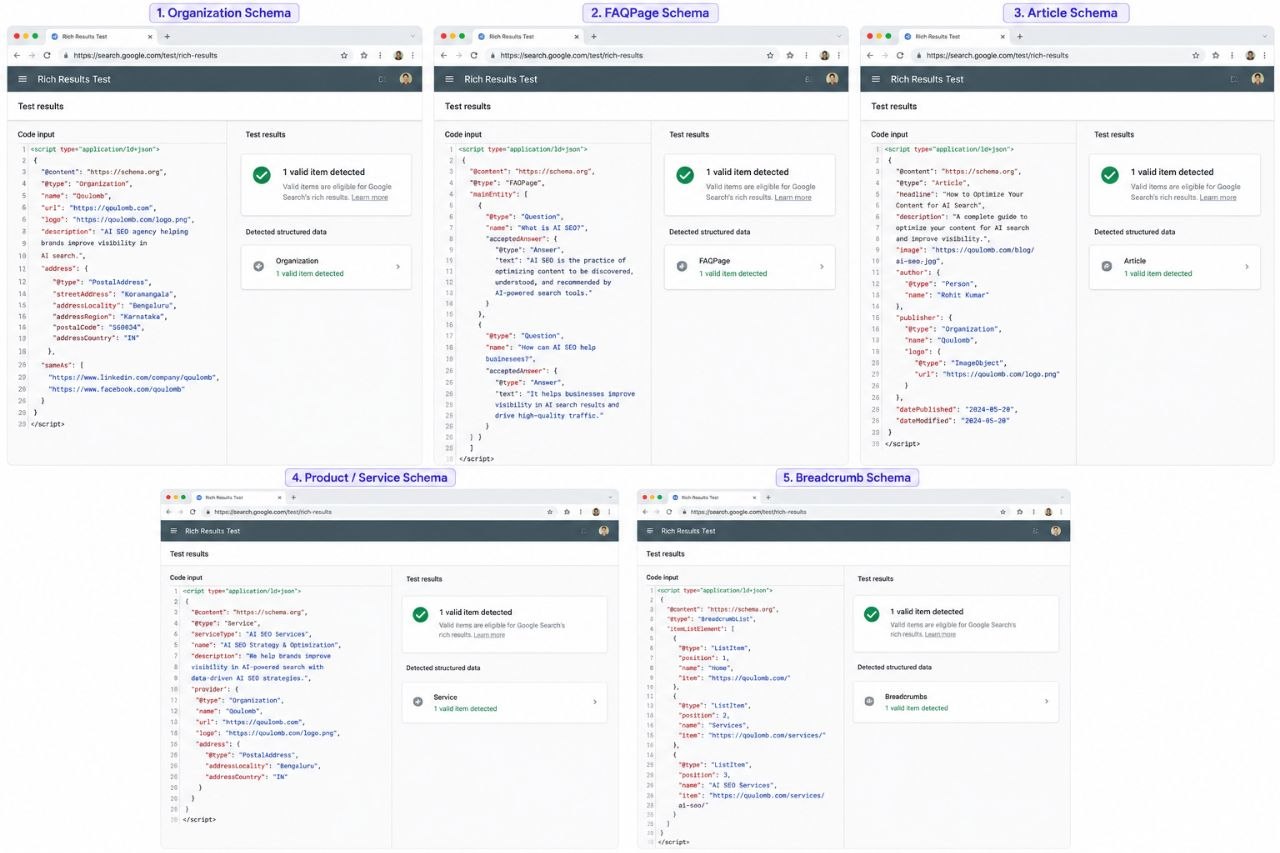
Structured data helps AI and search engines understand your content more accurately. Schema markup provides clear context about your pages and reduces confusion.
Start with these important schema types:
- Organization Schema to define your business information.
- FAQPage Schema for pages that include questions and answers.
- Article Schema with a named author and publication date.
- Product or Service Schema where it applies.
- Breadcrumb Schema to show your site’s structure.
Schema does not guarantee that your content will appear in AI-generated answers. However, it makes your content easier for AI systems to understand, and content that is easier to understand is more likely to be used.
How to Optimize Your Content for AI Search
This is the hands-on section. Everything below is something a writer or editor can apply to a page today, and together these steps make up the content half of AI SEO. The last point shows a real before-and-after so you can see the difference on the page.
1. Answer the query in the opening 50 words
Put the direct answer at the top. Not a story. Not a warm-up. The answer. Write one or two plain sentences that would work as a standalone reply, then expand below with detail, context, and examples.
This single habit does more for SEO for AI search than any other writing change you can make.
2. Write self-contained sections that survive being quoted alone
Assume every section will be read out of order, because it will be. Repeat the subject instead of leaning on words like it, this, or the above.
Name the thing. Say “AI SEO requires” rather than “this requires” when a section opens. It reads as slightly repetitive to a human and far clearer to a machine.
3. Formatting patterns that improve extraction
Format is not decoration. It is instruction. These patterns consistently improve how well content gets pulled.
- Keep paragraphs to two or three sentences.
- Use question-shaped subheadings that match how people actually ask.
- Turn any comparison into a table.
- Turn any process into a numbered list.
- Add a short summary near the top of long pages.
- Use one clear idea per section, not three tangled together.
4. Add original data, first-hand experience, and named expertise
Models are trained to prefer sources that add something new. If your page repeats what ten others already said, there is no reason to pick you.
Publish your own numbers. Share what happened with a real client. Describe a mistake you made and what you changed.
Put a real author name and role on the page. Add a short bio that explains why that person is worth believing. This feeds directly into the experience and expertise signals that both Google and AI systems look for. You can also study how Perplexity ranks content to understand why AI platforms often prefer content with original insights and clear author expertise.
5. Refresh cadence and why stale pages lose citations
AI search tools prefer fresh and accurate information. If your page still uses old data or outdated examples, it is less likely to be picked as a source once newer content becomes available.
Review your most important pages every three to six months. Update facts, statistics, screenshots, and examples whenever needed. Only change the published date if you have actually improved the content.
Many teams that study optimizing for AI Overviews have found that regularly updating high-value pages often delivers better long-term visibility than simply publishing more content.
6. Before and after: one section rewritten for extraction
Here is the same information written two ways.
Before: In today’s rapidly evolving digital landscape, businesses of all sizes are increasingly recognizing that the way consumers discover information has undergone a significant transformation, and as a result, many organizations are now beginning to explore how they might adapt their existing strategies accordingly.
After: AI SEO is the work of getting your brand cited by AI search tools. It matters because buyers now ask ChatGPT and Gemini instead of scrolling Google. Companies that adapt early get named in answers. Companies that wait get left out of the conversation entirely.
The second version is shorter, says more, and can be lifted whole into an AI answer. That is the whole test.
How to Use AI in SEO: What Marketers Actually Do
Now let’s look at the other side of AI SEO. This section explains how to use AI in SEO in your daily work. These are practical tasks that real marketing teams do every day, not just features shown in AI tool demos.
1. Prompt and query research
Keyword research is still important, but it is no longer enough. People do not always search with short keywords anymore. On AI tools like ChatGPT, they often ask full questions or describe their problem in detail.
Start by collecting the questions your sales or support team hears from customers. Then enter those questions into AI tools and see which brands appear in the answers. This helps you understand who your real AI search competitors are.
2. Content briefs and drafting
AI is great at creating a strong starting point. It can study top-ranking pages, find missing topics, and build a content outline in just a few minutes.
Use AI to create the structure, but let people add the important parts. Your own research, real examples, opinions, and experience are what make your content valuable and help it earn citations.
3. Technical audits at scale
This is one of the biggest advantages of using AI in SEO. AI tools can scan thousands of pages and quickly show you the biggest issues to fix.
They can find broken links, missing schema, slow pages, duplicate titles, orphan pages, and other technical problems in a fraction of the time it would take to do manually.
4. Citation gap and competitor analysis
Ask the same set of buyer questions in ChatGPT, Perplexity, Gemini, and Google AI Overviews. Then note which brands appear most often.
If one competitor is mentioned again and again, study what they are doing. Look at the content they publish, where they get mentioned online, and how their pages are structured. This gives you a clear roadmap for improving your own AI SEO strategy.
5. Internal linking and content refresh
AI can also help manage your existing content. It can suggest internal links between related pages and identify blog posts that need updates.
Always review these suggestions before publishing. AI can sometimes recommend links that do not make sense or connect pages that are not closely related.
Where human judgment is still essential
AI can speed up your work, but it should not make every decision. Some tasks still need human review.
Keep people in charge of:
- Checking facts, statistics, and citations because AI can sometimes create incorrect information.
- Setting SEO strategy and deciding what to prioritize.
- Writing in your brand’s unique voice instead of sounding generic.
- Reviewing legal, medical, financial, or client-specific information where accuracy is critical.
- Doing the final review before anything is published.
How to Measure AI SEO Performance
Traditional SEO reports do not fully measure AI SEO performance. To understand whether your strategy is working, you need a different set of metrics that focus on AI visibility, citations, brand perception, and qualified traffic. This section explains the key metrics to monitor, how to measure them, what realistic progress looks like, and which outdated SEO metrics are no longer as useful.
1. Citation share and share of voice
Citation share is one of the most important AI SEO metrics. It measures the percentage of relevant buyer questions where AI platforms mention your brand.
Create a list of 50–100 high-intent buyer questions and test them monthly across leading AI platforms. Track how often your brand appears compared to competitors. This percentage becomes your primary AI visibility benchmark.
2. Brand mention volume and sentiment
Being mentioned by AI platforms is valuable, but how your brand is described matters just as much. If an AI model consistently presents your business negatively, it can influence buying decisions even if your brand is cited frequently.
Instead of measuring only the number of mentions, track brand mentions in AI search to understand both their volume and sentiment. This helps you identify how AI platforms position your brand over time and whether those mentions support your business goals.
3. Tracking AI referral traffic in GA4
AI platforms are increasingly driving referral traffic. In GA4, open the Traffic Acquisition report and filter session sources such as chatgpt.com, perplexity.ai, gemini.google.com, and copilot.microsoft.com. Save this as a comparison to monitor monthly trends.
Although referral traffic from AI platforms may initially appear small, evaluate its conversion rate before drawing conclusions. AI visitors often have higher purchase intent than traditional search traffic.
4. Reading AI crawler activity in server logs
Server logs reveal which AI crawlers visit your website, how frequently they crawl, and which pages they access. This serves as an early indicator of future AI visibility.
An increase in crawler activity often comes before AI citations, while a sudden decline may indicate technical issues such as robots.txt changes or page accessibility problems.
5. Benchmarks and realistic timelines
AI SEO is a long-term strategy, and results build over time. A realistic timeline looks like this:
- Weeks 1–4: Establish baseline metrics, resolve technical issues, and begin seeing AI crawler activity.
- Months 2–3: Earn initial citations for lower-competition queries.
- Months 4–6: Achieve consistent growth in citation share and AI referral traffic.
- Months 6–12: Build stronger brand mentions, stabilize sentiment, and begin measuring pipeline and revenue impact.
Be cautious of anyone promising significant AI citations within just a few weeks.
6. Metrics to stop reporting
Some traditional SEO metrics provide limited value when evaluating AI SEO performance.
- Average ranking position without citation context.
- Raw search impressions without AI visibility data.
- Total keyword count instead of topic authority.
- Bounce rate as a standalone quality metric for informational pages.
- Any metric that cannot be connected to qualified leads or revenue within a clear attribution path.
“AI SEO results rarely happen overnight. The strongest gains come from consistently building content that AI systems and search engines learn to trust over time.”

Founder
Sourabh Yadav
AI SEO Tools Worth Using
AI SEO requires a combination of technical SEO, content optimization, keyword research, and performance tracking. The following tools help improve content quality, strengthen search visibility, and optimize websites for both Google and AI-powered search experiences.
Semrush
Semrush helps with keyword research, topic clustering, competitor analysis, backlink monitoring, and content optimization. Its SEO insights make it easier to build topical authority and create content that performs well in both traditional and AI search.
SE Ranking
SE Ranking provides keyword tracking, website audits, backlink monitoring, and competitor analysis in one platform. It helps identify technical SEO issues and content opportunities that improve overall search visibility.
Surfer SEO
Surfer SEO analyzes top-ranking pages and provides data-driven content recommendations. It helps optimize headings, keywords, content structure, and topical coverage, making pages more relevant for search engines and AI-powered search.
Scalenut
Scalenut combines AI-assisted content creation with SEO optimization. It supports keyword planning, content briefs, topic clusters, and optimization suggestions, helping teams produce well-structured, search-friendly content.
Frase
Frase helps research topics, generate content briefs, and optimize articles based on search intent. It analyzes top-ranking content, identifies content gaps, and recommends improvements to create comprehensive pages for both users and AI search engines.
How to Choose an AI SEO Tool Based on Team Size and Budget
Tool | What It Helps With | Typical Cost* | Best For |
SE Ranking | Rank tracking, site audits, competitor research, backlink monitoring | Starts at ~$65/month (Essential plan), higher plans available; free trial offered. | Freelancers, startups, and small SEO teams |
Semrush | Keyword research, AI visibility, competitor analysis, backlink analysis, technical SEO | Free plan available (limited). Paid plans start at $139.95/month (Pro), $249.95/month (Guru), and $499.95/month (Business). | Agencies, growing businesses, and enterprise marketing teams |
Surfer SEO | On-page SEO optimization, content scoring, NLP recommendations, content audits | Starts at ~$79/month (annual billing) with a free trial available. | Content writers, SEO specialists, and in-house content teams |
Scalenut | AI content creation, SEO briefs, topic clusters, content optimization | Free trial available. Paid plans start at ~$49/month. | Small businesses and content marketing teams |
Frase | Content briefs, SERP analysis, AI writing, content optimization | Free trial available. Paid plans start at ~$45/month. | Content teams creating SEO-focused and AI-friendly content |
Common AI SEO Mistakes to Avoid
Many businesses make the same AI SEO mistakes again and again. The good news is that most of them are easy to fix once you know what to look for. If you want to understand how does AI SEO work, avoiding these mistakes is just as important as following best practices.
1. Publishing AI content without editing
One of the biggest mistakes is publishing AI-generated content without checking it. AI can save time, but it can also make mistakes, repeat information, or even create incorrect facts.
Google also discourages publishing large amounts of low-quality content just to improve rankings. Always review, edit, and improve AI-generated content before publishing. It is better to publish fewer high-quality articles than many average ones.
2. Treating GEO and SEO as separate strategies
Some teams manage GEO and SEO as two different projects. This usually creates extra work without better results.
In reality, the same page can rank on Google and also appear in AI-generated answers. A strong content strategy and good technical SEO support both SEO for AI search and traditional search at the same time.
3. Trying to optimize for every AI platform
There are many AI search platforms today, but you do not need to focus on all of them at once.
Start with the platforms your audience actually uses, such as ChatGPT or Google AI Overviews. Once you build strong visibility there, you can expand to other AI search tools.
4. Focusing only on your own website
Your website is important, but it is not the only place AI tools collect information.
Review websites, comparison articles, industry directories, and trusted publications also influence AI-generated answers. If your competitors are mentioned on these websites and your brand is not, you could lose visibility even with good content.
5. Measuring success only by rankings
Ranking first on Google is no longer the only goal. Sometimes an AI-generated answer gets more attention than the search results below it.
Instead of looking only at rankings, also track AI citations, brand mentions, qualified leads, and revenue. These metrics give you a much clearer picture of whether your AI SEO strategy is actually helping your business grow.
Your First 30 Days of AI SEO
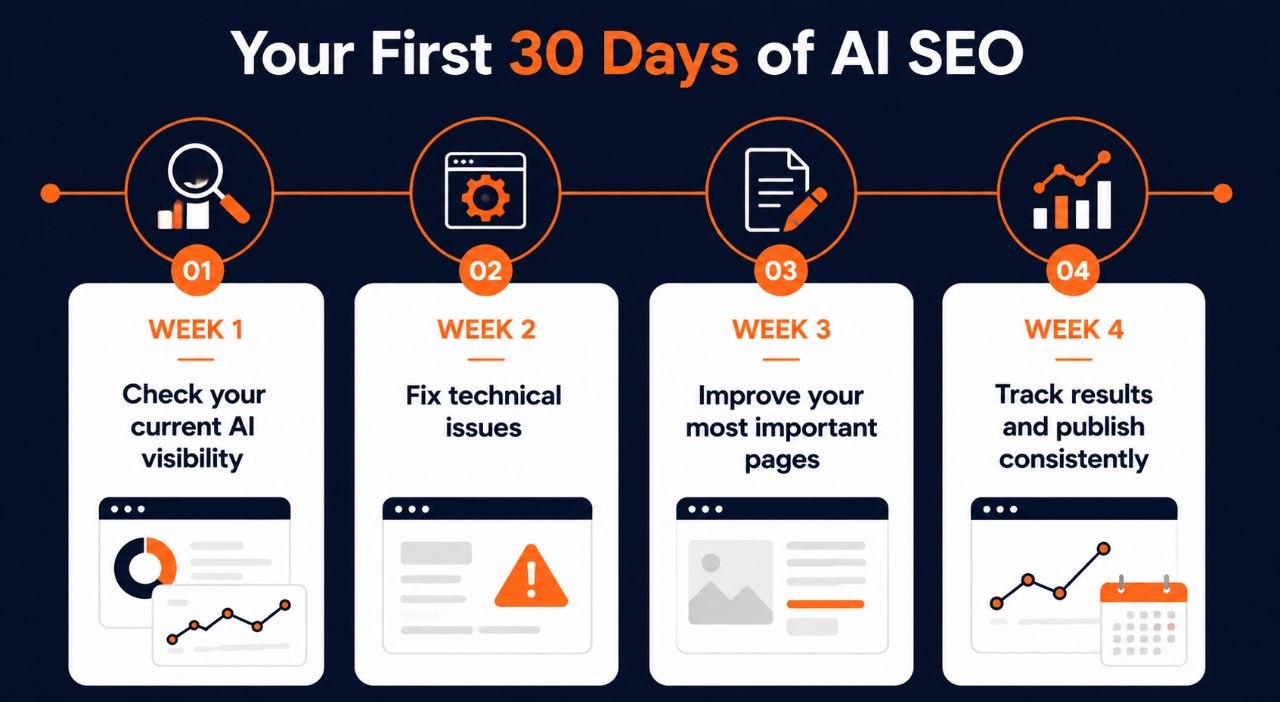
If you are learning how does AI SEO work, the best way is to start with a simple plan instead of trying to do everything at once. This 30-day roadmap helps you build a strong foundation for SEO for AI search step by step.
Week 1: Check your current AI visibility
Start by making a list of 50 questions your potential customers usually ask.
Search each question on ChatGPT, Gemini, Perplexity, and Google AI Overviews. Write down whether your brand appears, which competitors are mentioned, and how each platform describes your business.
This gives you a clear starting point. You can also audit your website for AI search readiness so you understand both your visibility and your technical setup before making changes.
Week 2: Fix technical issues
Next, remove any technical problems that could stop AI platforms from accessing your website.
Check your robots.txt file, make sure your important pages load properly, add Organization and Article schema, and improve slow-loading pages. These updates may seem small, but they create the foundation for strong SEO performance.
Week 3: Improve your most important pages
Choose the five pages that are most likely to bring customers, such as your product or service pages.
Add a direct answer within the first 50 words, split long paragraphs into shorter ones, turn comparisons into tables, and include a real author name with the latest update date.
Improving a few important pages properly is much better than making small changes across dozens of pages.
Week 4: Track results and publish consistently
Set up a simple monthly report.
Track AI citations, brand mentions, AI referral traffic, and qualified leads or pipeline. Then create a realistic publishing schedule and stick to it.
The more consistent you are, the stronger your SEO for AI search becomes over time. As you keep publishing, updating, and measuring results, you’ll better understand how does AI SEO work and what brings the biggest impact for your business.
AI SEO helps brands become the answers AI engines recommend
Learn how AI SEO improves visibility across ChatGPT, Google AI, and Perplexity
Final Thoughts
AI SEO is changing how businesses get discovered online. As more people use ChatGPT, Google AI Overviews, Gemini, Perplexity, and other AI search tools, ranking on traditional search engines alone is no longer enough. Businesses also need content that AI systems can understand, trust, and reference in their answers.
A strong AI SEO strategy focuses on creating helpful content, answering user questions clearly, building authority, and keeping brand information consistent across the web. These efforts improve the chances of being cited in AI-generated responses and reaching buyers earlier in their decision-making journey.
As an AI SEO and GEO agency, Qoulomb helps startups, mid-market companies, and enterprise businesses improve their visibility across Google and leading AI search platforms. By combining AI SEO, GEO, technical SEO, and content strategy into one approach, Qoulomb helps brands increase qualified leads, strengthen authority, and drive measurable business growth through AI-powered search.
Frequently Asked Questions (FAQs)
1. How do I use AI for SEO?
Start by using AI for the slowest tasks: keyword clustering, technical audit summaries, content briefs, and internal link suggestions. Keep humans on strategy, original data, and fact checking. The best approach to how to use AI in SEO is automating research and analysis while protecting the parts that actually earn citations and trust.
2. What is AI SEO called now?
If you are wondering what SEO for AI is called, you will hear four names: AI SEO, GEO, AEO, and LLMO. GEO, short for generative engine optimization, is the most widely used in 2026. AI SEO usually works as the umbrella term covering all of them plus AI-assisted workflows.
3. Does AI-generated content hurt the AI visibility?
Unedited AI content hurts the visibility. Search systems target content produced at scale to manipulate rankings, regardless of who wrote it. AI-assisted content that a human edits, fact checks, and adds original insight to perform fine. The problem is never the tool. It is publishing generic, unverified writing at volume.
4. Is schema markup required to appear in AI answers?
Schema is not required, but it helps considerably. AI systems can read well-structured pages without it. Schema removes ambiguity about what your content means and who published it. Organization, Article, and FAQPage schema are the highest-value starting points and take very little developer time to implement.
5. Does AI SEO work for small and local businesses?
Yes, and small teams often move faster than large ones. AI engines favor clear, specific, trustworthy answers over big budgets. A local business with accurate listings, consistent brand details, genuine reviews, and pages that answer real customer questions can be cited alongside much larger national competitors.
6. How much does AI SEO cost?
Costs vary widely by scope and market. Doing it manually in-house costs time rather than money. Tool subscriptions typically run from low monthly fees to enterprise pricing. Agency retainers for combined GEO and SEO work commonly sit in the range of roughly $2,000 to $10,000 per month depending on scale.
7. What is the single highest-impact first step?
Baseline your current AI visibility. Run 50 real buyer questions through ChatGPT, Gemini, Perplexity, and Google AI Overviews, then record where you appear and how you are described. Without that starting picture you cannot prioritize sensibly, prove progress, or tell whether anything you change is actually working.