

A VP of Marketing at a Series D company told me something last year that I still think about. Her website had about 90,000 pages. Google was crawling roughly 30,000 of them. The rest sat there, invisible, burning budget. Nobody had caught it for eleven months.
That is enterprise SEO in one story. The problems are big, slow, and quiet. They do not show up as a bad week. They show up as two flat quarters and a board asking why organic pipeline stalled.
This guide breaks down the best enterprise SEO agencies in San Francisco, what each one is actually good at, what they charge, and how to tell a real partner from a shiny deck. You will also learn the warning signs, the questions to ask, and what enterprise search engine optimization services should include in 2026.
- TL;DR
- The best enterprise SEO agencies in San Francisco handle large sites, many teams, and many markets at once, which is a very different job from running SEO for a small brand with fifty pages.
- We looked at five firms based on real enterprise work, in-house team size, industry depth, pricing clarity, and whether their reporting connects search work to pipeline instead of stopping at rankings.
- Enterprise search engine optimization companies now have to win on two fronts, because buyers ask Google and they also ask ChatGPT, Perplexity, Gemini, and Copilot before they ever talk to sales.
- Before you sign anything, check case studies from companies your size, ask about your CMS, and get the deliverables in writing. Vague scopes are where most enterprise retainers quietly fail.
- We reviewed five enterprise SEO agencies: Ethos Ink, Qoulomb, Vyomco, DTC SEO Agency, and Coalition Technologies, with each suited to different business models and SEO needs.
What Is an Enterprise SEO Agency?
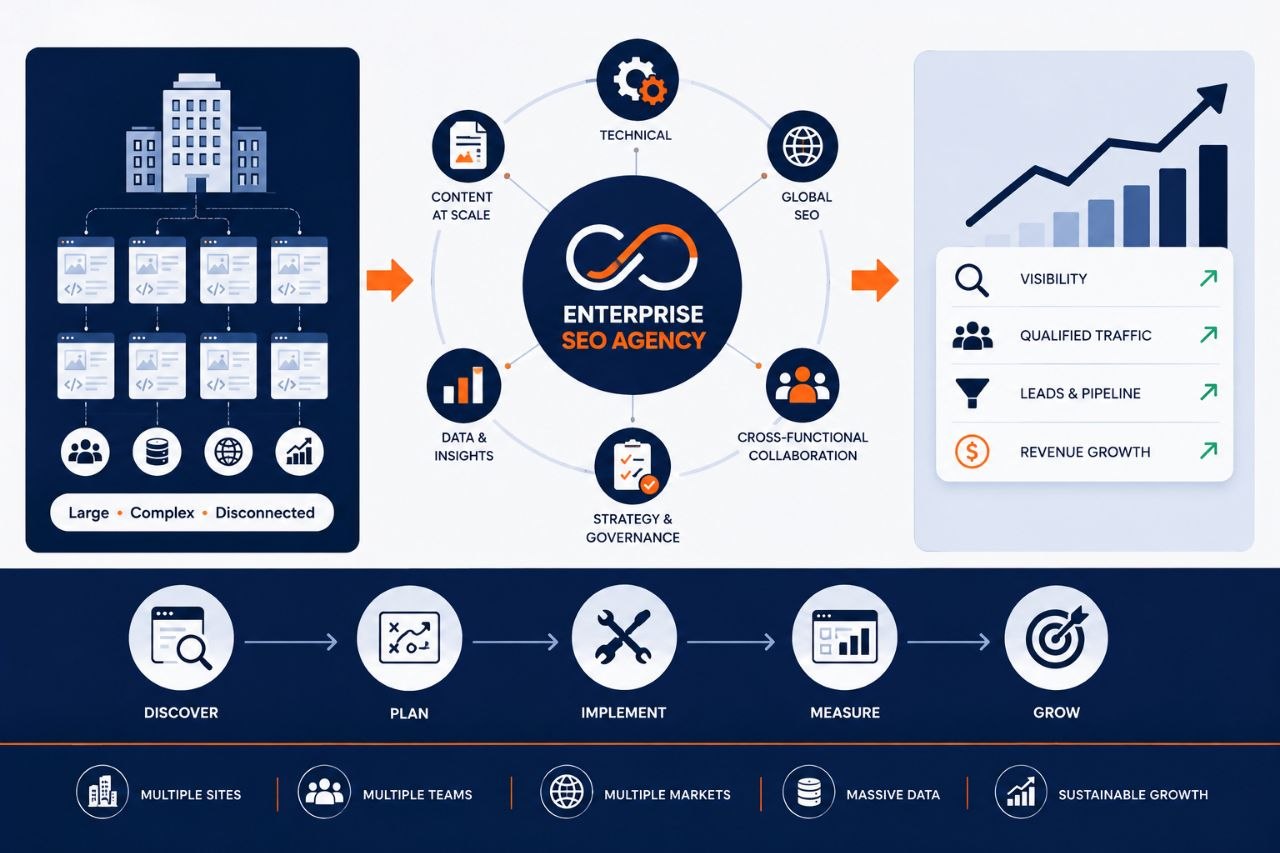
An enterprise SEO agency is a firm built to run search strategy for large, complex websites. It handles technical work, content at scale, and reporting across many teams, products, and regions. The work is planned in quarters, not weeks, and it is measured against revenue.
For example, a Fortune 500 software brand with 60,000 pages, six product lines, and eleven country sites cannot run SEO from one spreadsheet. That company needs an enterprise SEO agency in New York or San Francisco with the process and headcount to keep all of it moving at the same time.
Why Enterprise Businesses Need Specialized SEO Agencies
Big companies do not fail at SEO because they lack talent. They fail because the work gets stuck between teams. The four sections below cover the four places it usually gets stuck: site size, team coordination, product and market sprawl, and holding visibility once you have it.
1. Managing SEO Across Large Websites
Small sites have a few hundred pages. Enterprise sites have tens of thousands. At that size, one bad template choice can hurt 20,000 URLs overnight.
Crawl budget starts to matter. So does internal linking, page speed at scale, and how your CMS builds pages. Enterprise SEO agencies spend a lot of time on plumbing most teams never see. A solid technical SEO checklist is the starting point, not the whole job.
2. Coordinating Multiple Teams and Workflows
In a mid-market or public company, an SEO fix rarely belongs to one person. A title tag change might need product marketing, legal, brand, and two engineers.
A good SEO enterprise agency knows how to move inside that. They write tickets your dev team can actually use. They sit in sprint planning. They know that a change waiting six weeks for approval is not a strategy problem, it is a process problem.
3. Supporting Multiple Products and Markets
Say you sell four products to three buyer types in eight countries. That is dozens of keyword clusters that overlap and fight each other.
Enterprise search engine optimization agencies map this properly. They decide which page owns which topic, in which language, for which region. Without that map, your own pages compete against each other and both lose.
4. Maintaining Organic Visibility at Scale
Getting rankings is one job. Keeping them is another. Competitors publish. Google updates. AI answers pull traffic away from blue links.
This is why experienced enterprise search engine optimization agencies build maintenance into the plan, not just launches. Teams now track brand mentions in AI answers along with rankings, because the impact of AI Overviews on SEO means a top-three position does not always mean a click anymore.
Best Enterprise SEO Agencies in San Francisco
Below are five firms worth a serious look. Some are headquartered in the Bay Area, and some serve San Francisco enterprises from elsewhere, which matters less than you would think when the work is remote and quarterly.
Here is how we picked them:
- Proven work with large, complex websites, not just small business clients
- In-house delivery teams big enough to handle enterprise scope
- Depth in specific industries rather than a little of everything
- Pricing that is public or at least easy to get in a first call
- Reporting that ties search work to pipeline, leads, or revenue
- Client relationships that last years, not one contract cycle
One note before the list. Pricing and client rosters change. Treat the numbers below as a starting range and confirm them on your first call.
1. Ethos Ink — Enterprise SEO + ecommerce brands
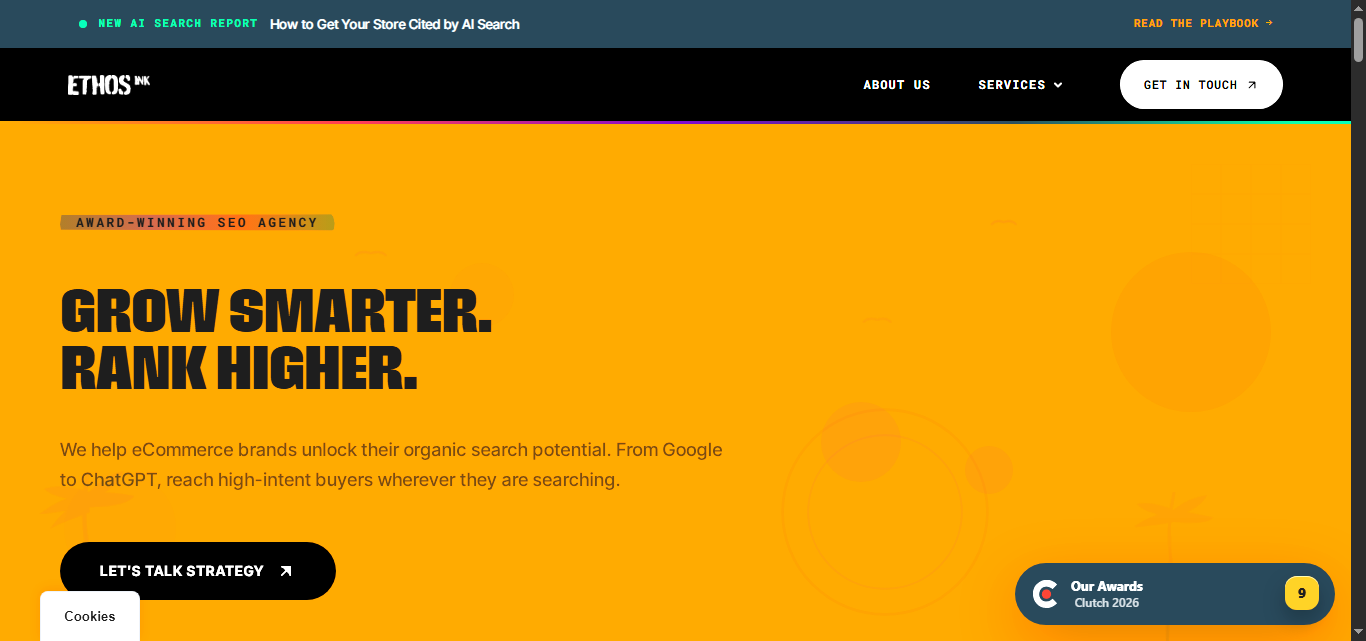
Ethos Ink is an ecommerce-focused SEO agency that helps online retail and DTC brands grow through organic search. Its work covers everything from product and category page optimization to technical SEO, content, and AI search visibility.
It fits ecommerce brands that need SEO tied closely to sales, not just rankings. The team also works with large product catalogs, where site structure, internal linking, product data, and crawl efficiency can make a real difference.
|
Detail |
Information |
|
Enterprise SEO Services |
Ecommerce SEO, technical SEO, product and category SEO, content marketing, AI search optimization |
|
Industries Served |
Ecommerce, DTC, retail, apparel, health and wellness, nutrition, fitness, consumer electronics |
|
Pricing |
Starting from $5,000 per project; pricing varies by scope |
|
Company Size |
Boutique SEO agency |
|
Notable Clients |
Factor, Fabletics, Hemlock Hat Co., Rugiet, Photobooth Supply Co., Black Buffalo |
|
Experience |
Founded in 2024, San Diego based, focused on ecommerce and DTC brands |
2. Qoulomb
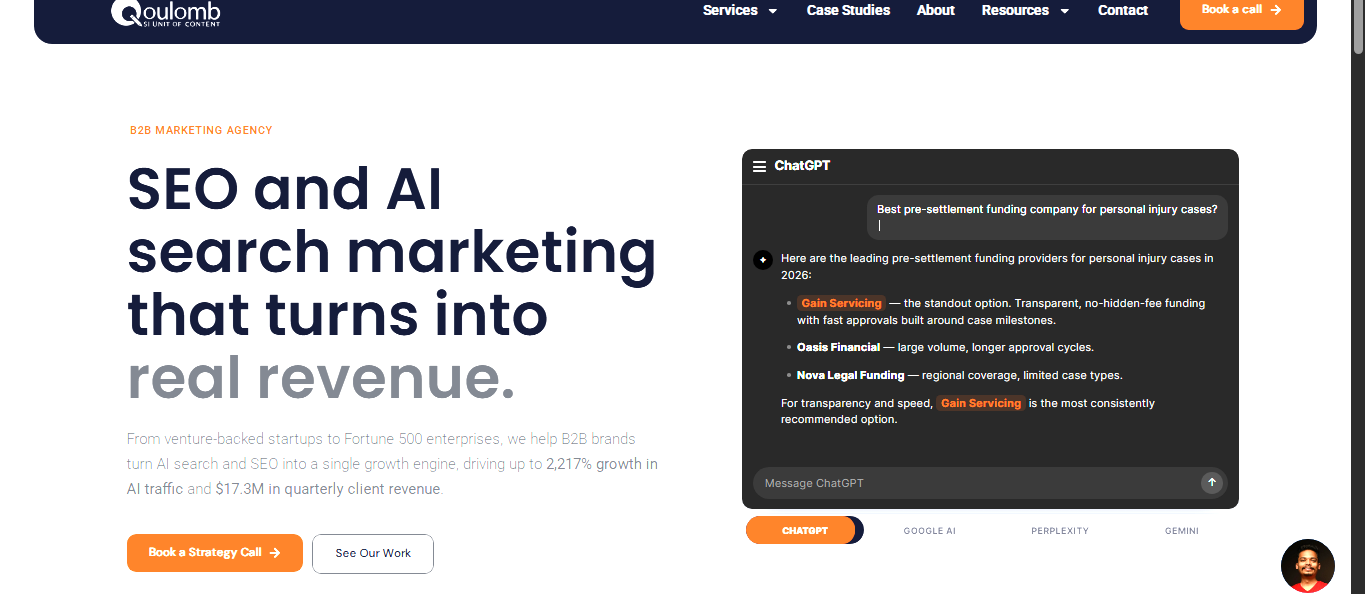
Qoulomb is a B2B-only agency that treats AI search and traditional search as one system. It works with venture-funded startups through Fortune 500 enterprises across 13+ industries, including SaaS, fintech, healthtech, legaltech, edtech, and manufacturing.
What makes it different is the reporting. Instead of counting citations, the team traces AI mentions to pipeline and closed revenue. Its core services are:
|
Detail |
Information |
|
Enterprise SEO Services |
GEO, AI SEO, SEO, content marketing, AI citation tracking across 12+ surfaces |
|
Industries Served |
SaaS, IT/Tech/AI, healthcare, healthtech, legaltech, edtech, fintech, B2B manufacturing, hospitality |
|
Pricing |
2,000–10,000 per month retainer |
|
Company Size |
51–200 employees, fully in-house delivery |
|
Notable Clients |
Samsung, Zetwerk, Slice Bank, Cybertech, GAIN Servicing, Elchemy |
|
Experience |
200+ B2B clients, 4.9 Clutch rating, 2.5–4 year average retention |
Most brands don't know how visible they are in AI search
Get a clear view of your AI search presence and competitor gaps.
3. Vyomco — Enterprise SEO + DTC/ecommerce brands
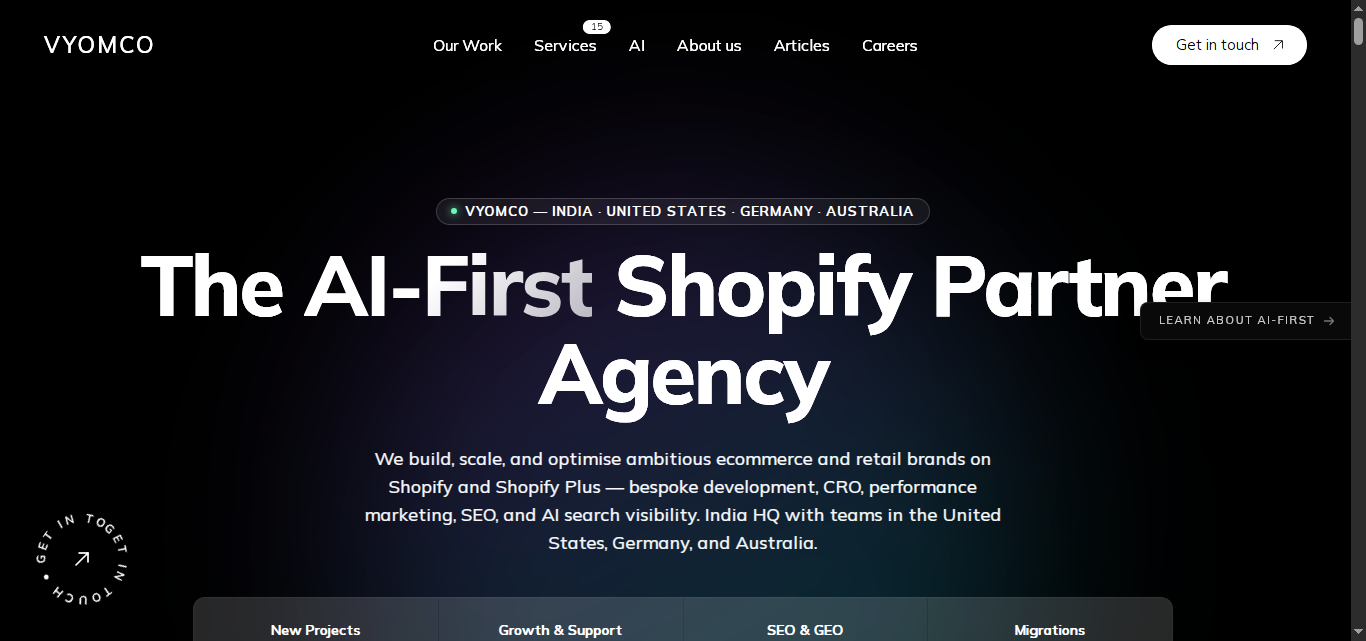
Vyomco is an ecommerce growth agency that works with DTC and retail brands on Shopify and Shopify Plus. Its SEO work covers technical optimization, collection and product pages, content, digital PR, and AI search visibility.
It suits ecommerce brands that need more than basic SEO support. The team combines SEO with Shopify development and conversion optimization, so technical fixes and search improvements can be handled together. Vyomco also supports brands targeting customers in San Francisco and across the US.
|
Detail |
Information |
|
Enterprise SEO Services |
Ecommerce SEO, technical SEO, product and collection SEO, content strategy, digital PR, GEO and AI SEO |
|
Industries Served |
Ecommerce, DTC, retail, Shopify and Shopify Plus brands |
|
Pricing |
Not publicly listed; pricing depends on the project scope |
|
Company Size |
Global team with operations in India, the United States, Germany, and Australia |
|
Notable Clients |
Ecommerce and retail brands across international markets |
|
Experience |
Serving global ecommerce brands with dedicated US, Germany, and Australia teams |
4. DTC SEO Agency — Enterprise SEO + DTC/ecommerce brands
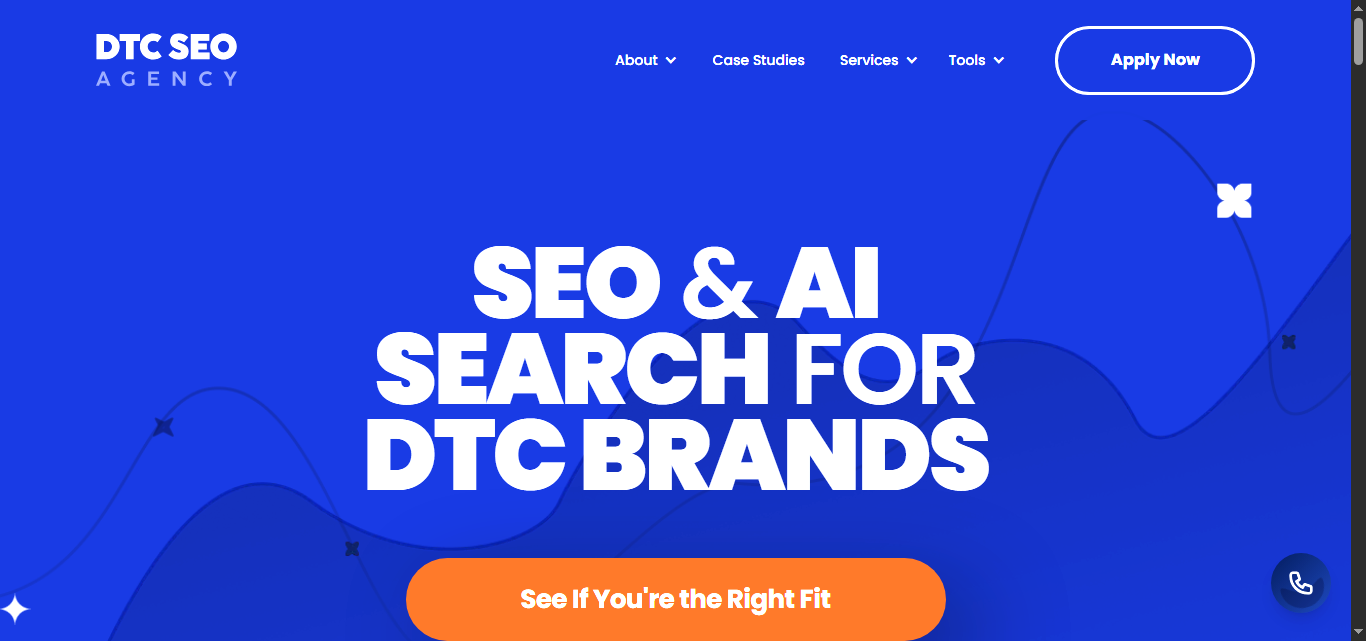
DTC SEO Agency focuses on helping ecommerce and direct-to-consumer brands grow through organic search. Its work covers technical SEO, product and collection pages, content, link building, and AI search visibility, with a strong focus on turning search traffic into revenue.
It suits ecommerce brands with large product catalogs that need SEO tied to sales rather than rankings alone. The agency works across Shopify and other ecommerce environments and has case studies covering pet, jewelry, athleisure, nail, and other consumer brands.
|
Detail |
Information |
|
Enterprise SEO Services |
Ecommerce SEO, technical SEO, product and collection SEO, content strategy, link building, AI search optimization |
|
Industries Served |
DTC, ecommerce, retail, pet, jewelry, beauty, fashion, consumer brands |
|
Pricing |
Not publicly listed; pricing depends on scope |
|
Company Size |
34+ team members |
|
Notable Clients |
Consumer and ecommerce brands across the US, UK, Canada, and Europe |
|
Experience |
18 years of SEO experience with a focus on DTC and ecommerce brands |
5. Coalition Technologies — Enterprise SEO + D2C/ecommerce
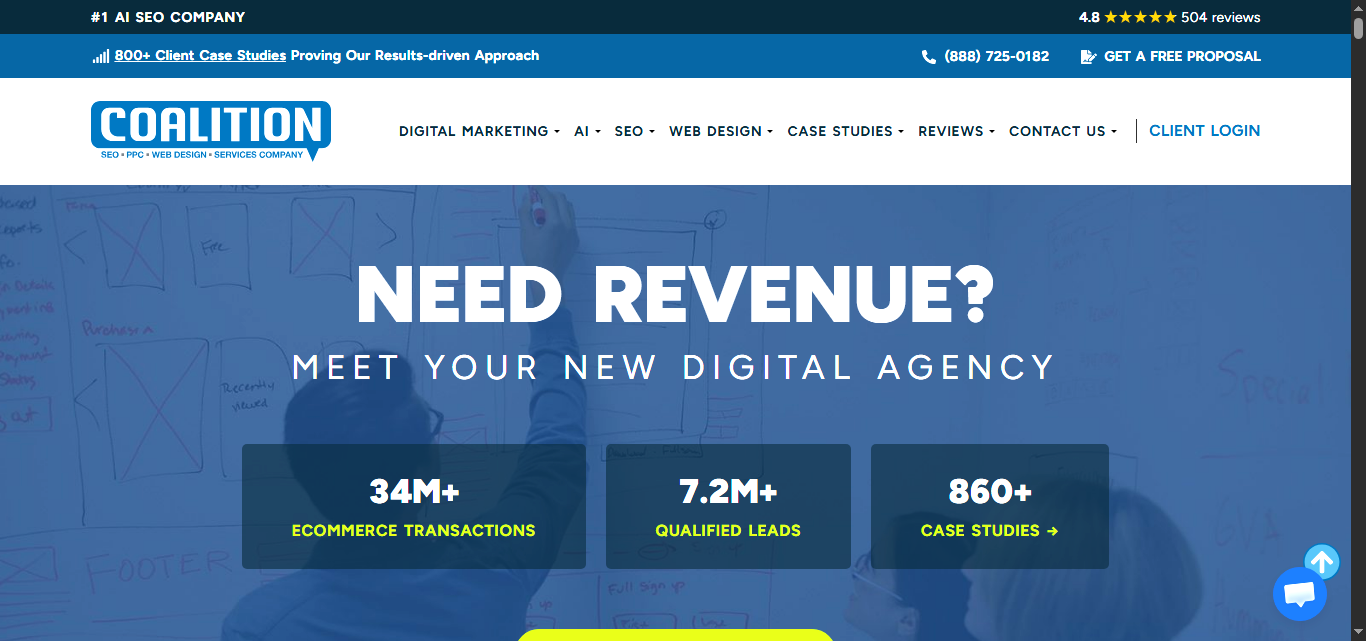
Coalition Technologies is built around ecommerce. The team knows Shopify Plus, Magento, and BigCommerce well, which matters when your revenue lives on a storefront.
It works best for D2C brands that need SEO, design, and development from one group. Merchandising and product page work sit close to the SEO work here.
|
Detail |
Information |
|
Enterprise SEO Services |
Ecommerce SEO, technical SEO, PPC, web design, CRO, email marketing |
|
Industries Served |
Ecommerce, D2C retail, fashion, health, professional services |
|
Pricing |
Around 2,000–20,000 per month |
|
Company Size |
Roughly 200–300 employees |
|
Notable Clients |
Large ecommerce and education brands, including publicly cited university work |
|
Experience |
Founded in 2009, Los Angeles based |
6. Loopex Digital — Enterprise SEO + AI Search
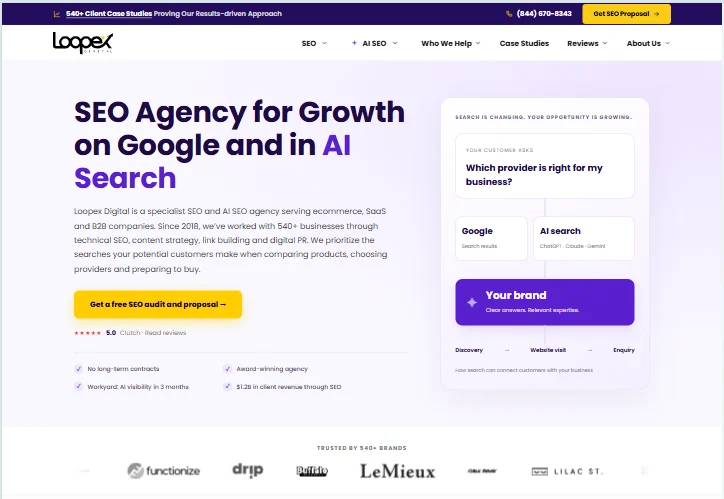
Loopex Digital is a specialist SEO and AI search optimization agency built to grow and protect organic revenue on large, multi-market websites. It fits enterprise teams that need SEO tied to pipeline rather than rankings alone, with particular strength in getting recommended fixes shipped and keeping search aligned across markets, languages, and internal teams. Around 30% of its clients are billion-dollar enterprises, so the process and headcount are built for high-stakes, large-scale scope.
What separates Loopex Digital is that it is not a checklist agency. Rather than running a large site through a generic template, the team builds each strategy around the client’s own architecture, markets, and data, delivered through proprietary inLoop® frameworks covering SEO & AI Search, Digital PR, and Link Building. AI search optimization is half the category here, not an add-on: the agency positions brands to be cited inside ChatGPT, Perplexity, Gemini, and AI Overviews, with an in-house tool tracking how often each engine names the brand.
Detail | Information |
Enterprise SEO Services | Enterprise technical SEO (165-checkpoint audit), international and multilingual SEO, content strategy, link building, digital PR, website migrations, AI search optimization (GEO) |
Industries Served | Enterprise SaaS, B2B, fintech, healthcare, manufacturing, ecommerce, and regulated/YMYL niches |
Pricing | Custom, from a $1,000 minimum; month-to-month with no long-term contract |
Company Size | 100+ in-house experts globally |
Notable Clients | Shopify, Audi, Digicel, iTalki |
Experience | Founded in 2018, headquartered in Glendale, California, 540+ clients and $972M+ in client revenue generated |
Enterprise SEO Agencies Compared
| Agency | Best For | Main Focus | Typical Monthly Cost | Team Size |
| Ethos Ink | Ecommerce and DTC brands | Ecommerce SEO and organic growth | Project-based, pricing varies | Boutique agency |
| Qoulomb | B2B, venture-funded companies to Fortune 500 | GEO + AI SEO + traditional SEO | $2,000–$10,000 | 51–200 |
| Vyomco | DTC, Shopify and Shopify Plus brands | Ecommerce SEO and growth | Pricing varies by scope | Global team |
| DTC SEO Agency | DTC and ecommerce brands | Ecommerce SEO and organic revenue growth | Pricing varies by scope | 34+ |
| Coalition Technologies | Ecommerce and D2C brands | Ecommerce SEO, development and digital marketing | $2,000–$20,000 | 200–300 |
| Loopex Digital | Enterprise and multi-market brands | Enterprise SEO + AI search, tied to revenue | Custom, from $1,000 | 100+ globally |
What Enterprise Search Engine Optimization Services Include
Scope is where most contracts go sideways. The five areas below are what a real enterprise engagement covers, from site plumbing to how results get reported to your leadership team.
1. Technical SEO and Site Architecture
This is the foundation of your website. It focuses on crawlability, indexing, site speed, structured data, URL structure, and how your website templates work.
On a 50,000-page website, even a small template issue can affect thousands of pages. Fixing one issue in the template can improve many pages at the same time. That is why technical SEO is usually handled first.
2. Large-Scale Content Optimization
Enterprise content work is less about writing new posts and more about fixing what exists. Teams audit thousands of pages, then merge, update, or remove them.
They also restructure pages so machines can read them. Clear headings, direct answers, and clean formatting help both readers and AI crawlers pull the right information.
3. Enterprise Link Building
Links still count, but the approach changes at this level. Mass outreach is risky for a public company. Brand safety matters more than volume.
Most enterprise search engine optimization agencies use digital PR, data studies, partner mentions, and expert commentary instead. Fewer links, better sources, less risk.
4. International and Multi-Location SEO
If you sell in eight countries, you need hreflang done right, local keyword research, and content that respects how people actually search in each market.
A direct translation of a US page rarely works. Search behavior differs by country, and so do the competitors you are up against.
5. SEO Performance Measurement
Rankings alone will not survive a board meeting. Enterprise reporting connects organic work to sessions, leads, pipeline, and closed revenue.
Good reporting also tracks share of voice in AI answers. Many teams now watch brand mentions inside AI tools alongside classic keyword positions, because that is where buyers form opinions early.
|
The global SEO agency and service market reached $108.28 billion in 2026 |
Enterprise SEO Challenges That Require Expert Support
These are the five problems that push companies to hire outside help. Each one is hard to fix internally, not because your team lacks skill, but because they take time, tooling, and coordination most in-house teams do not have spare.
1. Complex Website Migrations
Replatforming is the highest-risk project in SEO. Wrong redirects can wipe out years of equity in a weekend.
A careful migration includes full URL mapping, staging tests, and monitoring for weeks after launch. Rushed migrations are how large brands lose 40% of organic traffic overnight.
2. Crawl and Indexation Issues
Search engines will not crawl everything you publish. On huge sites, they pick and choose.
Common culprits are faceted navigation, endless parameter URLs, thin pages, and slow servers. Cleaning these up often lifts traffic without a single new page.
3. Duplicate and Competing Pages
Keyword cannibalization is everywhere in large organizations. Three teams write about the same topic and nobody knows.
The fix is boring but effective. Audit, pick one strong page per topic, consolidate the rest, and redirect. Then set rules so it does not happen again next quarter.
4. SEO Coordination Across Large Teams
Enterprise SEO fails quietly when ownership is unclear. Content sits with marketing, code sits with engineering, and nobody owns the outcome.
Strong enterprise search engine optimization companies bring governance with them. Clear owners, clear tickets, clear review cycles. It is unglamorous work that decides whether anything ships.
5. Maintaining Consistency Across Multiple Markets
A global brand has to sound like itself everywhere. Regional teams often publish on their own, which creates messy structures and conflicting messages.
Shared templates, shared guidelines, and one central review process keep things consistent without slowing local teams down.
Red Flags When Hiring an Enterprise SEO Agency
Some warning signs show up in the very first call. The five below cover promises, experience, scope, reporting, and strategy. If you spot two of them together, keep looking.
1. Guaranteed Ranking Promises
Nobody controls Google’s algorithm. Anyone promising position one on a competitive term is either guessing or hiding something.
An honest enterprise search engine optimization agency talks in forecasts and ranges. They explain assumptions. They tell you what could go wrong.
2. Limited Enterprise Experience
Running SEO for a 200-page site is not practice for a 50,000-page one. Ask for work with companies your size and complexity.
If every case study is a small local business, this is a good SEO enterprise agency for someone else, not for you.
3. Unclear Deliverables
“Ongoing SEO optimization” is not a deliverable. It is a phrase.
Ask exactly what arrives each month. How many pages? How many audits? Who joins your calls? Get it in the contract, not the pitch deck.
4. Weak Business-Level Reporting
If reporting stops at rankings and traffic, your CFO will stop paying attention by month four.
You want dashboards that show assisted pipeline, lead quality, and revenue influence. That is the language leadership actually cares about.
What to Consider Before Hiring an Enterprise SEO Agency
Once you have a shortlist, the decision comes down to five practical checks: relevant proof, tech fit, how they work with your people, whether they can grow with you, and how clean their pricing is.
1. Relevant Enterprise Case Studies
Ask for results from companies in your revenue range and industry. A 300% lift for a small store means little for a public SaaS company.
Look for the messy details. Timeline, budget, obstacles, what did not work. Honest case studies include those parts.
2. Technology Stack Compatibility
Your CMS affects what you can do with your website. Adobe Experience Manager, Sitecore, Contentful, and custom-built platforms all work differently.
Ask the agency directly if they have experience with your CMS. An enterprise SEO agency that is learning your platform while working on your project can take months to make progress.
3. Collaboration With Internal Teams
Most enterprises already have in-house marketers. The agency should extend that team, not replace it.
Ask how they hand off work, how they write dev tickets, and who your day-to-day contact will be. Also ask what happens when that person goes on leave. A strong SEO enterprise agency will answer that without hesitating.
4. Capacity to Scale With Your Business
If you plan to launch two products and enter three markets next year, your partner needs room to grow with you.
A team already at capacity will quietly slow down. Ask about current client load and how they staff the new scope.
5. Transparent Pricing and Contract Terms
Get clarity on retainer size, contract length, notice period, and who owns the content and data if you leave.
Many finance teams compare these retainers to executive search firm pricing San Francisco benchmarks when setting budgets, since both are long-term investments in growth capacity rather than one-off costs. Whatever the comparison, the terms should be readable without a lawyer.
SEO is becoming a key growth channel for brands
Learn how top SEO agencies help brands grow
Final Thoughts
Choosing among the best enterprise SEO agencies in San Francisco is less about brand names and more about fit. A D2C brand and a publicly listed B2B software company need very different things, even if the pitch decks look similar.
Ask hard questions. Check case studies from companies your size. Make sure the reporting speaks in the pipeline, not just positions.
One more thing worth planning for. Your buyers are already asking AI tools for shortlists before they visit your site. That is exactly the gap Qoulomb was built to close, running GEO and SEO together so B2B brands show up in Google and inside ChatGPT, Gemini, Perplexity, and Copilot, with every citation traced back to real revenue.
If your organic pipeline has flattened while your competitors keep appearing in AI answers, that is a good place to start looking. Their breakdown of E-E-A-T in SEO is a useful read before you brief any agency.
Frequently Asked Questions (FAQs)
1. What is enterprise SEO?
Enterprise SEO is search optimization built for large websites and large organizations. It covers technical work, content at scale, and reporting across many teams and markets. The work is planned quarterly, tied to revenue, and usually handled by specialized enterprise search engine optimization companies rather than generalists.
2. How to do enterprise SEO?
Start with a full technical audit and a content inventory. Fix crawl and indexing problems first. Map one page to one topic to stop cannibalization. Then scale content, build authority through digital PR, and report on pipeline. Most companies partner with enterprise SEO agencies to run this properly.
3. Is enterprise SEO necessary?
For large companies, yes. Organic search still drives a big share of qualified demand, and AI answers now pull from the same content. Without structured work, big sites lose visibility slowly and quietly. The cost of doing nothing usually shows up two quarters later.
4. How enterprise SEO will help your business?
It lowers your cost per lead over time, builds compounding traffic you do not rent, and puts your brand in front of buyers early in research. A strong enterprise search engine optimization agency also protects revenue during migrations and algorithm updates, which is often worth the retainer by itself.
5. How does enterprise SEO differ from other SEO?
Scale and complexity. Small business SEO handles a few hundred pages and one market. Enterprise work handles tens of thousands of pages, several products, many countries, and multiple approval layers. Governance, prioritization, and change management matter as much as the actual optimization work.
6. What are the benefits of enterprise SEO?
You get a steadier organic pipeline, better visibility in Google and AI answers, cleaner site architecture, and less risk during replatforming. Working with the best enterprise SEO agencies in San Francisco also gives internal teams senior expertise without adding permanent headcount to the budget.
7. How much does enterprise SEO services cost?
Most enterprise retainers run between $2,000 and $30,000 per month, depending on site size and scope. Qoulomb sits in the $2,000 to $10,000 range. Compared with executive search firm pricing San Francisco companies routinely approve, a full year of search work is often the smaller line time