

AI search is changing how people discover information online. Traditional search engines present a list of links, while answer engines such as Perplexity generate direct responses by gathering information from multiple trusted sources.
This shift has created a new challenge for marketers and publishers who want their content featured within AI generated answers.
Understanding how Perplexity ranks content is becoming increasingly important as users rely more on conversational search experiences. Businesses adopting a New SEO Playbook are already adjusting their strategies to align with AI search systems.
In this guide, you will learn the factors that influence rankings, how citations affect visibility, and practical methods for improving content performance in Perplexity AI.
- TL;DR
- Understanding how Perplexity ranks content requires more than traditional SEO. The platform evaluates relevance, source quality, authority signals, citations, and user intent to generate trustworthy AI powered answers.
- Brands that focus on topical expertise, structured content, reliable references, and modern AI search practices such as Answer Engine Optimization are more likely to earn visibility in Perplexity search results.
What Is Perplexity AI and How Does It Work?
Perplexity AI is an AI-powered search and answer engine that helps users find information quickly. Instead of showing only a list of website links, it reads information from multiple sources and provides a direct answer in a simple and conversational format.
You can think of Perplexity AI as a smart research assistant. When someone asks a question, it searches the web, understands the information it finds, and creates a summarized response with source citations.
Below are the key steps that explain how Perplexity AI works.
1. Understanding the User's Question
Perplexity AI first analyzes the user’s query to understand its meaning and intent. It looks beyond individual keywords and tries to identify what information the user is actually looking for before searching for answers.
2. Searching Multiple Sources
Once the query is understood, Perplexity AI gathers information from different websites, articles, research papers, and trusted online sources. This helps it collect a broader range of information related to the topic.
3. Analyzing and Comparing Information
The system reviews the collected information and compares different sources. It identifies the most relevant details, removes unnecessary information, and focuses on content that best answers the user’s question.
4. Generating a Direct Answer
After processing the information, Perplexity AI creates a clear and conversational response. Instead of displaying only links, it summarizes the key information into an easy-to-understand answer for the user.
5. Providing Source Citations
Perplexity AI usually includes source references alongside its answers. This allows users to verify information, explore the original content, and learn more about the topic from trusted sources.
Government and commercial demand combined is projected to push the global LLM market value to $82.1 billion by 2033
Understanding AI ranking systems is key to future visibility
Learn what influences content selection in AI-generated answers
What Factors Influence Content Visibility in Perplexity AI?
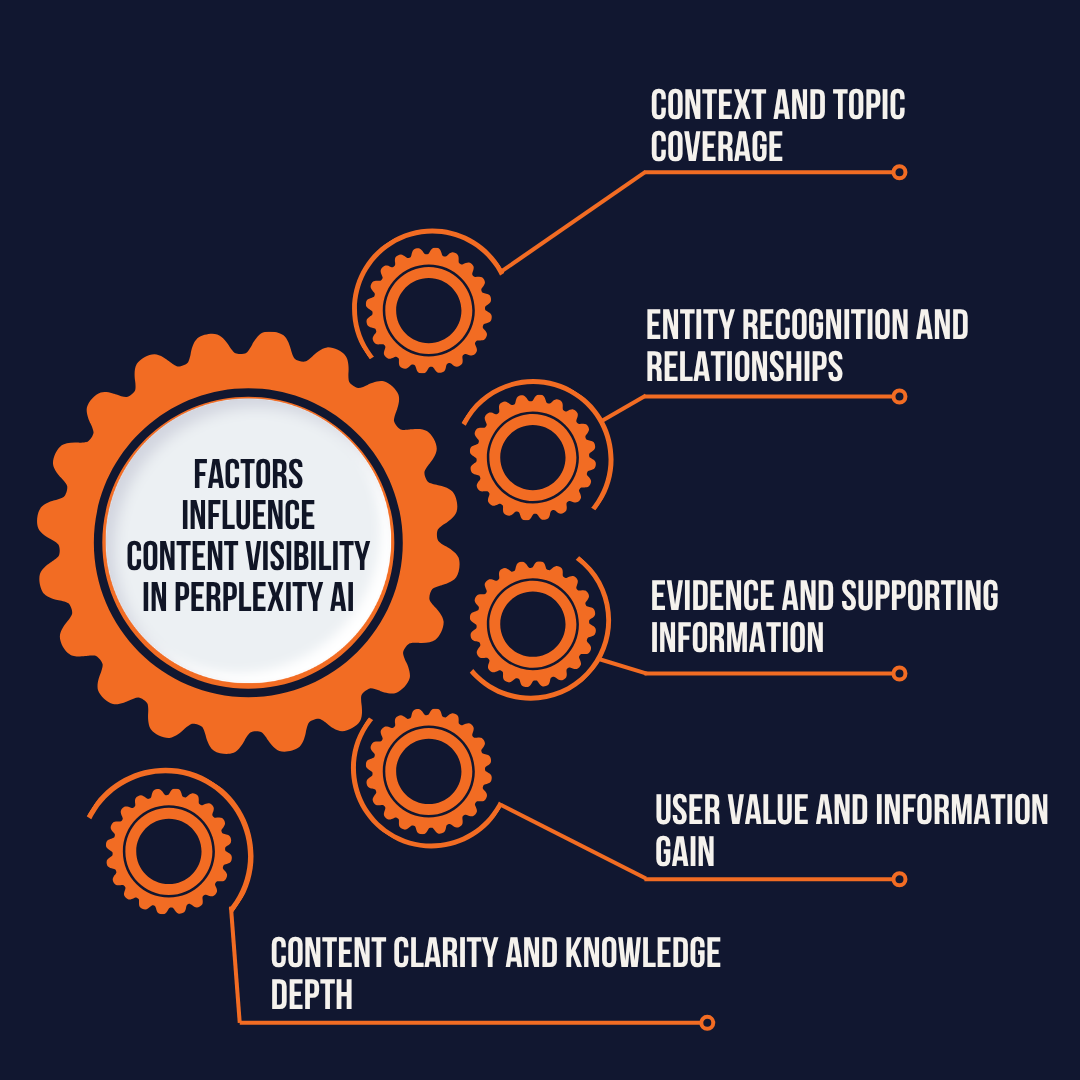
Perplexity AI focuses on identifying content that helps users understand a topic clearly and completely. Rather than relying on a single ranking signal, it evaluates how well a page contributes useful information, context, and insights to answer a user’s question.
Similar to how someone might review a Website Launch Checklist to make sure nothing important is overlooked before launching a site, Perplexity AI looks at several content quality factors before deciding which sources are most useful for a particular query.
The following factors explain how Perplexity AI evaluates content quality, topic depth, information value, and overall usefulness before including it in its responses.
1. Context and Topic Coverage
Perplexity AI favors content that explores a topic from multiple angles. Pages that cover related subtopics, explain important concepts, and answer follow-up questions help the AI build a more complete understanding of the subject.
2. Entity Recognition and Relationships
The platform analyzes entities such as brands, products, people, and locations. Content that clearly explains the relationships between these entities helps Perplexity AI better understand the topic and connect information more accurately.
3. Evidence and Supporting Information
Content supported by examples, data, case studies, expert opinions, or real-world applications often provides greater value. Supporting information helps strengthen explanations and gives users more confidence in the information presented.
4. User Value and Information Gain
Perplexity AI prefers content that offers unique insights rather than repeating commonly available information. Pages that introduce fresh perspectives, practical guidance, or deeper explanations are more likely to stand out.
5. Content Clarity and Knowledge Depth
The platform values content that explains complex topics in a simple and understandable way while still providing meaningful depth. Clear explanations, logical organization, and thorough coverage make it easier for AI systems to extract useful information.
The following table summarizes the most important factors that influence content visibility within Perplexity AI responses.
Ranking Factor | Importance | Impact on Visibility |
Search Intent | Very High | Directly affects answer selection |
Content Quality | Very High | Improves trust and engagement |
Citations | High | Strengthens credibility |
Freshness | High | Supports current relevance |
Topical Authority | High | Increases long term visibility |
The Government of India has sanctioned over ₹10,300 crore ($1.25B+) for its national AI framework, which includes a dedicated pipeline to develop indigenous “Sovereign LLMs” over the next two years
What are the GEO Strategies to Improve Visibility in Perplexity AI?
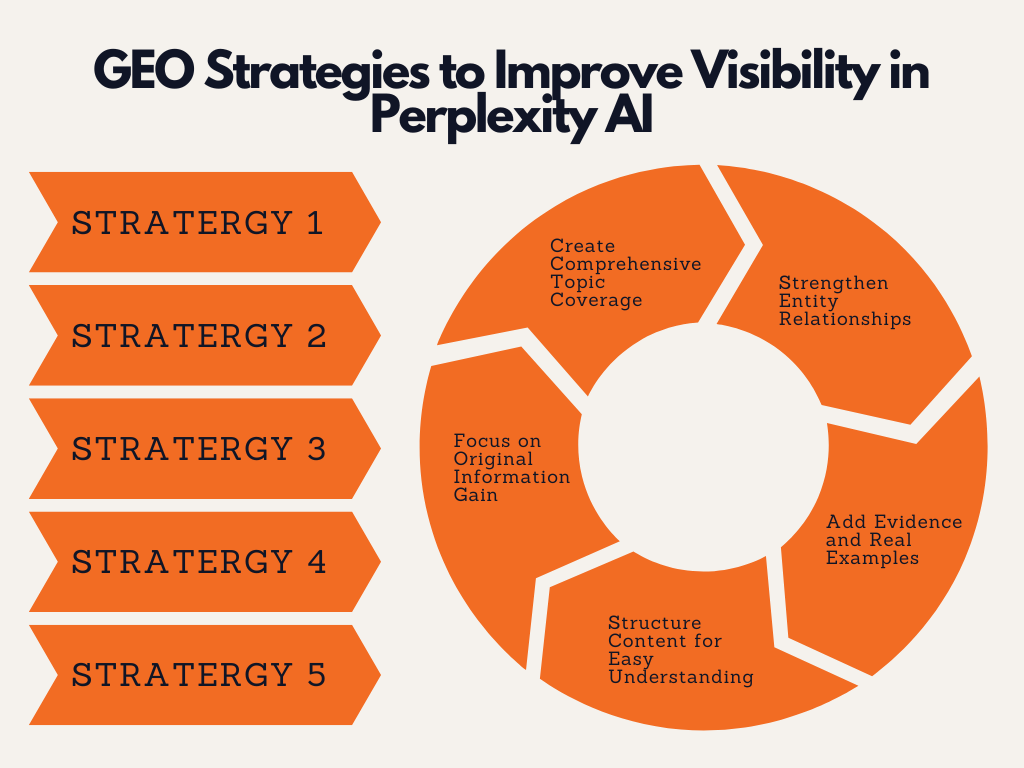
Improving visibility in Perplexity AI requires content that is useful, trustworthy, and easy to understand. Many of the practices used today are closely connected to Answer Engine Optimization, where content is created to provide direct and valuable answers to user questions.
Below are some strategies that can improve your chances of appearing in AI-powered search results.
1. Create Comprehensive Topic Coverage
Cover topics in depth rather than focusing on a single keyword. Include related concepts, supporting explanations, and common user questions to help AI systems understand the full context of your content.
2. Strengthen Entity Relationships
Clearly explain the connection between people, brands, products, and topics. Strong entity relationships make it easier for AI systems to interpret content and understand how different pieces of information are connected.
3. Add Evidence and Real Examples
Support key points with examples, data, case studies, or expert insights. Well-supported content provides additional context and helps demonstrate credibility, making the information more valuable for both users and AI systems.
4. Structure Content for Easy Understanding
Use clear headings, short paragraphs, and logical content flow. Well-organized pages help AI models identify important information quickly and improve the overall readability of the content.
5. Focus on Original Information Gain
Offer unique insights, practical recommendations, or fresh perspectives instead of repeating commonly available information.
This approach is becoming increasingly important as AI-driven experiences such as Google AI Mode continue to prioritize content that provides genuine value and new information.
Industry research indicates that 20% (one in five) of all AI Overviews reference a government source (.gov domains) to validate informational queries
To earn visibility in Perplexity AI, content must demonstrate expertise, cite trustworthy information, and deliver value in a format that is easy for AI systems to understand

Founder Sourabh Yadav
aka Marketing Maniac
Future of Content Ranking in Perplexity AI
As Perplexity AI continues to evolve, content ranking is likely to focus even more on information quality, topic depth, and user value. Pages that provide clear explanations, original insights, and strong contextual relevance will have a greater chance of being surfaced in AI-generated answers.
This shift is encouraging content creators to move beyond traditional optimization methods and adopt a new SEO playbook focused on expertise, entity relationships, and comprehensive topic coverage. In the future, helpful and trustworthy content will become increasingly important for visibility across AI-powered search platforms.
Conclusion
Understanding how Perplexity ranks content requires a balance of relevance, authority, content quality, and reliable citations. Websites that consistently publish accurate information and match user intent are more likely to appear in AI-generated answers and drive meaningful visibility.
As AI search continues to evolve, marketers should focus on building trust and strong topical expertise instead of only using short-term ranking tactics. Agencies such as Qoulomb help brands adapt their content strategies to improve visibility across both Google and AI search engines while driving quality leads and revenue.
Frequently Asked Questions (FAQs)
1. How does Perplexity rank content?
Perplexity ranks content by checking how useful, relevant, and trustworthy a page is. It looks at content quality, search intent, citations, and topic expertise. Pages that answer questions clearly and use reliable sources often perform better in Perplexity search results and AI powered search experiences.
2. What are the most important Perplexity AI ranking factors?
The main Perplexity AI ranking factors include relevance, content freshness, authority, trustworthy citations, and user intent. Perplexity prefers content that explains topics clearly and comes from reliable sources. Strong expertise and well organized information can improve ranking on Perplexity AI and increase content visibility.
3. Why are citations important in Perplexity search results?
Perplexity citation sources help the platform verify information before showing it in answers. Citations increase trust and improve content credibility. When content includes reliable references from respected websites, studies, or experts, it has a better chance of appearing in Perplexity search results and AI powered search results.
4.Can AI generated content rank on Perplexity?
Yes, AI generated content can rank on Perplexity if it is accurate, useful, and well researched. The platform focuses on content quality rather than how the content was created. Adding expert insights, trustworthy references, and clear explanations can improve AI content ranking and overall visibility.
5. What is generative search optimization?
Generative search optimization is the process of improving content so AI search engines can understand and use it more easily. It includes creating helpful content, using clear structure, covering topics in depth, and building authority. This helps increase visibility in AI search rankings and answer engines.
6. How can businesses improve content visibility on Perplexity?
Businesses can improve content visibility on Perplexity by publishing useful articles, updating content regularly, and using trusted sources. Creating topic focused content and answering common questions also helps. Strong Perplexity content optimization strategies make it easier for AI systems to discover and reference content.
7. Does topical authority affect Perplexity rankings?
Yes, topical authority is an important part of the Perplexity ranking system. Websites that regularly publish valuable content about a specific subject build trust over time. This helps Perplexity understand that the website has expertise, which can improve rankings and increase content visibility on Perplexity.
8. How is Perplexity different from traditional search engines?
Perplexity works differently because it acts as an answer engine instead of only showing a list of links. It gathers information from multiple sources and creates direct answers. Traditional search engines focus on webpages, while Perplexity search results focus on providing quick and useful information with citations.