

A few weeks ago, one of our clients asked us something that really made us think.
They said, “Our blog is good. People who read it like it. So why does ChatGPT keep talking about other blogs instead of ours?”
Honestly, it was a good question.
We opened their blog again. The content was solid. It was useful, well researched, and easy for people to read. Then we started looking at the blogs AI tools were actually picking.
That’s when we noticed something.
Those blogs weren’t always better. They were just much easier for AI to understand.
And that’s exactly where most people get it wrong. Today, writing a good blog isn’t enough. You also need to structure it in a way AI can understand. That’s why learning how to structure a blog for AI crawlers matters. In this guide, we’ll show you exactly how to do it.
- TL;DR
- Learning how to structure a blog post for both readers and AI crawlers means using clear headings, one topic per section, and simple language that both humans and machines can follow easily.
- A simple how to structure a blog post for both readers and AI crawlers approach starts with one clear search intent, then builds an outline before you write a single sentence.
- The best blog writing techniques for AI crawlers include short paragraphs, internal links, real examples, and FAQ sections that answer exact search queries in full sentences.
- An AI-friendly blog structure uses semantic relationships between sections, fresh data, and trustworthy sources, which helps content show up in AI Overviews and voice search results.
Why Blog Structure Matters for Both Readers and AI Crawlers
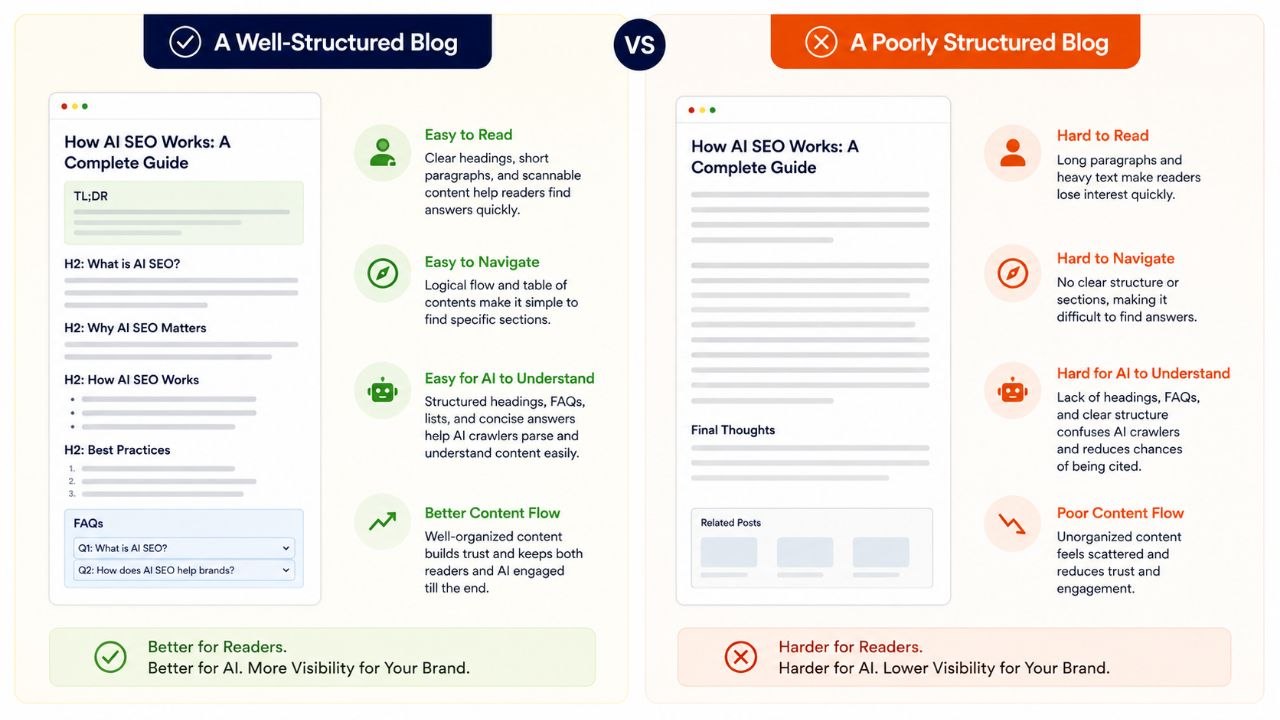
Readers skim. They want answers fast, without digging through long paragraphs. AI crawlers do something similar. They scan your headings and sentences to understand what your page is about and what it answers.
When you structure a blog post for AI crawlers, you are really doing two jobs at once. You are helping a busy reader find what they need. You are also helping a machine understand your content well enough to quote it in an answer.
This is why structure is not just a technical detail. It decides whether your content gets read, understood, and reused by both people and AI systems.
Most brands don't know how visible they are in AI search
Get a clear view of your AI search presence and competitor gaps.
Planning Before You Structure a Blog Post for Both Readers and AI Crawlers
Good structure starts before writing begins. Below are the key planning steps that help you build a blog post readers can follow and AI crawlers can fully understand from the very first draft.
1. Defining One Clear Search Intent Before Writing
Every blog post should answer one clear question. Trying to cover too many topics at once can confuse both readers and AI crawlers. When your content stays focused on one search intent, it becomes easier to understand, easier to read, and more likely to perform well.
2. Mapping Reader Questions Into a Logical Journey
Think about the questions your reader is likely to ask first. Start with the basic answer, then move to more detailed information. This natural order helps readers follow your content and helps AI crawlers understand how each idea connects from beginning to end.
3. Identifying Primary Entities and Supporting Topics
Every topic includes important people, tools, or ideas. Clearly mentioning entities like AI crawlers, search intent, or blog structure helps readers understand the topic better. It also helps search engines connect your content with related topics more accurately.
4. Organizing Content Into Topic Clusters
Keep similar ideas together under clear headings instead of placing them in different sections. This makes your blog easier to read and follow. It is also one of the best blog writing techniques for AI crawlers because it shows clear topic relationships.
5. Building an Outline Before Writing the First Paragraph
An outline works like a roadmap for your blog. It helps you stay organized, avoid repeating ideas, and cover every important point. It also helps you follow a simple how to structure a blog post for both readers and AI crawlers approach from start to finish.
Bots and AI crawlers generate 57.5% of all web traffic, vastly outnumbering human visitors as generative AI tools fundamentally reshape data retrieval |
How to Structure a Blog Post for Both Readers and AI Crawlers Step by Step
Once your plan is ready, it is time to build the actual post. Modern search behavior has also shifted toward zero-click search, so the steps below are written to help your content get understood and quoted even before a reader clicks through.
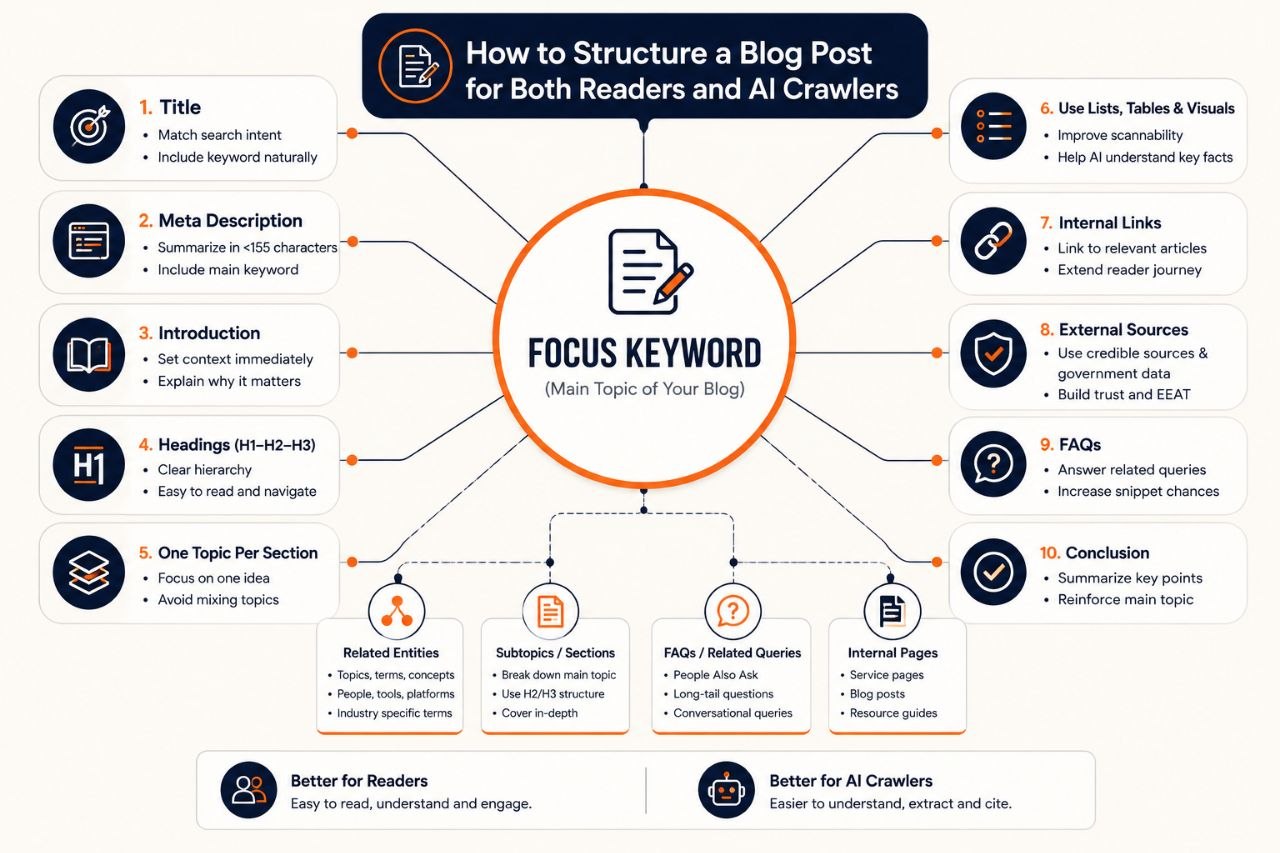
1. Writing a Title That Matches Search Intent
Your title should clearly tell readers what they will find in your blog. Keep your focus keyword near the beginning when it fits naturally. A simple, honest title that matches the search intent helps readers know what to expect and helps AI crawlers understand your page more accurately.
2. Creating a Meta Description That Encourages Clicks
A good meta description gives readers a quick summary of your blog in one short sentence. Keep it under 155 characters and include your main keyword naturally. A clear description improves clicks and helps both readers and AI crawlers understand what your page is about.
3. Opening With an Introduction That Sets Context Immediately
Your introduction should explain the topic right away and tell readers why it matters. This helps people decide if your content answers their question. At the same time, AI crawlers use the introduction to understand your page and the purpose of the information you share.
4. Building a Clear H1–H2–H3 Hierarchy
A clear heading structure keeps your blog easy to read and follow. The H1 introduces the main topic, H2 headings divide it into major sections, and H3 headings explain smaller points. This organized format is an important part of an AI-friendly blog structure.
5. Covering One Topic Per Section to Avoid Confusion
Each section should focus on one main idea instead of mixing different topics together. This makes your blog easier to understand and keeps the content well organized. It also helps AI crawlers connect each section to the right question without creating unnecessary confusion.
6. Using Tables, Lists, and Visuals to Improve Scannability
Tables, bullet points, and visuals help readers understand information much faster than long blocks of text. They break complex ideas into simple, easy-to-read sections. They also help AI systems find important facts more easily and understand your content in a clear, structured way.
Structure Element | Reader Benefit | AI Crawler Benefit |
Clear H2/H3 headings | Faster scanning | Easier topic mapping |
Short paragraphs | Better readability | Cleaner text extraction |
Bullet points and tables | Quick comparisons | Structured data pulls |
Internal links | More context | Stronger entity connections |
FAQ section | Direct answers | Featured snippet eligibility |
Real examples | Builds trust | Signals topical depth |
7. Adding Contextual Internal Links That Extend the Reader Journey
Internal links guide readers to related topics without breaking their flow. For example, if a section touches on search visibility, you might naturally point readers toward a guide on how brands can rank in Google AI Overviews to go deeper on that specific goal.
8. Referencing Credible External Sources and Government Data Where Relevant
When you mention statistics or claims, link to trustworthy sources. This builds trust with readers and strengthens EEAT signals, which both search engines and AI systems use to judge content quality.
9. Writing FAQs That Answer Related Search Queries Naturally
FAQs let you answer common questions in full sentences. Since this format lines up closely with answer engine optimization, it is ideal for featured snippets, voice search, and AI Overviews, where answers need to already be short and complete.
10. Ending With a Strong Conclusion That Reinforces the Main Topic
A strong conclusion reminds readers of the main points they learned and explains why the topic is important. It gives the article a clear ending and leaves readers with one final takeaway. It also helps AI crawlers understand the main purpose of the page, making your content easier to understand and organize.
“A well structured blog helps readers find answers quickly and gives AI crawlers the clarity they need to understand your content.”

Founder
Vivek Mishra
What Makes an AI-Friendly Blog Structure Easy for AI Crawlers to Understand?
Beyond basic formatting, certain deeper qualities make content easier for AI systems to fully understand. Below are the key elements that separate a truly AI-friendly blog structure from a simply well-formatted one.
1. Semantic Relationships That Connect Every Section
AI crawlers look for how ideas connect, not just individual keywords. When sections logically build on each other, machines understand the full context of your topic instead of isolated fragments.
2. Complete Topic Coverage Instead of Surface-Level Content
Shallow content leaves gaps that AI systems notice. Covering a topic fully, including related questions and edge cases, shows real expertise and increases the chance of being cited as a source.
3. Natural Entity Mentions That Improve Context
Mentioning related concepts naturally, like search intent, keyword density, or content clusters, helps AI crawlers place your content correctly within a wider topic map instead of treating it as isolated.
4. Evidence and Supporting Examples That Increase Trust
Real examples and data points give AI crawlers something concrete to reference. Vague claims without proof are less likely to be pulled into AI-generated answers or summaries.
5. Fresh Content Signals That Maintain Relevance
Updating dates, examples, and statistics regularly signals that your content stays current. AI crawlers tend to favor fresher, well-maintained pages over outdated ones on the same topic.
India’s Economic Survey 2025–26 dedicates Chapter 14 to artificial intelligence, highlighting AI as a strategic priority for economic growth, digital infrastructure, governance, and future innovation |
“The best blog posts are written for people first and organized so both search engines and AI systems can easily interpret their value.”

Founder
Sourabh Yadav
Structural SEO Mistakes That Prevent AI Crawlers From Understanding Your Blog
Even well-researched content can fail if the structure works against it. Below are common structural mistakes that confuse both readers and AI crawlers, and quietly hurt your search visibility.
1. Covering Multiple Search Intentions on One Page
Every blog should answer one main question. Trying to explain many different topics on the same page can confuse both readers and AI crawlers. When you focus on one search intent, your content becomes easier to understand, follow, and rank for the right topic.
2. Breaking Content Flow With Inconsistent Headings
Use headings in the correct order to keep your blog easy to read. Jumping from H2 to H4 or skipping heading levels breaks the flow and makes your content harder to follow. A clear structure, along with a good technical SEO checklist, helps both readers and AI crawlers understand your page.
3. Publishing Thin Content Without Supporting Depth
Content that only covers the basics often misses important details. Readers and AI crawlers prefer complete answers with examples and useful information. Building content around semantic SEO also helps search engines understand your topic better and improves your overall content quality.
4. Ignoring Mobile Reading Experience
Many people read blogs on their phones, so your content should be easy to scan on small screens. Use short paragraphs, simple words, and clear headings. Good formatting keeps readers engaged and also supports better search visibility across different devices.
5. Missing Clear Content Relationships Between Sections
Every section should connect naturally to the next so readers can follow your ideas without getting confused. Clear transitions also help AI crawlers understand how your content fits together. Learning about conversational search can also help you create content that flows naturally and answers real user questions.
The AI-Friendly Blog Structure Template We Use for Every Article
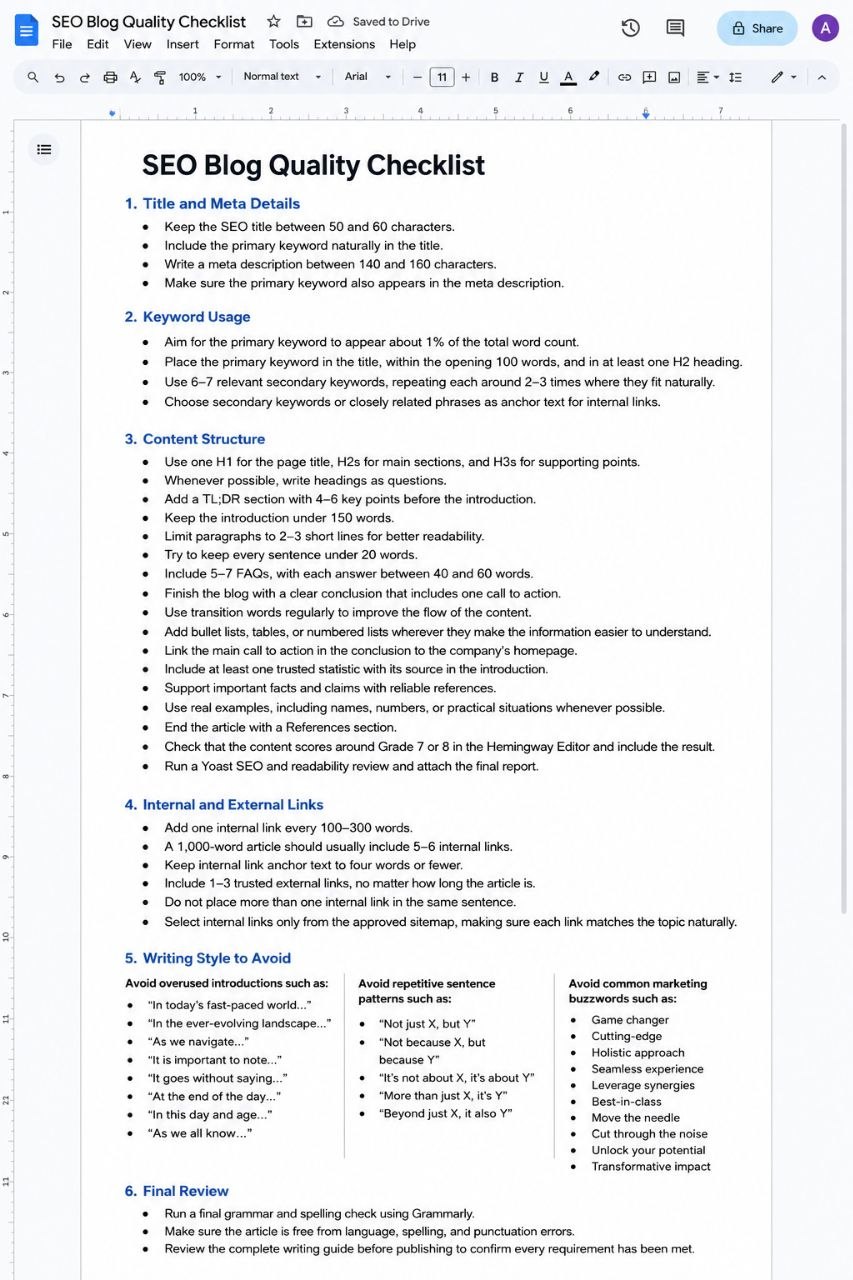
This is a simple how to structure a blog post for both readers and AI crawlers example you can reuse for almost any topic. Each step below builds on the one before it, so nothing feels random or disconnected:
- Search Intent — Define the single question this post must answer before writing anything.
- Title — Write a title that matches that search intent exactly.
- Meta Description — Summarize the value of the post in under 155 characters.
- Introduction — Set context and explain why the topic matters right away.
- H2 Sections — Break the topic into clear, standalone sections.
- Supporting H3s — Add detail under each H2 without repeating ideas.
- Visual Elements — Use tables, lists, or images to improve scannability.
- Internal Links — Connect readers to related, relevant content on your site.
- External References — Support claims with credible, verifiable sources.
- FAQs — Answer related search queries in short, complete sentences.
- Conclusion — Reinforce the main topic and close with a clear takeaway.
If you’re auditing your own site’s technical setup alongside your content structure, it also helps to run through a full technical SEO checklist to make sure crawlers can actually access and read your pages properly in the first place.
AI search is becoming a key growth channel for global brands
Explore how top AI SEO agencies help brands generate growth
Final Thoughts
A great blog is not just about writing good content anymore. If people can understand it but AI cannot, you’re missing a big opportunity. The goal is simple: make your content easy to read, easy to follow, and easy to understand for both.
That’s where semantic SEO makes a real difference. It helps you organize your content around meaning, context, and clear relationships instead of just keywords. When you combine semantic SEO with a well-structured blog, your content has a much better chance of being understood, trusted, and surfaced by both search engines and AI platforms.
At Qoulomb, this is exactly how we approach content. We help brands create blogs that are useful for readers, easy for AI to understand, and built to drive long-term visibility, qualified traffic, and meaningful business growth.
Frequently Asked Questions (FAQs)
1. How to structure a blog post for both readers and AI crawlers?
Use clear headings, one topic per section, short paragraphs, and simple language. Add internal links, real examples, and an FAQ section. This structure helps readers scan easily and helps AI crawlers understand your content’s exact purpose.
2. What are the best blog writing techniques for AI crawlers?
The best techniques include clear H1–H2–H3 hierarchy, short sentences, bullet points, tables, and natural keyword use. Adding credible sources and answering questions directly also helps AI systems trust and reuse your content.
3. How does an AI-friendly blog structure improve search visibility?
An AI-friendly blog structure makes it easier for search engines and AI tools to understand your topic fully. This increases your chances of appearing in featured snippets, AI Overviews, and voice search answers.
4. Do internal and external links help AI crawlers understand blog content?
Yes. Internal links show how topics connect within your site, while external links to credible sources add trust. Both help AI crawlers map your content accurately within a wider topic network.
5. How should you make your blog interesting to readers?
Use a clear, conversational tone, real examples, and simple sentences. Break up long paragraphs, add visuals where helpful, and always answer the reader’s main question early instead of making them search for it.
6. What is the best writing style for blogs?
Short, clear sentences written in a friendly, direct tone work best. Avoid jargon and complex words. Aim for content a general reader, even someone in sixth grade, could easily read and understand.
7. How to optimize blogs for AI?
Structure content clearly, cover topics fully, and use natural entity mentions. Add FAQs, tables, and credible sources. This combination helps AI systems understand context and increases your chances of being cited in AI answers.
8. How to write blogs that can get ranked in AI?
Focus on complete topic coverage, clear structure, and trustworthy sourcing. Answer specific questions directly in FAQs. AI systems favor content that is well-organized, accurate, and genuinely useful over content that is vague or thin.